

A really great week for metal AM
Divergent is making promises. EOS is making sales. China is preparing to launch something that, frankly, shouldn’t be possible

Atomic Layer of the Week:
I rarely put the word “great” in a headline without quotation marks. This time, I do.
In the third week of June, the metal AM sector received three major pieces of news at once, and each of them is good in its own way.
Divergent unveiled Monolith One, an LPBF printer the size of a small apartment, and announced a factory with 64 of these machines outside Los Angeles.
Beehive Industries committed more than $50 million to 30 EOS machines in an order that EOS itself describes as the largest publicly disclosed in its history.
And China’s Chromium Platinum announced the DP-C1: a consumer metal printer designed to sit on a desk next to your coffee machine.
Three launches, three completely different visions of how this industry grows. One wants to build a new industrial age. Another simply sends invoices and delivers drone engines. The third is trying to bring metal printing into the home.
All three are exciting, although for very different reasons.
But still, I prefer to follow the old Soviet doctrine: trust, but verify… 🤨
Divergent: the machine you can’t buy
Let’s start with the loudest announcement.
California-based Divergent Technologies unveiled Monolith One: 12 lasers at 2 kW each, for a total of 24 kW, with a build chamber measuring 700 × 700 × 835 mm. The machine itself measures 6.5 × 6.5 × 8.2 meters - roughly the size of a studio apartment. It processes aluminum, nickel alloys, steel, and titanium, and the company even mentions multi-material structures.
You cannot buy this machine.
Divergent does not sell or license it. It is intended to operate exclusively within the company’s own vertically integrated manufacturing system. Six units are already running in Torrance, while a new factory in Long Beach is expected to install another 64 over the next two years. The targets are ambitious: up to 30,000 missile bodies or 60,000 warhead housings annually.
The company is currently valued at $2.3 billion and has raised more than $1 billion in funding.
Divergent describes Monolith One as “the most advanced industrial metal printer in the United States.”
So congratulations. We applaud the ambition. We admire the scale.
Let’s see where things stand a year from now
Beehive and EOS: boring but works
Now for the announcement that generated less excitement but probably matters the most.
Beehive Industries committed more than $50 million to purchase 30 EOS M4 ONYX systems. Delivery is scheduled within a year, Beehive’s fleet will grow to 50 machines, and EOS says this is the largest publicly disclosed order in the company’s history.
Behind that investment lies something very concrete: the Frenzy 8 engine for drone swarms, a $29.7 million U.S. Air Force contract, and calculations showing that additive manufacturing reduces costs by 60% compared to conventional methods.
The money has been spent. The contract has been signed. The deadline has been set.
The M4 ONYX is a six-laser platform featuring RFS Pro powder filtration and EOS’s full process-control software suite. The same systems are currently being adopted by ACMI, Incodema3D, and Ursa Major.
EOS has spent decades doing business in the most boring way possible: reliable hardware, reliable software, dependable service, and zero drama.
Beehive bought 30 machines that are known to work because it has a real contract that needs to be delivered.
Chromium Platinum: metal 3D printer on your desk
Finally, a trade-show announcement - but one that is genuinely surprising.
China’s Chromium Platinum will officially unveil the DP-C1 on June 24 in Shenzhen: a consumer-grade SLM metal printer.
Its dimensions are 500 × 515 × 830 mm, and it features a proprietary 300 W air-cooled fiber laser.
It prints stainless steel.
Users can generate models from photographs, text prompts, or voice commands. The ecosystem includes the IronNova community platform and a library of 10,000 free designs.
Sound familiar?
It’s essentially the Bambu Lab playbook applied to metal: hardware, AI, content, and community.
The company was founded in 2023, has sold more than 1,000 machines across 60 countries, and already offers a desktop metal printer for dental applications.
Will people actually start printing steel at home?
I have no idea. It sounds absurd.
We don’t even know the price yet.
But the fact that someone is seriously attempting it is fascinating.
However… Remember a company called Desktop Metal? They also promised desktop metal manufacturing.
What does it all mean?
In a single week, we saw a vision involving 64 industrial machines, $50 million actually spent, and the first serious attempt to place metal additive manufacturing on a home office desk.
The money is there.
The contracts are there.
Defense demand is there.
Metal AM is finally moving into the role it was always supposed to play: a highly specialized industry focused on certification-heavy sectors such as aerospace, defense, and healthcare, supported by software that is finally beginning to connect all the pieces.
This is the industry growing up in real time, measured not in press releases but in signed contracts and delivered machines.
It’s entirely reasonable to celebrate growth in metal AM.
But...
The problem is that, in absolute numbers, that growth is still relatively small.
One floor below, in the desktop segment, hardware is selling at volumes that metal AM can only dream about, and the market is expanding so rapidly that it is gradually becoming something different from “additive manufacturing” in the traditional sense.
There, the conversation is about millions of units per year.
Here, it is still about thousands.
The metal AM pie remains small, no matter how loud the party around it becomes.
So yes, congratulations to Divergent for its ambition, and we’ll wait to see the parts.
Applause for EOS and Beehive for doing the boring work that actually gets delivered.
And with great curiosity, we watch as the Chinese attempt to put a laser on every desk.
Then we remind ourselves that even the best week in metal AM is still only a small piece of something much larger happening right next door.
Atomic Layer from the Past:
Now, this is a huge anniversary!
13 years ago, Stratasys acquired MakerBot Industries for approximately $403 million in stock!
MakerBot, founded in 2009, had become the leader in low-cost 3D printers, selling over 22,000 units by mid-2013 and 44,000 by January 2014. However, post-acquisition, new printer models released in January 2014 were flawed, damaging the company’s reputation and leading to lawsuits.
Co-founder Bre Pettis left MakerBot, then Stratasys, and eventually exited the industry entirely. MakerBot struggled to define its identity between industrial and educational markets. Years later, the company merged with Dutch Ultimaker, forming a completely new entity.

News & Gossip:
#1
This incredible story gets more incredible by the hour. Monday you’ll get a dedicated piece from me, and on LinkedIn I’m cooking up a meme even better than the Formlabs one that so many of you loved last time 😁 😇
Here’s the thing... Nano Dimension now wants out of 3D printing entirely.
It’s merging with Infinite Epigenetics, an AI health-diagnostics outfit, in a deal worth up to $890 million. The combined company takes the new name and the ticker IEAI.
Yes, AI right there in the ticker 🤣
In twelve months Nano shed Desktop Metal, Fabrica, Markforged and its own flagship Additively Manufactured Electronics business. What’s left is cash, a Nasdaq listing and a sudden passion for epigenetics.
Shareholder Murchinson (7.4%) calls it dilution and basically a SPAC. Nano denies it. I’ll unpack the rest Monday.
#2
Now all of you - please stop and listen! Markforged has invented colored plastic 🤯
Onyx GF is chopped glass-fiber nylon, now available in red, yellow, blue, green, grey and white, for owners of the FX10 and FX20. The pitch is “colour-coded tooling,” “error-proofing fixtures” and “safety indicators.” The GM says bringing colour to the factory floor “unlocks a new level of operational velocity.”
Friends, that’s a fancy way of saying your jigs can now be blue.
To be fair, the engineering is real. The colour is in the formulation, so no painting or post-processing, and you can still reinforce it with continuous carbon fiber. Solid, useful, boring in the good way.
I just wish a company that survived all the turmoil had led with something bigger than a six-pack of crayons.
#3
This one is serious for a change. Stratasys has launched FDM PA6/66-GF30-FR, a flame-retardant nylon reinforced with 30% glass fiber, for the Fortus 450mc and F900.
The point is certification: it meets EN 45545-2 HL2 and FMVSS 302 fire-safety standards, so it’s cleared for load-bearing, end-use rail parts and on-demand spares.
It was developed with railway OEMs, and both Alstom and Siemens Mobility put their names behind it.
Plain and simple: just a qualified material that lets rail operators print certified spares when and where they need them, with strength competitive against ULTEM 9085.
#4
Anycubic closed a Series B on June 17, 2026, in the hundreds of millions of yuan. Led by Guotai Haitong and Fortune Capital, with Challenger Capital, Mirae Asset Capital (China) and the Qingbo Fund joining; Blacksheep Technology advised.
Money goes to multi-color and multi-material FFF, resin printers, core hardware and software, new materials, plus global distribution and service.
#5
This story has two parts. The first is this:
No, son, Zortrax is not giving up.
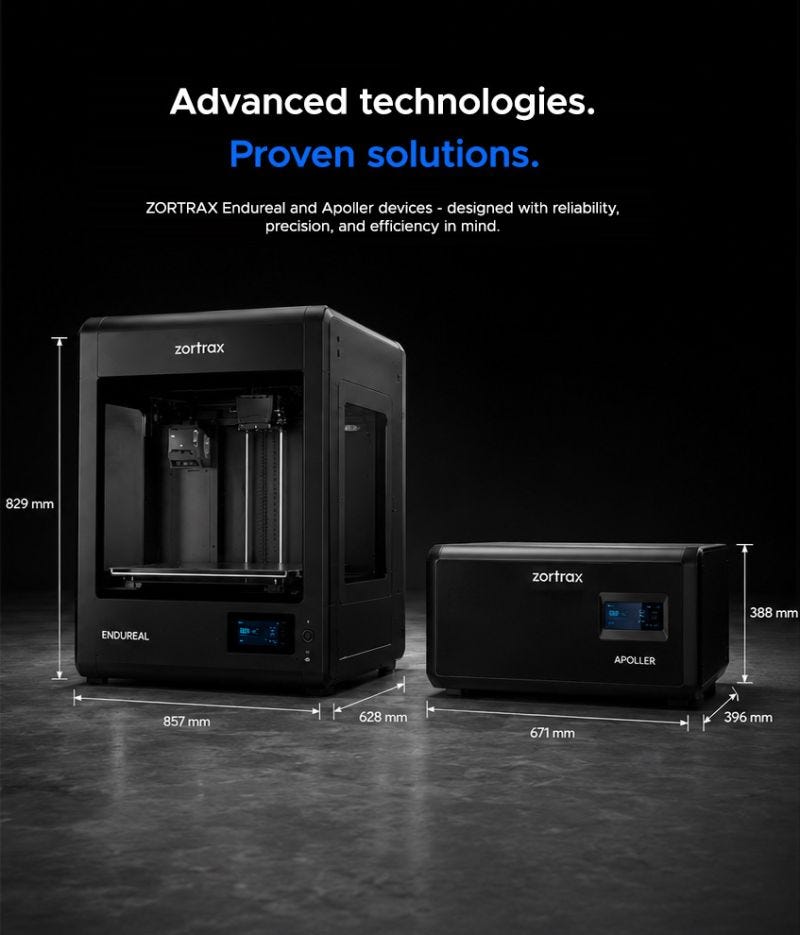
Zortrax has just announced that they signed a letter of intent with 2B Digital in Cairo to establish strategic cooperation in additive manufacturing technologies and develop distribution channels for ZORTRAX devices, particularly Endureal and Apoller, in the Middle East.
And they even showed this. Isn’t it wow? 🤩
#6
And now with part two - a reality check (courtesy of the Warsaw Stock Exchange):
By Resolution No. 901/2026, dated June 18, 2026, the Warsaw Stock Exchange management fined Zortrax S.A. 15,000 złoty (roughly four thousand euros) for failing to publish its 2025 annual report properly on NewConnect.
The Exchange called it a serious breach that kept investors from timely access to the company’s financial situation.
There’s more. Zortrax must now sign a one-year contract with an Authorised Adviser and make it public, because the WSE explicitly noted this was another reporting failure within the last two years.
So along with a new partnership in the Middle East comes a 15,000 PLN wrist-slap. Well... when things aren’t going your way, they aren’t going your way 😩