

Additive Manufacturing Clowns
3DP War Journal #89

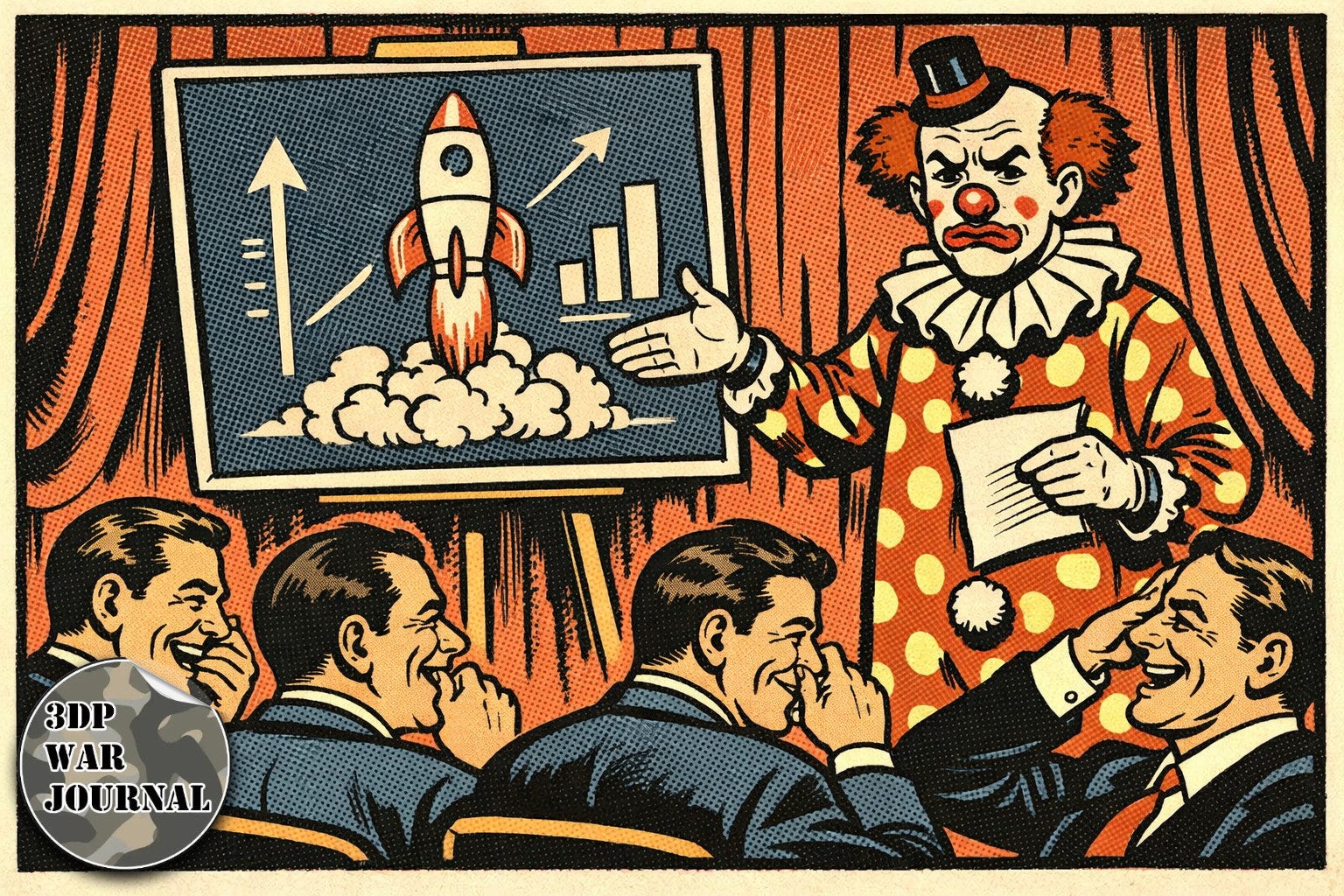
If you promise something once and fail to deliver, people understand. Technology is hard, timelines slip, markets are unpredictable. They get it.
The second time, there’s already a little less enthusiasm, a little more restraint. But they kind of still trust you.
But by the third promise in a row that comes to nothing, people stop taking you seriously.
Now imagine you reach the fifth or sixth time. Each time nothing came of it. And yet you stand on stage with your back straight and a slide of a rocket behind you, look the audience in the eye and say:
this is a real game-changer!
a disruptive leap!
we are redefining the industry!
At that point you stop being someone who fails to keep promises.
People start looking at you like a clown.
(Which you are.)
For more than a decade, the AM industry did exactly that. It produced promises like an assembly line, inflated words like balloons - colorful, visible from far away, and completely empty inside.
Every new printer model was a “game-changer.” Every new material “redefined possibilities.” Every software update was “breakthrough.”
The vocabulary was painfully repetitive, as if someone had written a single keynote template in 2011 and since then nobody had dared to change it.
Meanwhile, reality looked roughly like this: the industry wanted to race down the highway at two hundred kilometers per hour, but under the hood it had the engine of a scooter. There was progress - but slow, organic, painstaking.
And the truth is, there is nothing embarrassing about that. That’s exactly how serious technology works.
The problem was that the language the industry used had completely drifted away from what it actually delivered.
The 3D printing industry suffers from a messiah complex. Every company is the savior, every presentation is a litany.
From: A short review of clichés that damage the image of the AM industry
And while the enthusiasm is understandable - the technology really is interesting, it really does have potential - something else is harder to forgive. Behind the torrent of words there was nothing concrete. Behind the promises there was no serious thinking about the user. Companies focused on shining instead of building.
Machines - yes. Materials - of course. Certifications and applications for aerospace and medicine - absolutely. But software? The ecosystem? Ready libraries of models? Help for someone who is not an engineer with a PhD and ten years of experience?
That either didn’t exist, or existed at a level that can be described in one word: embarrassing.
Instead: beautiful catalogs. Trade show booths that looked like film sets. Conference presentations full of charts going up and to the right. Serious faces describing achievements that were going to arrive - in a year, in two years, in five.
And all those slightly aging men, dressed in slightly careless but still tasteful startup clothes, treated customers and investors like extras in their own movie about a technological revolution…

All the while burning through piles of other people’s money.
And worst of all - they didn’t create any real value in the process. For anyone.
That’s why the industry’s cleanup - painful and expensive as it is - was necessary. And it is still happening.
But there are companies that understand what real work actually looks like.
Dyndrite is a good example. Not very media-friendly, not particularly spectacular, not organizing events with special effects. It makes software for metal 3D printing. It works directly with hardware manufacturers to make their machines run smarter and more efficiently. It travels around the world meeting potential users - not to sell them a dream, but to show them something concrete: here is the problem, here is the solution, here is the number.

Just specialized software that actually works and actually improves results.
And paradoxically - that is exactly the revolution the industry needed. Not a slogan, not a catchphrase, not a presentation with an animated logo.
Just someone who understood that hardware is not enough, that a machine without intelligent software is like an engine without a gearbox - it technically runs, but it won’t take you anywhere.
That is the direction that should dominate. More humility, more substance, less rhetoric. Less messianism, more engineering. Less “we are redefining the industry,” more “here is what we built and here is how it works.”
Because if you say “game-changer” for the seventh time in a row and nothing changes - nobody listens anymore.