

Afraid AI will take your job? Go into AM - AI won't replace you there 😎
When tokens become the currency of careers, the only real resilience is having a profession that can’t be generated with a prompt


For the past few months, white-collar workers have been in a state of deep panic. Everyone is staring at reports of yet another round of layoffs in Silicon Valley and hundreds of other corporations scattered across the world. Everyone’s asking themselves the same question: does my profession even still exist?
AI is taking jobs from good people. It optimizes processes, simplifies workflows, eliminates corporate bureaucracy. It cuts costs, restructures organizations, improves profitability.
It increases value (to shareholders).
Except most of that is either false or only half true.
And none of it is actually new. We’ve already seen this before - dozens, if not hundreds, of times. The exact same cycle happened in 3D printing twice.
So before Skynet takes over the world, it first has to politely pass through the Gartner hype curve. And right now, it hasn’t even reached the first truly critical stage.
I remember 2013. Do you?


Magazines were writing that 3D printing would change everything. That everyone would have a printer at home and print their own shoes, kidneys, cars or rockets that will take to space. The stocks of Stratasys and 3D Systems were breaking records. Bre Pettis was the second Steve Jobs coming.
And then came the great disappointment.
But not for long, because just around the corner another crew was already waiting with another bubble to inflate.
This time „3D printing” was replaced by „Additive Manufacturing”. Basically the same thing - but „pretty serious” this time. Desktop Metal, Nexa3D, Velo3D, Shapeways (the US one), Carbon, and others promised an industrial revolution the world had never seen before.
And the world never saw it.
Just like with the first wave, very little of those promises actually materialized.
3D printing / Additive Manufacturing has become a disappointment, people with money turned away from it, and today companies with „3D” in their name are avoided like a single mother with three on a dating site.
And now AI is following the exact same path…
What will kill the first wave of AI hype is tokenmaxxing
Tokenmaxxing is one of the most grotesque inventions to come out of Silicon Valley. Companies started measuring employee productivity by the number of tokens they “burned” through language models. The more tokens you consumed, the more productive you were considered.
It sounds like a joke. It’s not a joke.
The result is that employees began running multiple AI agents in parallel, stretching prompts, automating things - not because any of it was useful, but because they wanted to win the internal token rankings.
It’s a bit like measuring a chef’s efficiency by the number of liters of water used. You can outperform everyone else simply by leaving the tap running during the meeting.
And this is where the more cynical side of the story appears. Token budgets do not grow, they do not accumulate value, they do not appear in salary negotiations. Tokenmaxxing is hustle culture degenerated into absurdity - a race for the appearance of productivity, not actual productivity.
At the same time, analysts are starting to do the math. It turns out that in many cases it’s still cheaper to hire a junior developer to write lines of code than to spend money on the tokens required for a model to do it.
Oh - and in both cases, a senior engineer still has to check whether it actually works.
But that’s not something tech bros want to talk about today. For now, everyone is just pushing tokens.
So tell me honestly: in an environment where your value is measured by the number of tokens purchased from OpenAI, do you really feel secure?
Because if compute is doing the actual work, and your role is simply “coordinating compute,” then the question of how many coordinators are actually needed becomes very uncomfortable.
This is exactly what the peak of hype looks like.
And I have good news and bad news for you.
The bad news: AI is not going away.
The good news: what you are seeing right now is not the true picture of this technology. The AI sector is moving toward what Gartner calls the Peak of Inflated Expectations.
And do you know what comes after the peak?
Trough of Disillusionment
The Gartner Hype Cycle is one of the most useful tools for reading technological history.
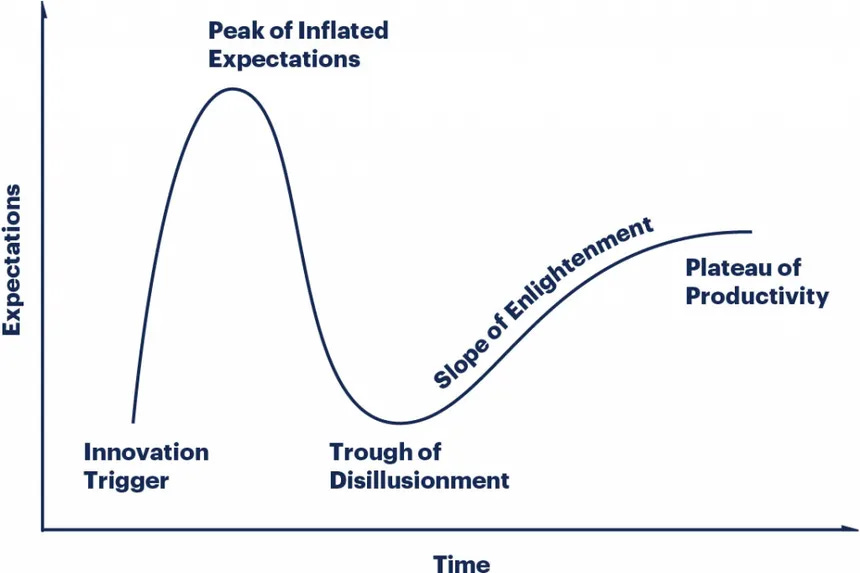
The pattern is always the same: a technology appears, the media falls in love with it, investors pour money into it, everyone says it’s the end of the old world and the beginning of a new one.
Then reality arrives. The bubble bursts. Headlines appear: “technology X has failed,” “sector Y was a scam,” “Z is nothing more than a useless toy.”
But behind the scenes, the technology quietly matures, finds applications nobody predicted, and eventually becomes an industry.
The internet in 2000. Blockchain in 2017. 3D printing in 2013 and additive manufacturing in 2020. Now generative AI.
I will never say AI is a scam. I’m saying you are witnessing the peak of inflated expectations. And right after that peak, people become especially vulnerable to making terrible career decisions.
Either you throw yourself into the chaos and burn enormous amounts of energy on something that, a year from now, will look completely different.
Or - and this is the option nobody talks about out loud - you look at the other side of the same curve and ask: what’s waiting there, beyond the valley?
The answer is Additive Manufacturing
AM went through this curve honestly. At the height of the hype, we were supposedly going to print guns, cars, houses, even internal organs for transplantation.
Basically, we were supposed to print everything.
12-26-2013: Computerworld reported that Organovo expects to unveil the world’s first 3D-printed human liver in 2014

On December 26, 2013, Computerworld published an article about the biotechnology company Organovo, titled “The first 3D printed organ - a liver - is expected in 2014.” Written by Lucas Mearian, the article stated, “Organovo now expects to unveil the world’s first printed organ - a human liver - next year.
Then the valley came. Companies either consolidated or went bankrupt. (mostly the latter)
But technologically, the work quietly continued in the background. Development never stopped.
Today, additive manufacturing is entering the slope of enlightenment - the phase where a technology begins delivering what it originally promised, just in a different place and at a different pace than everyone expected.
Dentistry, where 3D-printed orthodontic aligners have reached cost parity with CNC manufacturing while simultaneously offering a level of personalization impossible to achieve through traditional methods.
Medical implants, prosthetics, orthotics, surgical planning models tailored to individual patients.
Automotive, which has used 3D printing practically since the beginning. Rail and maritime industries. Aerospace and space technology, where printed engine components are now standard and nobody even asks anymore whether it makes sense.
Defense, where the ability to print spare parts in the field - without supply chains, without warehouses, without waiting for a container from Shenzhen - has strategic significance.
I’m saying this to highlight the fundamental difference between AM and AI at this particular moment in history.
AI primarily produces digital content: text, code, images, analysis. Important things - but from a market perspective - easily configurable, easily replicated, and difficult to price.
Additive manufacturing, meanwhile, produces physical things.
You can touch AM
You cannot “generate” a dental implant with a single prompt. You cannot type into ChatGPT: “create a defense drone component with 1200 MPa tensile strength and deliver it to a base in Romania within 48 hours.”
That requires expertise, machines, materials, processes - and, importantly - people who understand how all of it actually works.
And this is where we arrive at the core of the issue.
AM skills are rare.
Not because the industry is closed off, but because the intersection of engineering knowledge, additive process expertise, materials science, and design-for-additive-manufacturing capabilities is an extremely narrow path.
And there’s one thing you cannot ignore in this equation:
AI does not replace AM. AI enhances AM.
Generative design algorithmically creating geometries optimized for 3D printing is one of the most beautiful examples of synergy between AI and physical manufacturing.
Topology optimization supported by machine learning algorithms produces parts that humans would never be able to design manually. AI-assisted print-process simulations reduce validation time and costs by orders of magnitude.
In other words: if you understand AM, AI becomes a tool for you. If you only understand AI all you’re left with are tokens.
There’s another argument that rarely appears in discussions about the future of work, yet is becoming absolutely critical right now.
The pandemic showed how fragile global supply chains really are. The ability to manufacture locally, on demand, without warehousing and without dependence on factories in the Far East, is a strategic advantage - not just a business advantage.
AM enables exactly that.
A digital design can be transmitted in seconds. Printed locally. Delivered locally. No ship, no container, no six-week wait.
If you have AM expertise, you can become the operator of this “factory inside a laptop.” And that factory cannot be replaced by a prompt.
The Gartner curve is not just a chart for analysts. It’s a career map, if you know how to read it.
Right now, you are witnessing the peak of AI hype.
In one, two, three years - the valley of disappointment. Layoffs at companies that rebuilt entire business models around generative AI without solid foundations. A correction of expectations. New questions about what AI actually can and cannot do.
And AM?
AM is already on the other side of that valley. It is entering the plateau of productivity. The technology has matured. Machine and material costs are falling. Industrial applications are documented and scalable. Skilled people are scarce.
Anyone entering AM today is entering at the beginning of a growth phase.
Not at the top of a bubble. At the beginning of something that is finally starting to work.
I’m not saying you should ignore AI. I’m saying you should stop being afraid and start thinking strategically.
AI is a tool. AM is an industry.
And it is precisely this industry that the coming decades will need.
Your tokens can be taken away from you. Your expertise cannot.
Very good post!
I am a teenager and am interested In AM. I often use the 3D printer from my dad and experiment and optimize with it. Recently I became interested in AM in general. Is there anything I should read that would help me understand AM and also helps me open opportunities for a potential job in 3D printing?