

America invented 3D printing. Today, it has only a handful of manufacturers left...
3DEO enters insolvency, Fusion3 is liquidated, Würth Additive shuts down. US is going through what every mature market goes through: contraction, consolidation, and the exit of the weakest players.


In less than a month, three American 3D printing companies have disappeared from the market, each in its own way.
California-based 3DEO entered insolvency proceedings. Its patents, software, and metal sintering systems are being sold as a single package, while the rest of its manufacturing equipment is headed to the auction block.
North Carolina’s Fusion3 has been liquidated. Its printers and spare parts are being auctioned off by a Greensboro auction house: 15% buyer’s premium, credit card pre-authorization required to register.
Würth Additive Group announced the “orderly wind-down of all operations” in a plain LinkedIn post. Around fifty words. No explanation beyond a “carefully considered business decision.”
Three companies. Three states. One direction.
The United States is the country that invented 3D printing. In 1986, Chuck Hull and Ray Freed founded 3D Systems, the world’s first commercial 3D printing company. Soon afterward came Stratasys, DTM, Z Corporation, Solidscape, and many others.
Now, forty years later, America can count the manufacturers that are truly doing well on one hand. The rest are either niche businesses or forgotten entries in the registry of dissolved companies.
Yet despite the lamentations of commentators mourning America’s defeat to China and claiming it has surrendered the entire industry, I’m nowhere near writing the obituary for American additive manufacturing.
Because what we’re witnessing is nothing more than the next stage of market evolution: consolidation. The exact same process that transformed the computer industry, the paper printer industry, and the mobile phone industry.
At the same time, this is nothing more than a reality check for a country. Sometimes, despite the best intentions, effort, and talent, you simply cannot build something people aren’t ready for - or don’t actually need or want.
A few years ago, I went through exactly the same process in Poland.
Yes, it was painful. Pretty disappointing. And sad.
And no, there was nothing anyone could do to stop it.
American AM
Let’s start with the ones actually doing well:
The two pillars are standing where they’ve always stood. In Q1 2026, 3D Systems posted roughly $95 million in revenue, with double-digit growth in dental, medtech, and defense. Stratasys closed 2025 at $533 million. Neither is near its old peak. Neither is close to bankruptcy. They’re not going anywhere.
Then two giants who keep dabbling in 3D printing: HP, with MJF and Metal Jet, and GE, running its metal arm as Colibrium Additive. Both are serious names on the AM scene and rounding errors on their parents’ balance sheets.
Beyond those four, two companies are actually thriving. Formlabs, the only one that walked out of both the consumer boom and the “mass production” era intact, holds around 55% of the global SLS market. Carbon prints over 1 million end-use parts a week and reached positive cash flow without raising fresh money.
Velo3D survived, but with an asterisk: it came within touching distance of bankruptcy, restructured, and today runs on defense contracts.
After that, the niche: B9Creations in dental and casting resins, Vision Miner in high-temp PEEK, Xact Metal in low-cost metal LPBF, and LulzBot, still shipping out of Fargo.
And below them, a long bench of specialists quietly moving hardware: Mantle, Optomec, and Sciaky in metal; Thermwood and re:3D in large-format polymer; Boston Micro Fabrication, Fabric8Labs, Impossible Objects, Intrepid Automation, Inkbit, and Axtra3D in the specialty corners. Real companies, real machines, none of them big enough to change the story.
Now the second list…
MakerBot, the company that put 3D printing on newspaper front pages between 2010 and 2013, got absorbed into Ultimaker and is quietly fading out. Printrbot died in 2016. Solidoodle, Type A Machines, Robo3D, M3D, Airwolf3D: gone, or shrunk to a garage and a website.
Desktop Metal, Markforged, Nexa3D. Please don’t get me started again 😡
These were the companies that drove the growth of 3D printing in the US and worldwide.
Today they’re footnotes.
Why the market keeps growing while companies keep dying
This is where one of my Three Laws of the AM Market comes into play once again:
The value of the market and the value of the companies operating within it are not correlated.
The 3D printing market continues to grow. Most forecasts expect annual growth in the double digits for years to come. And yet companies continue to disappear.
That’s the rule, not the exception.
There have always been far more players than the market could realistically support.
At any given moment, only a handful make real money. The rest hover around break-even or below it. Every five or ten years the deck gets reshuffled. Leaders become laggards. Some disappear entirely.
The market keeps growing anyway.
We’ve already seen exactly the same movie elsewhere.
In the 1980s and 1990s, dozens of companies built personal computers. Today, the meaningful players can be counted on one hand. Paper printers? Once crowded with brands. Today, a handful divide the global market. Mobile phones? Same story.
Markets mature. The crowd thins out. The elite survive, along with a few niche specialists.
And yet, nobody writes an obituary for “computer technology.”
All the companies that survived all had one thing in common: they had a reason to exist. Customers kept coming back. They had a moat.
In 3D printing, that moat is now software and low manufacturing costs. The survivors sell an ecosystem or a unique, often certified solution.
The companies that failed sold a printer. And that was the end of the story.
That’s why I look at America’s growing list of casualties without much emotion, because I know this is the natural order of things.
Bloated ambitions. Founders with oversized egos. Financial projections and sales forecasts that made the universe of Peppa Pig look brutally honest and true.
These companies collapsed because they had to. For years they survived on borrowed money, feeding themselves on fantasies straight out of the most optimistic investor pitch decks.
Then reality arrived.
Business models built entirely on someone else’s patience and someone else’s money died one after another.
That’s all there is to it. There’s nothing new about it. Nothing surprising.
I watched exactly the same thing happen in Poland a few years ago.
Did you know that we once had more than thirty manufacturers of 3D printers?
Poland: the fallen “King of 3D Printers”
Between 2014 and 2018, Poland was home to more than 30 manufacturers of 3D printers (in fact, it was closer to forty).
Ready?
Zortrax, Zmorph, Sinterit, 3DGence, Omni3D, Hbot3D, Verashape, Monkeyfab, UBOT 3D, 3D Proto, 3D Universal, 3DDDBot, 3dimension, 3DKreator, 3NOVATICA, 7H7, Atmat, Aye Aye Labs, CB Printer, CORO Technology, Deus, Dexer, Dragon 3D, Endivio, Golem3D, Graften, Infinum 3D, Idea Lab, Jelwek, Lume 3D, Paramid 3D, Pirx3D, Sandmade, Totem 3D, Tytan 3D, Urbicum.
And I know there were at least another three that I’ve simply forgotten.
Now add more than 10 filament manufacturers and 2 producers of 3D scanners.
We were supposed to become Europe’s 3D printing powerhouse.
I’m pretty sure we had the highest number of 3D printer manufacturers per capita anywhere in the world 😬
Why were there so many?
For exactly the same reason as everywhere else: RepRap, expiring FDM patents, cheap hardware, and the belief that if you could assemble a printer in your garage, you could build a company around it.
And you could. For a year or two.
Right until the first serious wave of warranty claims, or the moment you had to scale beyond hobby-level production.
Most of those thirty-plus companies were selling exactly the same thing: a local variation of an open-source design, with no proprietary materials and no market beyond Poland.
Unlike the Americans, we didn’t have deep pockets, so our collapse simply happened faster. Today, only a handful remain.
Sinterit in Kraków continues to push forward in SLS - although it seems to require another financial lifeline from Germany that owns it, every few years. Omni3D remains focused on large-format systems. Ubot3D quietly operates in its niche.
And then there’s the curious case of 3DGence, which now sells HP printers under its own brand, even though neither company has publicly explained exactly how that arrangement works.
Everyone else on that list is either gone or has reinvented themselves into something completely different.
It’s the same curve America is drawing today - just on a larger scale.
The Polish aftermath
Alright, so Poland once had all those manufacturers. And we lost almost all of them.
Truth is, most of them were failures anyway. Maybe five companies ever reached any meaningful scale, and only two - Zortrax and Sinterit, left a real mark on the global industry.
So what happened next? Did 3D printing in Poland die? No domestic manufacturers = no 3D printing?
Well, quite the opposite.
After years of barely scraping by, it’s only now that you can honestly say there’s real money to be made in Polish additive manufacturing.
Companies stopped building 3D printers and they started using them instead.
Yes, those printers come from China. They keep coming from China.
Out of every hundred new 3D printers installed in Poland, all one hundred are Chinese. Maybe once in a thousand you’ll spot a Polish-built machine.
Maybe.
But additive manufacturing itself is booming.
Poland has never sold as many 3D printers as it does today. Every segment is growing: consumer, industrial, medical, education... you name it.
Whether that’s a good thing that the growth is based on Chinese technology, is a completely different debate. Sure, in theory it would be better if Polish companies were using Polish-built 3D printers.
But the moment you start grounding that idea in reality - looking at the history of individual manufacturers, the business decisions they made over the years, and why they ultimately failed - you quickly realize you’re no longer talking about reality.
You’re talking about wishful thinking. About what we’d like to be true, not what actually is.
The uncomfortable truth is that every failed Polish 3D printer company was ultimately brought down by its own founder or CEO.
I write that with genuine sadness. I know those stories. Every single one of them. But I also write it because it’s true.
And despite all of that, the industry kept growing. It still is. Nothing is stopping it.
I realize that, for a proud American engineer, this probably sounds close to blasphemy. It will probably make some people hit “unsubscribe” before it makes them stop and think.
But then again... You don’t subscribe to this newsletter because you want to be told everything is great, do you?
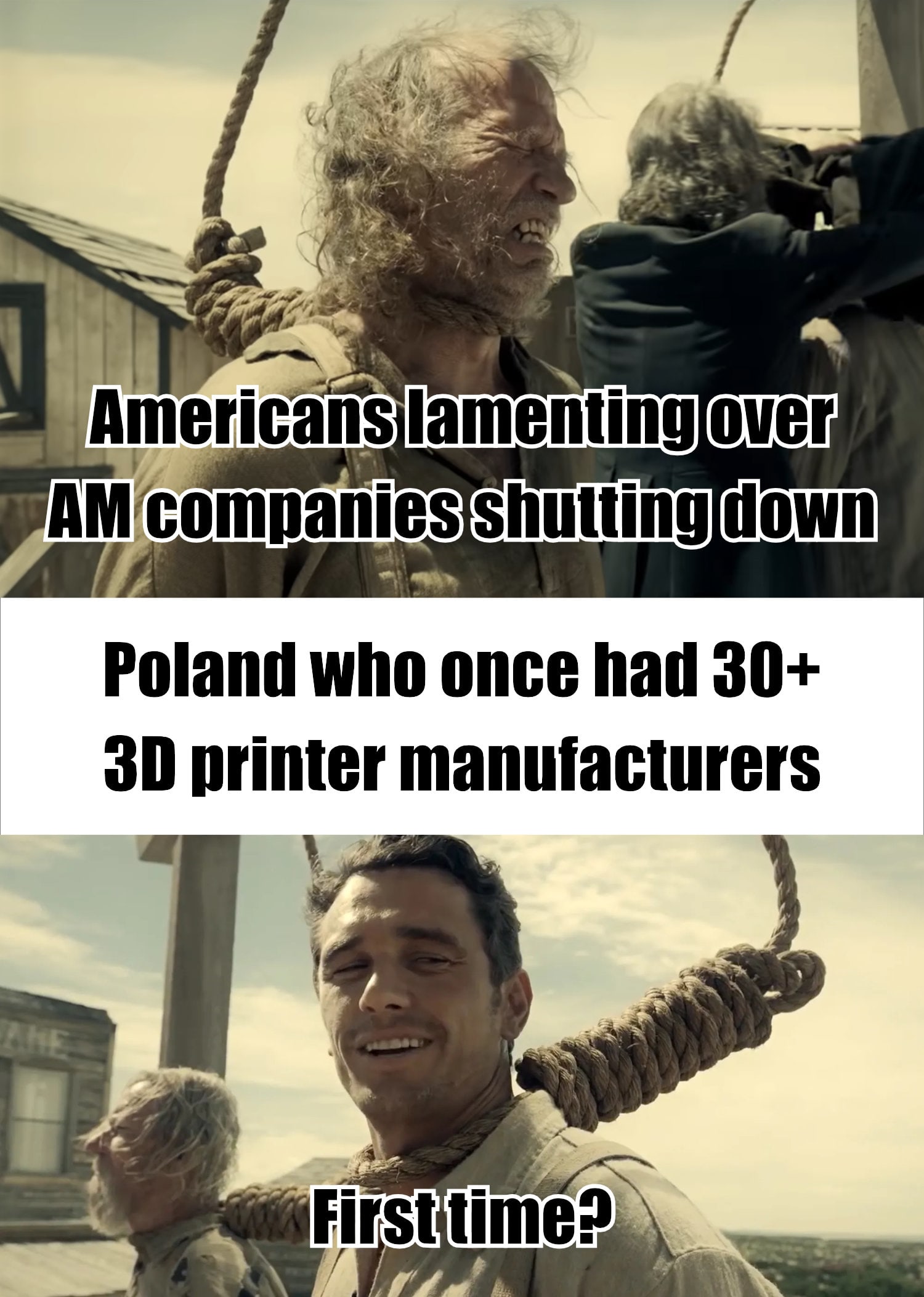
Here’s the reality. This is simply how markets work. And there’s very little anyone can do to change it.
The market is doing what it has always done: thinning the herd, rewarding companies with products that genuinely matter, and lowering the barriers to entry for the next generation.
America is still learning that lesson. We learned it years ago in Poland.
We paid our tuition in hard currency - thirty-something companies.
Only then were we able to reach the point where we are today.