

Autodesk implements Wonder 3D - an AI image generation model from prompts - into Flow Studio
RECODE.AM #41

For a long time, tools for creating three-dimensional models remained the domain of a narrow group of specialists - people who spent years mastering complex interfaces, understanding mesh topology, and manually guiding geometry from a sketch to a finished production file.
Autodesk has just taken a step that could significantly change this picture by introducing a new generative AI model called Wonder 3D into its Flow Studio platform.
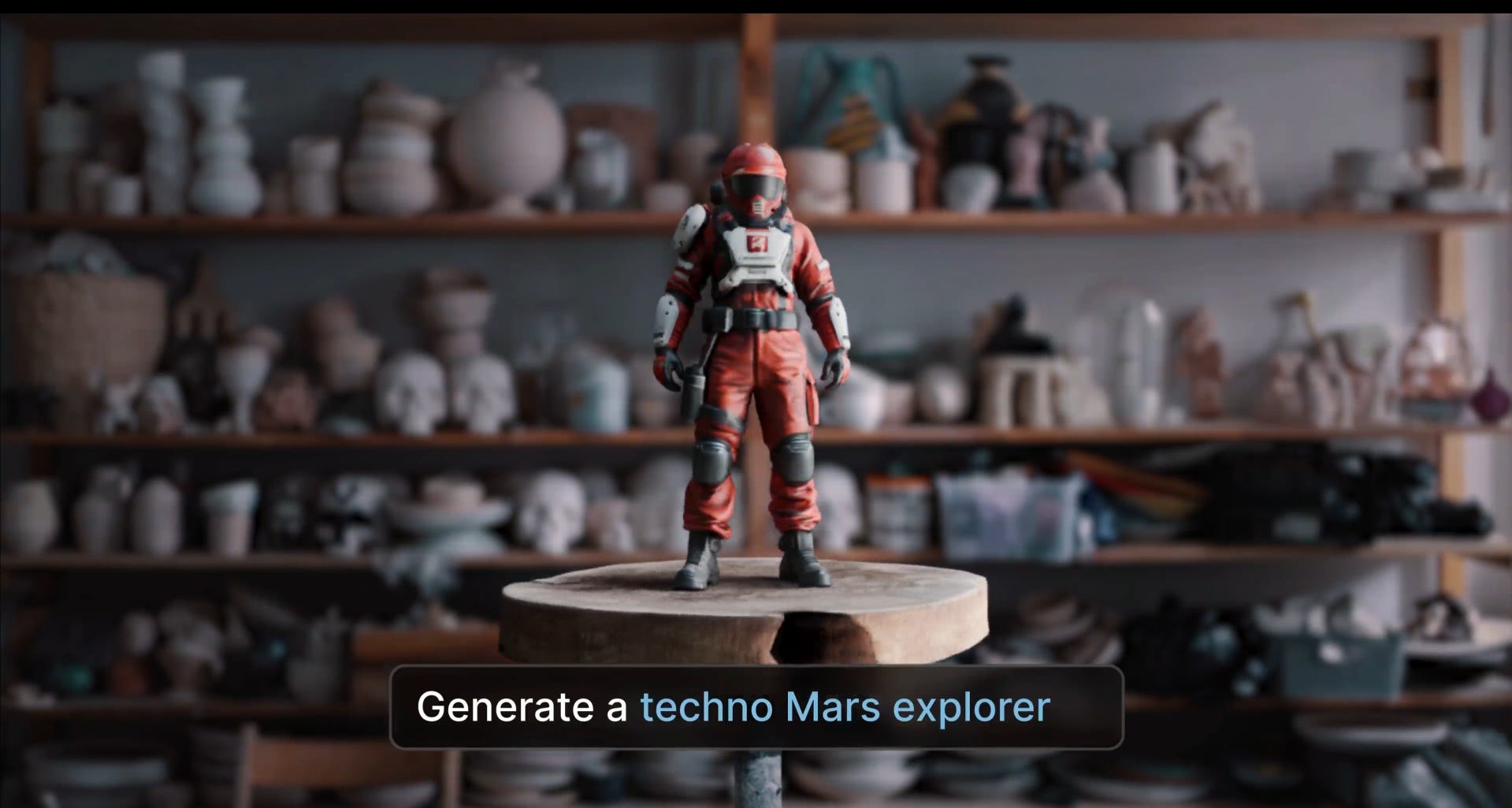
Wonder 3D is a cloud-based tool that allows users to create fully editable three-dimensional digital assets from a text description or a reference image.
In practice, this means that a user can enter a description of a character, object, or environmental element, and the system will generate a ready-to-use model complete with geometry and textures - without the need for manual modeling.
The ability to convert an image into a model opens up a completely different workflow scenario: a sketch on paper, a photograph of an existing object, or a conceptual illustration can become the starting point for creating a file suitable for further development in a professional production environment.
For the 3D printing industry, this direction is far from irrelevant. One of the bottlenecks in additive manufacturing remains the stage that precedes production itself - the preparation of the model.
Traditionally, this required either access to a ready-made CAD file or the involvement of a modeler who could prepare printable geometry based on design assumptions.
Wonder 3D shortens this path. The ability to export generated models in the .OBJ format means the file can go directly into preparation software - and from there to a 3D printer.
Autodesk has equipped Wonder 3D with three key operating modes.
The first is text-to-3D, which generates models of characters, creatures, and objects directly from a written description.
The second is image-to-3D, where the input model is a sketch, photograph, or conceptual graphic.
The third – text-to-image - allows users to first generate a conceptual visualization and only then transform it into a spatial model.
This three-stage pipeline is logically consistent: first the idea, then the image, and finally the geometry. In the context of 3D printing, this sequence reflects the natural order of design iteration—from concept through visualization to a physical test print.
It is also worth noting that the Flow Studio platform, where Wonder 3D operates, is not a new creation. Wonder Dynamics - a startup founded in 2017 by VFX artist Nikola Todorovic and actor Tye Sheridan - spent years building tools for automating special effects, primarily in the areas of character animation and motion capture.
In May 2024, Autodesk acquired the entire company, integrating its technology into the Flow cloud platform and renaming Wonder Studio to Flow Studio.
The acquisition was a natural consequence of years of collaboration and the integration of Wonder Dynamics plugins with Autodesk Maya - one of the most widely used 3D tools in the entertainment industry.
Autodesk has made Wonder 3D available through four subscription plans.
the free plan provides access to basic AI features, including text-to-3D, image-to-3D, and custom character uploads.
the Lite plan, priced at $10 per month, expands the functionality with export to Unreal Engine and advanced camera tracking.
the Standard plan, at $45 per month, adds USD export and advanced VFX tools.
the most expensive Pro plan, priced at $95 per month, unlocks the full set of production features, including PNG export, support for up to 50 custom characters, and advanced rendering options.
From the perspective of a 3D printing user, the most relevant observation is that the barrier to entry for spatial design has just dropped dramatically. Not every additive manufacturing company has its own CAD department. Not every engineer can comfortably navigate complex modeling environments.
Wonder 3D will not replace an engineer when designing a complex functional component, but it may become a realistic starting point for a rapid prototype, a test model, or geometry used to validate a concept.