

Eco Fiasco
3DP War Journal #90

I recently saw a meme: “Iran suddenly accelerated the energy transition of the Persian Gulf so it could reach climate neutrality faster - and the whole world is pissed off”…
Every reasonable person knows that the environmental protection movement promoted over the past 20 years is driven maybe 5% by genuine concern for the planet and human life, and 95% by making big money off that movement.
Of course, there are people in this movement who sincerely believe in all this political-corporate nonsense and see paper drinking straws or bottle caps that can’t be removed as necessary steps toward saving the climate from destruction.
But that’s a minority.
These people have simply replaced God (Christian, Muslim, Hindu, or Buddhist) with Ecology.
They worship it and cultivate it in exactly the same way Christians, Muslims, Hindus, or Buddhists cultivate their faiths. And like in any faith - we see that something isn’t there, yet for various reasons we choose to believe that it is (because, for example, we feel it or experience it).
So Ecology is a religion. It has both devoted believers (even fanatics) and outright infidels.
Alright, enough eco-theology… back to the point. Let’s get back to that meme...
There’s a war!
Oil tankers either don’t sail at all, or only some do, or they get hit by missiles and burn (and don’t sail). Oil starts running out, prices skyrocket, and everyone watches in horror as a global economic crisis unfolds in real time.
But that’s not how it’s supposed to be, right? We should be happy that this “bad” oil will be gone, because fossil fuel consumption will decrease and the environment will improve.
So yeah, actually, this turned out well, didn’t it?
People supposedly wanted to move away from fossil fuels, but somehow it wasn’t going very well. Now they have a strong argument and motivation - fuel is scarce and expensive, so it’s the perfect moment to switch to solar panels, wind turbines, and heat pumps.
Hey! What’s going on? Why aren’t you switching? Why are you still filling up your tanks?
Because in reality, people are only interested in ecology as a philosophical concept.
The entire economy has been, is, and will continue to be based on fossil fuels. We discuss ecology in trembling voices while simultaneously taking full advantage of the benefits that only fossil fuel-based energy provides.
Ecology is a slogan. People want to talk about it, but they don’t want to live it – definitely not when they discover the consequences of an ecological lifestyle.
And I’m writing this as someone who spent three years working on a fascinating branch of ecology - compostable bioplastics. And who failed quite spectacularly.
Literally today, after nearly five years of activity, I am closing my eco-startup GREENFILL3D.
It has been operationally inactive for a year, and today it formally comes to an end.
Great idea, interesting field, valuable experience. But it didn’t work out… sometimes that’s just how it goes.
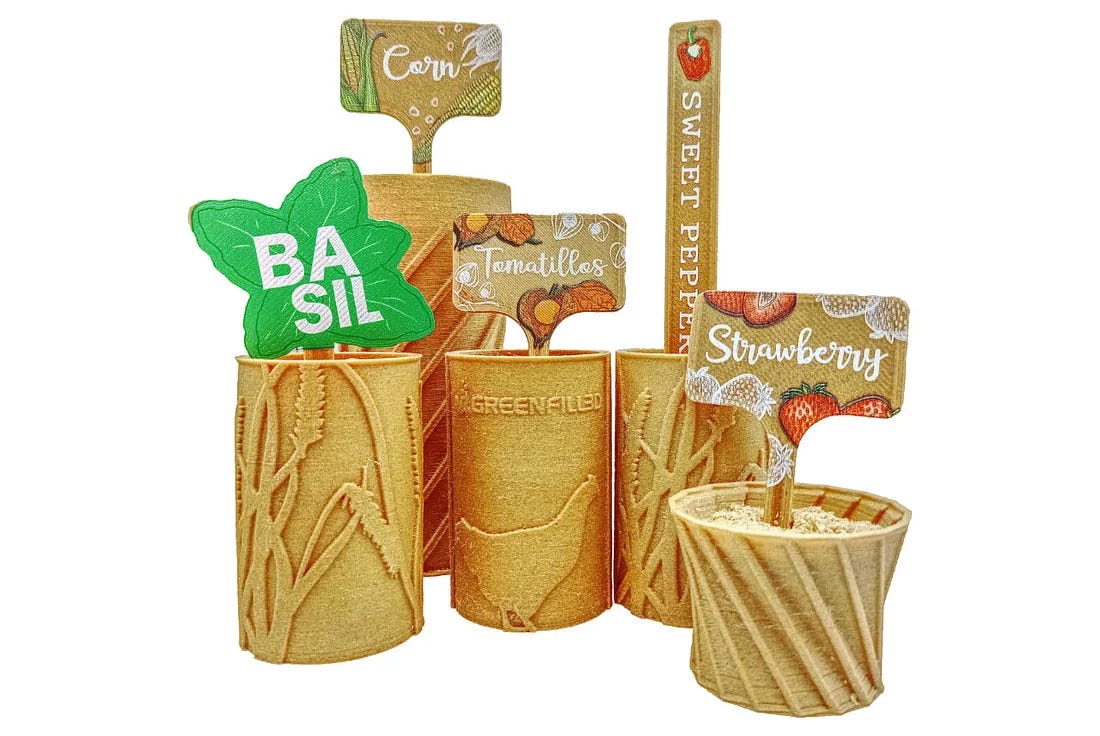
GREENFILL3D was a company that developed its own proprietary biodegradable filament based on wheat bran, a byproduct of pasta food production. Using this filament, it produced custom advertising stands - ECO POS - on 3D printers.
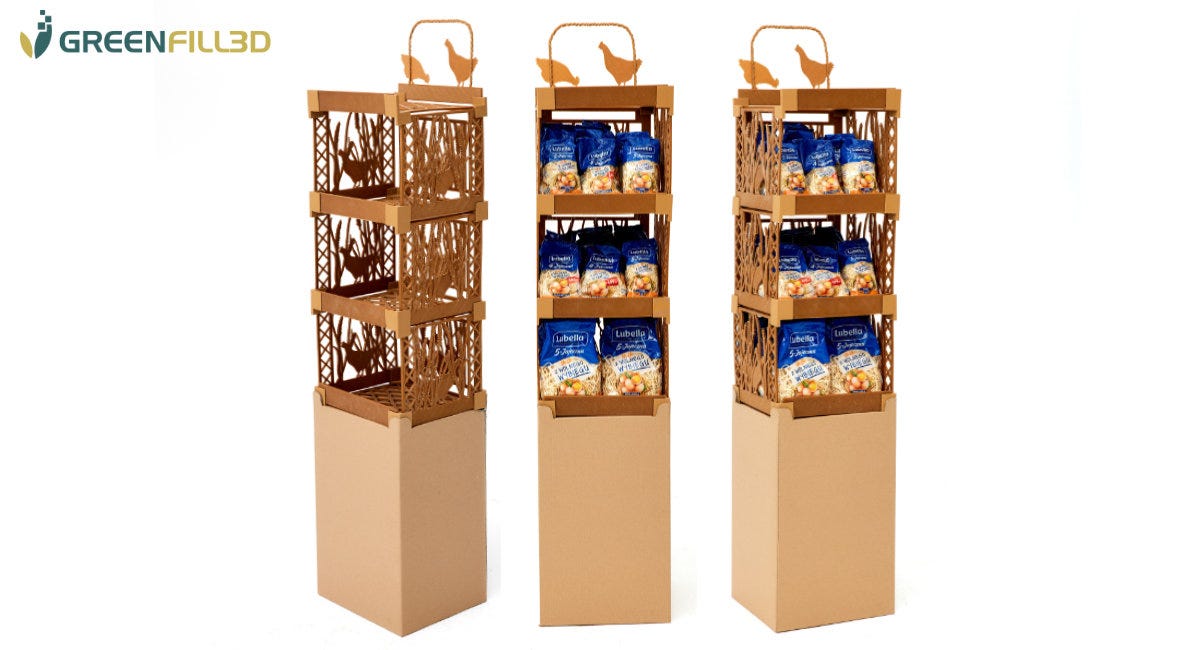
The company was founded in mid-2021 and debuted globally in February 2022, gaining immediate publicity. It won several awards and distinctions and was nominated for the 3D Printing Industry Awards in the sustainability category.
I described the story of GREENFILL3D here:

Unfortunately, by mid-2024 it was already a failed business that we were still trying to save with Anna Ślusarczyk. But there was nothing left to save. The sentiment had shifted. Nobody was interested in what we were doing.
Because what we were doing was serious. The world wanted to fight microplastics. And we offered one of the solutions - the best one we saw at the time.
So how do you fight plastic? The options are:
stop using it entirely; go back to the 19th century and make everything from wood, steel, glass, or ceramics
start recovering it - recycling; currently the dominant trend
start producing bioplastics - materials that will naturally decompose in soil under reasonable environmental conditions.
The first option is impossible. The second comes with a significant environmental burden (plastic must be cleaned of organic and chemical waste using water) and is difficult to implement (it requires advanced material sorting - the worse the sorting quality, the worse the recycled output).
So the third option seems the most attractive, right? Produce plastic that decomposes after use - disappears.
The catch is that the more biodegradable a plastic is, the lower its durability and lifespan.
Our wheat bran eco-filament was truly biodegradable. Buried in soil for less than a year, it “disappeared.” Really. It was tested. It actually worked.
It also had a beautiful natural wood color and texture. It looked fantastic as lamp shades.


For some time after printing, it was very flexible - hard to break, behaving somewhat like polypropylene.
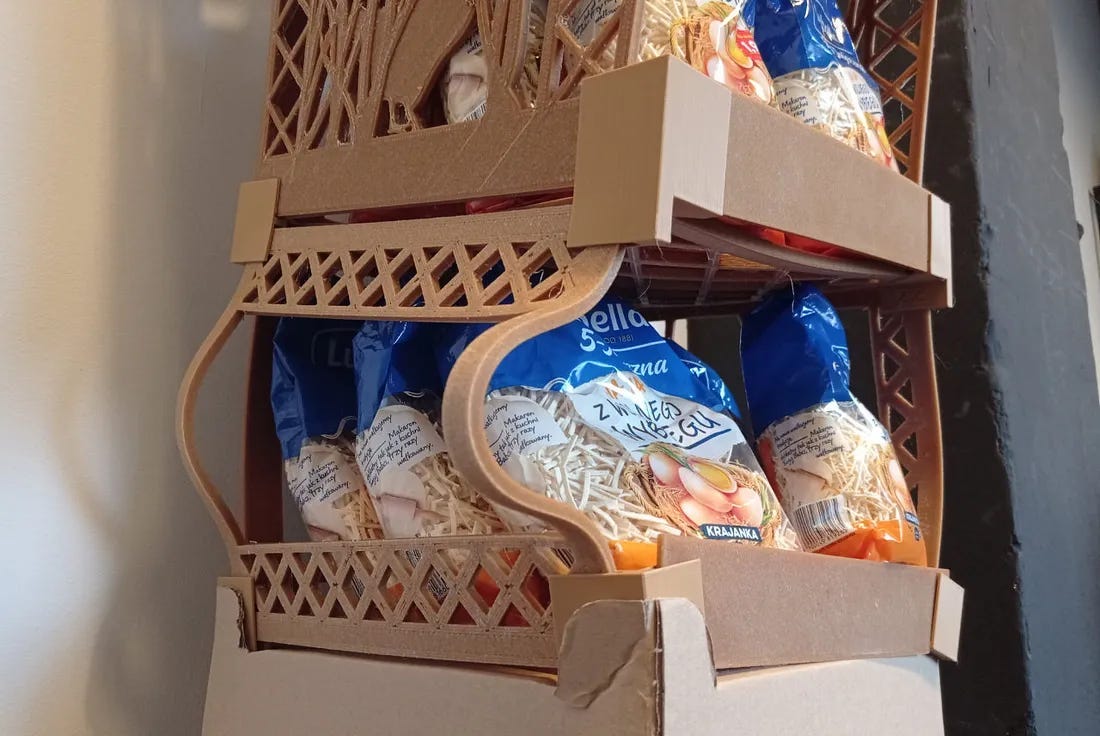
But the longer it “existed,” the more it degraded. It became brittle. It would crack in your hands like a communion wafer or matzo.
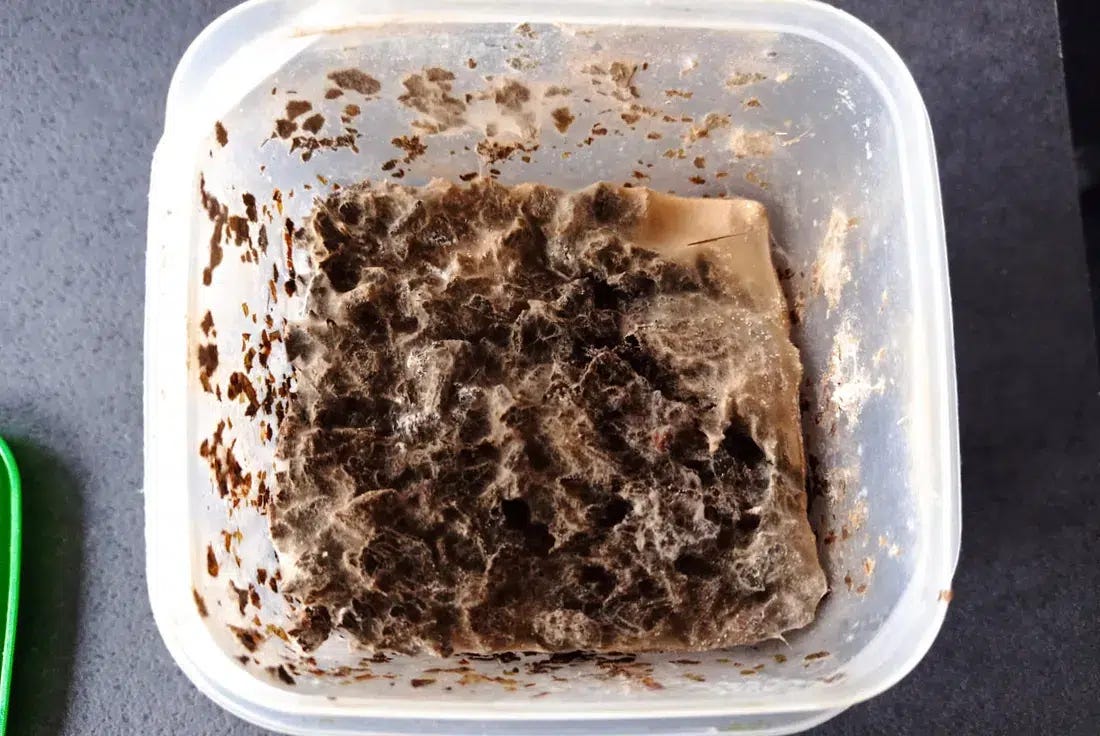
If you put it outside in winter and poured water over it - it quickly developed mold and started to rot. It wasn’t resistant to water or moisture - quite the opposite, water and humidity activated the decomposition process.
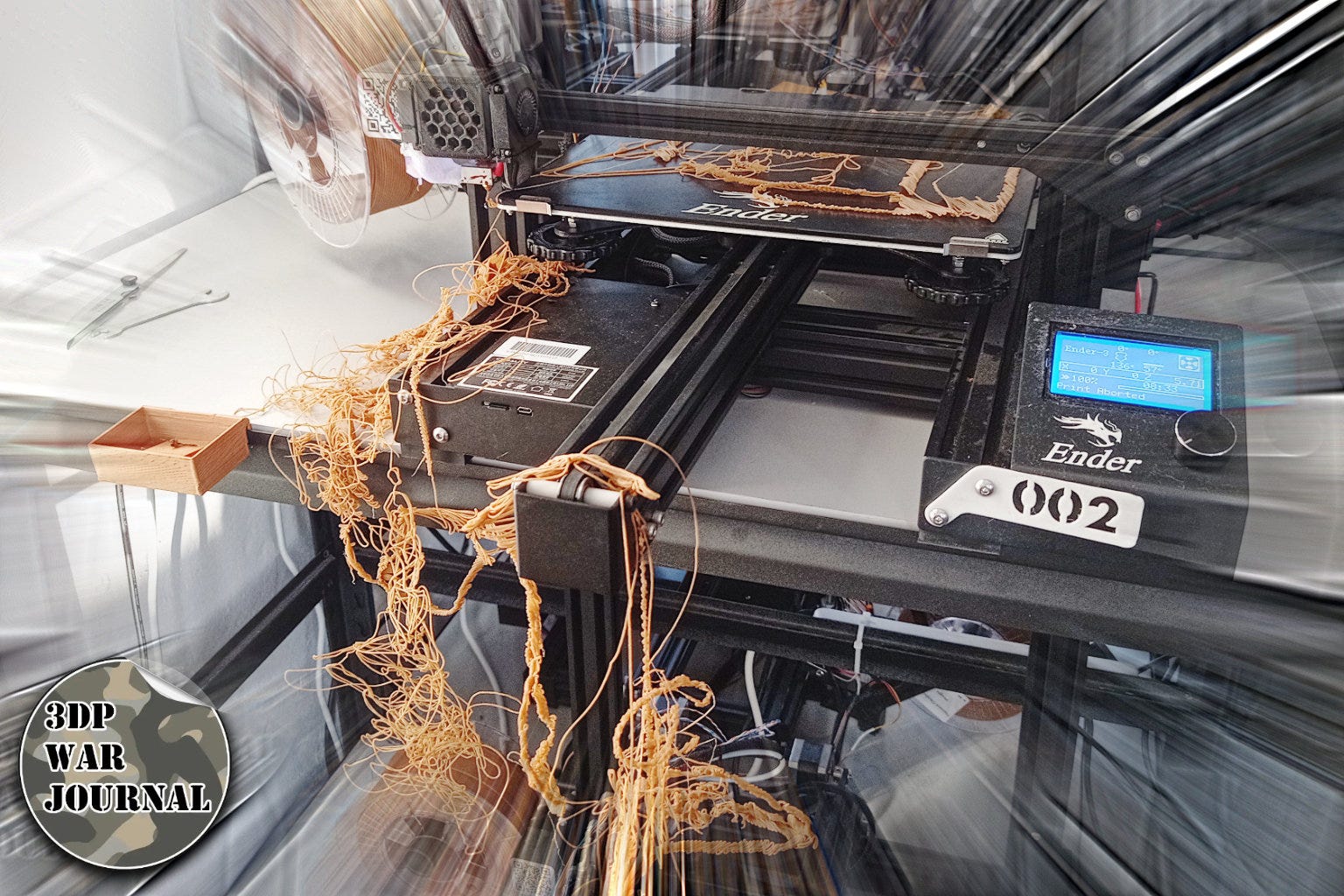
On top of that, it was very difficult to produce and later to use in 3D printing. We used modified Creality Ender 3 MAX printers. We never dared to print wheat bran on a Prusa or Bambu Lab machine - we simply didn’t want to risk damaging them.
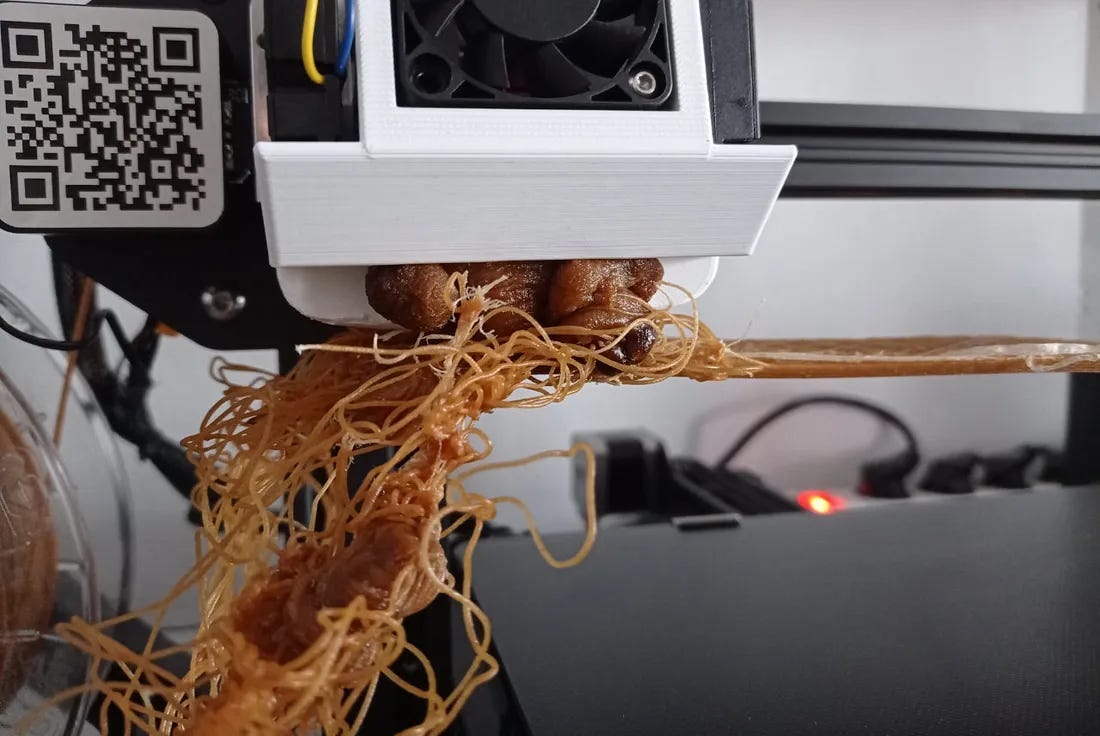
So in summary - it worked, but it wasn’t as simple as everyone expected or wanted. Trade-offs are inevitable. There’s no such thing as a free lunch.
And it was hard for us to achieve anything meaningful with it…
Yes, people asked about it a lot. We conducted many tests and prototypes - mainly in packaging and advertising - but most of it led nowhere. Potential clients were always disappointed by the final result in the form of… functional or durability limitations.
I even came up with a term for it:
people looking for eco-products made of eco-plastics are looking for water-resistant materials that dissolve in water.
That simply can’t be done. Biodegradability or compostability isn’t something you switch on with a button. It’s a process that, once activated, cannot be stopped or reversed.
So everything is slowly returning to square one. After a brief period of fascination, bioplastics are retreating. Today, recycling dominates - a process that isn’t without flaws and limitations, but is widely perceived as better.
Ultimately, ecology in manufacturing - especially in 3D printing - has moved far down the priority list. While 3-4 years ago it was a key point in every PowerPoint presentation, today it’s mentioned as the 6th or 8th advantage.
I wrote about this in detail here:

Ecology - both in everyday life and industrial production - is fine as long as it doesn’t get in the way of traditional products or manufacturing methods.
As long as an eco-product is convenient, it will be loved. When it turns out to be inconvenient - people quietly return to old (bad) solutions.
Oil, which is now starting to run short globally, is just as “bad” as it was before the Iran conflict or even before the war in Ukraine. And yet it is still used - with reluctance - because there is no better alternative.
And the current situation once again proves this, exposing the superficiality and weakness of the arguments of militant environmentalists.
There are supposedly so many alternatives to oil, but for now everyone is waiting for “that awful Iran” to either surrender or reach an agreement.