

Lasers have matured - now the battle is about software
How Ursa Major is rewriting the metal 3D printing workflow

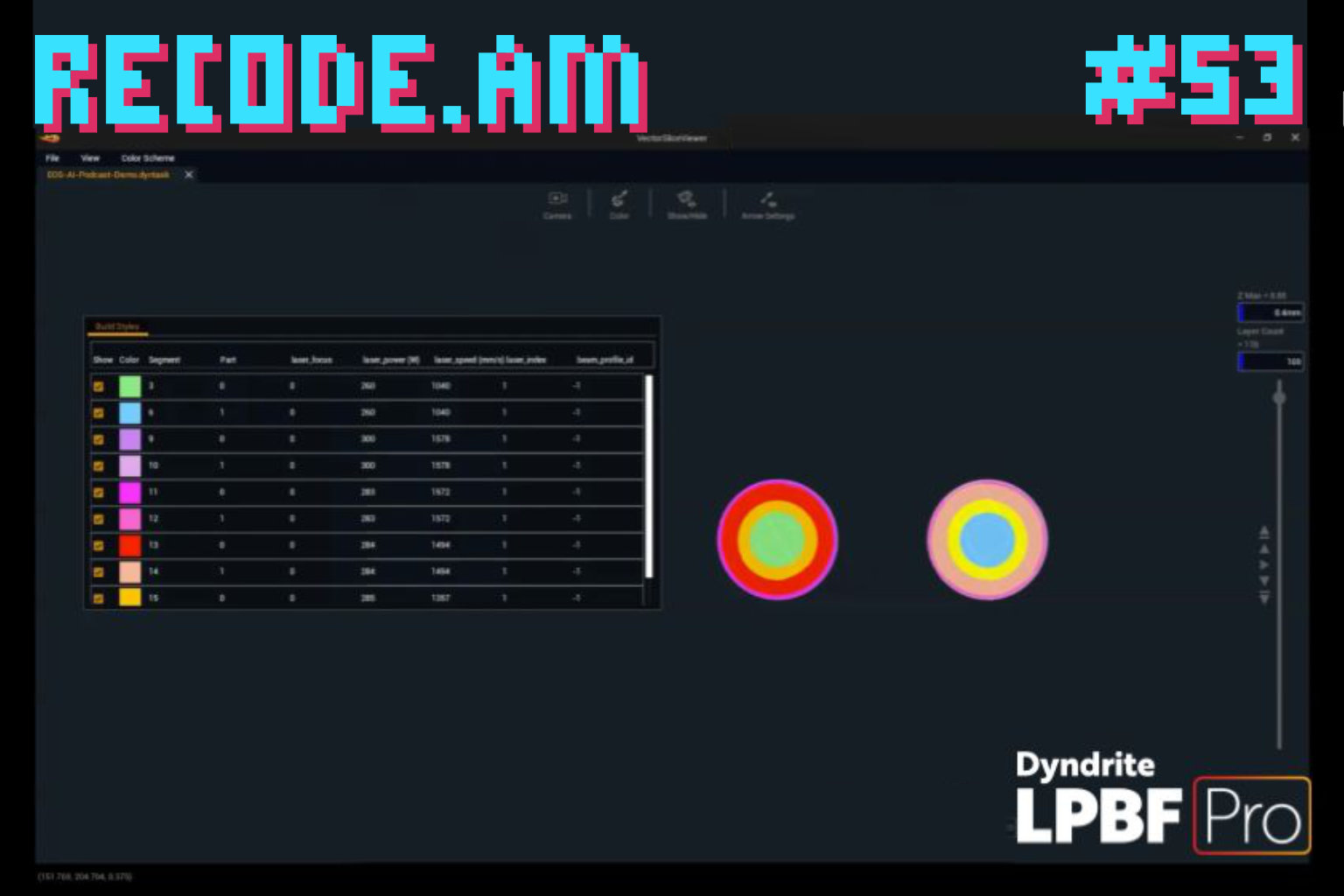
During a podcast episode, Thomas Pomorski, Director of Additive Manufacturing at Ursa Major, asks an AI agent to write a new hatch strategy and, twenty minutes later, prints it on an EOS machine. This is what industrial metal 3D printing is starting to look like.
Pomorski opens VS Code, logs into an AI agent, and enters a prompt. He asks for a new laser path strategy. One that fills hatch tiles from the outer edge of the part toward the center because it distributes heat more evenly.
The agent reads the slicer’s repository, creates a plan, writes the function, edits the configuration file, and assigns it to a specific part on the build plate.
Pomorski clicks “Run.”
The slicer imports the geometry, automatically generates supports, and slices the build for an EOS machine. Twenty minutes later, that same pattern is being laid down layer by layer inside the printer.
All of this happens live during an episode of the “Additive Snack” - podcast hosted by Fabian Alefeld from EOS.
No editing. No “we prepared this earlier.”
Pomorski runs the additive manufacturing facility at Ursa Major, a company that prints rocket engines for hypersonic systems, solid-fuel propulsion, and space propulsion applications.
For him, this is just a normal Tuesday at work…
The most interesting things are no longer happening in hardware
For more than twenty years, metal additive manufacturing has been driven forward by mechanical engineering. Better lasers, better gas flow, better optics, larger build chambers.
And to give the industry credit, that work has reached a level that would have seemed almost unimaginable a decade ago.
Today, Ursa prints the Hadley engine with roughly 80% of its mass produced on EOS equipment. The same engine has flown hypersonically more than nine times, returned to Earth, undergone inspection, and flown again.
The EOS M450 machines installed at Ursa Major feature four nLight lasers, enhanced gas flow systems, and upgraded optics.
So yes, the hardware is ready.
The problem is that hardware alone is no longer enough. All the fundamental additive manufacturing technologies have already been invented.
Hardware alone is not enough

Today, the year 2025 comes to an end. What will 2026 bring? Of course, no one knows - but let me propose a possible motto for the months ahead:
And when that happens, competitive advantage shifts to where there is still plenty left to optimize: process preparation, process control, and validation.
Those are software domains.
The anatomy of a single prompt
Let’s break down this demonstration…
The slicer used by Ursa Major is called Polaris and is being developed in collaboration with Dyndrite. At its core are TOML configuration files. These contain all input parameters: layer thickness, angles, top and bottom skin parameters, hatch settings, contours, and more. Engineers modify laser settings simply by editing text files, without touching the underlying code.
The second component is part-name-based segmentation. Every item on the build plate: “sample 1,” “sample 2,” and so on. It receives its own dedicated parameter strategy, automatically assigned through configuration.
One build plate. A dozen different process recipes. Zero manual clicking through individual parts.
So when Pomorski asks the agent for a new hatch strategy, the agent is not “drawing” anything. It is writing a function into the slicer repository and then connecting it to the selected part through a TOML file.
The toolpath strategy becomes a piece of code that can be version-controlled in Git, compared against previous versions, rolled back, and audited.
The process is no longer a collection of settings stored in the head of an operator and scattered across internal network drives. It becomes a formal, programmable description that can be analyzed and reproduced.
A company that controls only the hardware is standing on thin ice. Ursa’s demonstration shows why.
Without a programmable slicer, a request such as “create a new hatch strategy and deploy it to the machine” would have nowhere to land.
AI multiplies the capabilities of those who already understand the process
It would be easy to draw the wrong conclusion from this demonstration, that anyone with a laptop can now print a rocket engine.
Pomorski dismantles that idea himself, and he does it elegantly.
AI is a force multiplier for people who already possess expertise. If you can tell the agent that you care about the thermal history of a part at a 20-degree angle, and explain why, you’ll get excellent suggestions and working code.
But if you’re a junior engineer who doesn’t yet understand which factors influence a thermal profile, you’ll get far less value from the tool. The real advantage emerges when experience meets speed.
And speed is where this becomes powerful.
Ursa’s software development team consists of four people, yet its effective output resembles that of ten or more.
Pomorski describes a two- to threefold increase in the number of experiments and research plans that can be pushed through the machines.
He achieves all this while spending perhaps five percent of his time on software development because his primary job is running the factory, not writing code. Which naturally raises an interesting question: what happens when someone like that finds time for the remaining ninety-five percent?
There is another level of honesty here that I appreciate:
AI tools are not yet mature enough to be trusted in critical production environments.
Pomorski prototypes broadly with AI agents, and then the software team rebuilds the solution properly for production use, assigning the model small, precise tasks.
For context, Ursa is working with an older model version that complies with AWS GovCloud requirements, several releases behind what much of the rest of the world currently uses.
Even with that limitation, they are accomplishing things that were out of reach just a year ago. That says a great deal about where this curve is heading.
And all of this eventually shows up in the cost sheet.
Three or four years ago, very few people in the industry would have argued that 3D printing could be cheaper than conventionally producing an engine.
Today, Ursa is targeting a complete hypersonic vehicle at around one million dollars, while custom-built alternatives have historically cost between $20 million and $50 million per unit.
Part of that difference comes from better printers. But increasingly large portion comes from software: fewer failed builds, faster iteration cycles, and a four-person team performing the work of ten.
Why this is good news
First, we’re talking about “a corner of the market” where the West still holds a meaningful advantage.
Consumer FFF belongs to Chinese manufacturers, who control roughly 95% of the market below the $2,500 price point.
Industrial metal additive manufacturing is protected by certification requirements, process control expertise, service relationships. And now increasingly by software.
North America accounts for more than 37% of the global AM market, with defense applications becoming an increasingly powerful driver.
(Velo3D’s recent recovery has been fueled largely by defense-related orders)
So yeah, this is not a segment in decline…
Second, this story has allies:
In 2025, AAAME was established, bringing together Ursa Major, Dyndrite, EOS, and nLight around a shared objective: accelerating additive manufacturing deployment for national security applications.
Just look at that crew...
A company focused on applications. A software company. A metal 3D printer manufacturer. A laser manufacturer.
That said, a degree of skepticism is appropriate.
A successful demonstration on a podcast hosted by EOS, featuring a partner from the same alliance, is still a family gathering - not an independent audit.
And no AI agent changes the fundamental reality that AM remains a complement to injection molding, casting, and machining rather than a replacement for them.
But nobody here is arguing otherwise.
Ursa prints components as replacements for existing platforms quite deliberately because the industry is not yet ready for widespread adoption of double-wall geometries and lattice structures.
(Even though Ursa has already tested such designs successfully)
Maturity means understanding what your tools are capable of today. Hardware in metal additive manufacturing is ready.
The most interesting developments are now happening in software, at the intersection of programmable slicers, high-quality documentation, and AI agents capable of writing functions and deploying them to machines before the coffee gets cold.
This is still the beginning of the curve.
But for this troubled industry, that is a genuinely substantial reason for optimism.
Thanks for the great write-up of my conversation with Thomas! And I agree, leading industrial AM equipment has reached a level of maturity that allows software in harmony with smartly deployed AI to have significant impact.