


Anyone who regularly uses platforms with 3D printable models has encountered this irritating problem more than once: you stumble upon a super attractive, colorful model that at first glance looks like a small work of art, only to discover a moment later - while reading the description, comments, or looking at photos of other users’ prints - that it’s all one big scam.
A beautiful AI-generated visualization, while the actual model delivers maybe 30 percent of what’s shown in the image.
This is becoming increasingly common today. Just a few years ago, these platforms were dominated by manually created designs - often visually rough around the edges, but honest. The images usually showed exactly what you could expect to get from your own printer.
Today, the proportions have flipped. Models generated or “assisted” by artificial intelligence lure users with perfect shapes that exist mainly as 2D images.
Once they hit a 3D printer, the magic disappears.
The core of the problem is not the presence of AI in the design process itself. Artificial intelligence can be a great conceptual or inspirational tool. The trouble begins when the boundary between a concept and a finished, functional model becomes blurred.
An image generated by AI can suggest arbitrarily complex geometry, unrealistically thin walls, perfectly smooth transitions, and structures that are either impossible to print in practice or simply do not exist in the actual 3D file.
The user sees only a promise.
As a result, a large number of questionable-quality models flood these platforms, making it harder to find designs that are genuinely refined and properly tested. Algorithms that promote popular or frequently downloaded content further amplify the issue, because an attractive graphic draws clicks far more effectively than a photo of a raw FFF print.
Consequently, the top of search results and “trending” sections are filled with projects that look great as thumbnails but don’t necessarily hold up in real-world use.
For beginners this is particularly frustrating. People just entering the world of 3D printing often lack the experience needed to distinguish a realistic render from a visualization that violates the basic rules of additive manufacturing. They download the model, invest time and material into printing it, and are left with an object that barely resembles what they saw on screen.
Worse still, this problem does not always stem from bad intentions. With the development of image-to-3D and text-to-3D tools, creating “some kind of” model has become trivially easy. An attractive concept image and a few clicks are enough to generate a shape that roughly resembles the original idea.
For some creators, this is already sufficient justification to upload the file and consider the project finished - even if the model has never been printed or properly tested.
The threshold of acceptable quality shifts because, for the “majority of users,” it is supposedly “good enough.”
And to be fair, the quality of AI-generated models has undeniably improved. Today’s algorithms can reproduce overall geometry, proportions, and the character of an object far better than they could a year or two ago. Increasingly, generated models are close to what the visualization shows - at least at first glance.
However, this introduces a new problem: the social acceptance of mediocrity. If a model more or less works and kind of looks okay, many people consider that sufficient.
In the long run, this can lead to a general decline in standards.
Against this backdrop, attempts at systemic solutions are emerging. One of them is the MakerWorld initiative, which introduces clear rules regarding how models are presented. A key element is the requirement to include photos of real prints as an integral part of a project’s presentation.
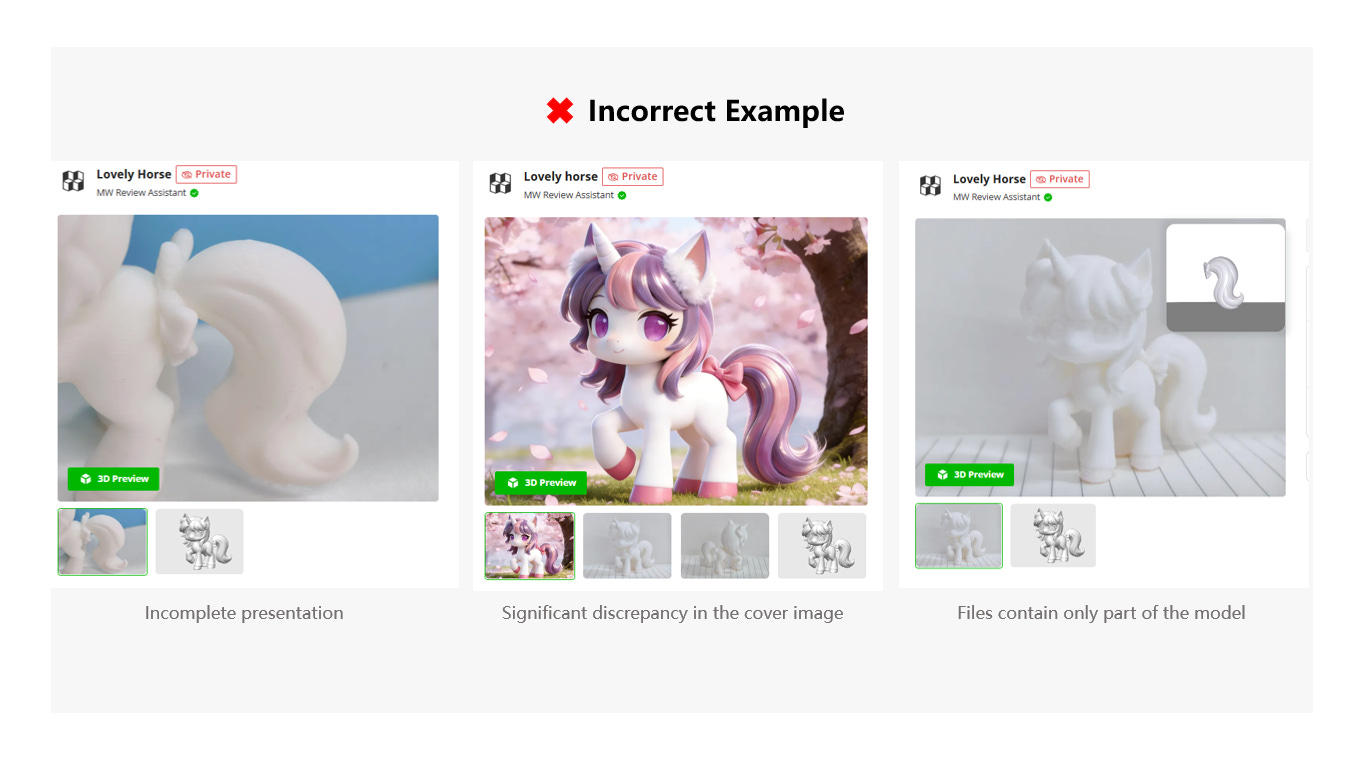
The idea is that users should be able to see what a model actually looks like straight off the printer before downloading the file, rather than only in the idealized conditions of a render or an AI visualization.
It is worth emphasizing, however, that even such initiatives do not solve the entire problem. Regulations can improve transparency, but they cannot replace critical thinking or creator responsibility.
AI in the world of 3D printing is here to stay, and in itself it is neither good nor bad.
The real question is whether it will be used as a tool to support genuine design - or as a generator of pretty promises with no real substance behind them.