

SphereneNXT: designing the inside of 3D printed parts moves to the browser
Cloud-based software generates adaptive internal structures, reducing weight, improving strength, and simplifying advanced design workflows

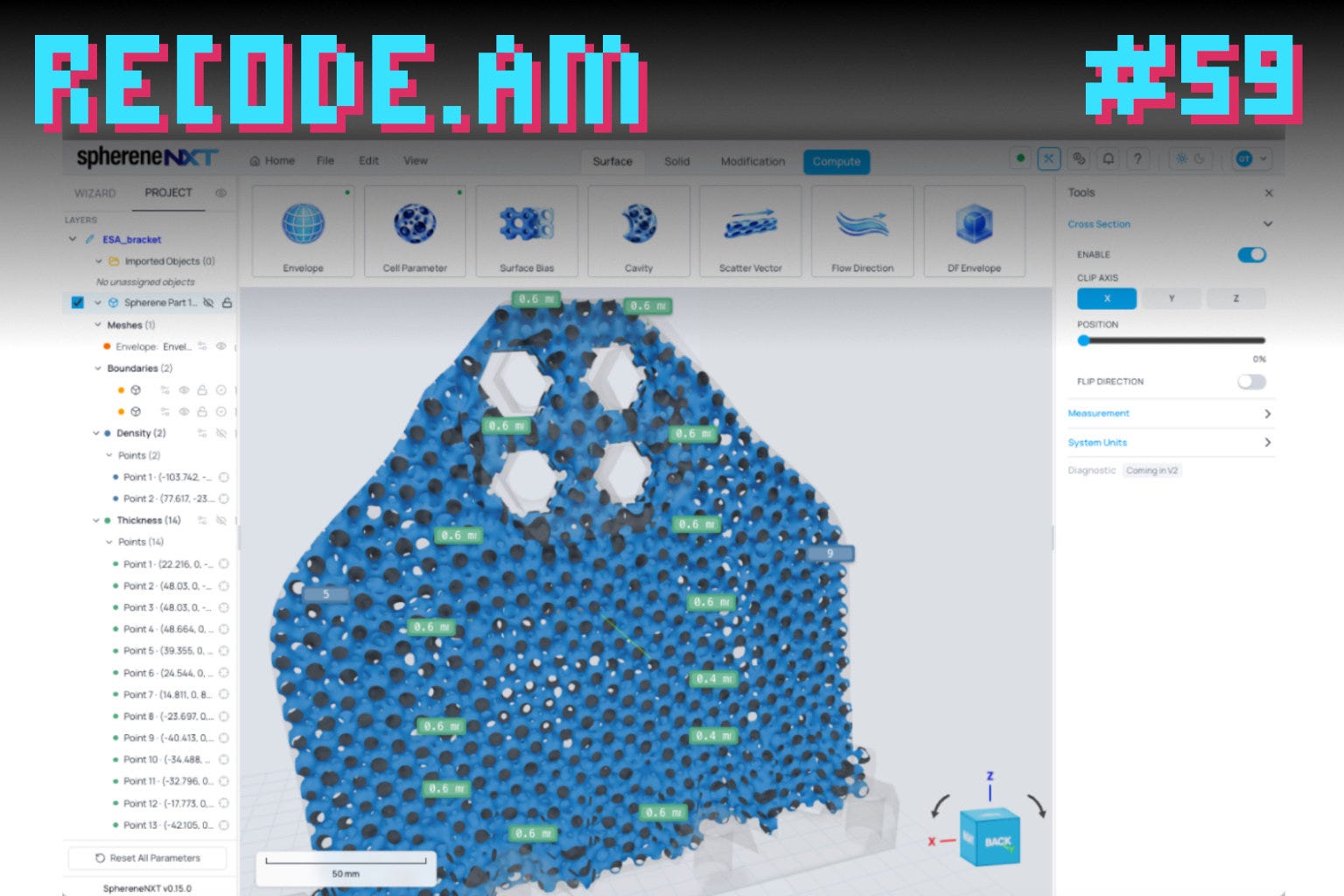
Swiss company Spherene has launched SphereneNXT, software focused on everything you can’t see with the naked eye: the inside of a 3D printed part. The entire application runs in a web browser, performs its calculations in the cloud, and is available in plans ranging from students to large engineering teams.
Anyone who has ever printed a part is familiar with the infill slider in a slicer: honeycomb, grid, gyroid. These are repeating patterns applied uniformly throughout the model, regardless of where the part is actually subjected to stress. Hollow on the inside, equally stiff everywhere.
Spherene takes a different approach.
Its ADMS (Adaptive Density Minimal Surface) technology creates smooth, curved internal walls - somewhat like a soap film stretched inside the part - that distribute loads across continuous surfaces rather than concentrating them in the thin beams of a lattice.
More importantly, those walls are adaptive. They become denser where stresses increase and thinner where little or no load exists.
The closest analogy in nature is bone.
Bones are not solid inside. Instead, they contain a porous internal structure that becomes denser precisely where it carries the greatest loads. Millions of years of evolution arrived at the same conclusion as the Swiss engineers: material only makes sense where it actually does work.
How does it work?
The software focuses exclusively on the internal structure of a part.
The external geometry remains entirely yours, meaning it doesn’t matter which CAD software you use. You upload your model, Spherene computes the internal architecture, and you either export the optimized geometry or send it directly to a 3D printer. Plugins are also available for nTop, Fusion, Rhino, and Grasshopper for users who prefer to stay within their existing design environment.
Alongside ADMS, the software also offers traditional TPMS (Triply Periodic Minimal Surface) structures, with density, wall thickness, and orientation controlled through scalar fields applied directly to the part’s surface.
Another feature is Flow ADMS, designed specifically for fluid flow and heat transfer applications.
Instead of producing a uniform internal structure, it generates geometry that guides fluids along predefined paths while delivering lower pressure losses than a conventional gyroid structure at comparable thermal performance. For engineers designing heat exchangers, that can make the difference between a theoretical exercise and a component that performs effectively in real-world operation.
Why does this matter for engineers?
Until now, designing advanced internal structures has largely been the domain of specialists working with expensive software licenses and highly complex workflows.
SphereneNXT removes several of those barriers.
Engineers can produce lighter, stronger parts without manually designing lattice structures. The algorithm automatically distributes material according to expected loads, meaning that when the geometry or material changes, there is no need to redesign the internal architecture from scratch. You simply adjust the parameters and run the calculation again.
Fewer design iterations and more consistent results. The generated structures are also self-supporting.
There are no internal support structures that must later be removed - a task that is often one of the most frustrating parts of post-processing.
Users also don’t need a powerful workstation or complicated software installation.
All computations are performed in the cloud. You simply open a browser, while the finished result is exported as a compact, error-free mesh ready for additive manufacturing.
This may not be a tool for every engineer, despite what the marketing brochure might suggest.
But for engineers developing lightweight brackets, heat exchangers, orthopedic insoles, or other performance-critical components, it removes a genuine bottleneck from the design process.
SphereneNXT became available on June 30, 2026, through spherene.io, with subscription plans tailored to everyone from students and independent designers to professional engineers and enterprise teams.