

The company that created the market and is still looking for its place in it
Three CEOs, a half-billion-dollar write-off, and the question of what 3D Systems actually is today


I don’t know whether someone at 3D Systems deliberately picks these dates, or whether they just happen that way.
On August 4, 2026, the company announced that Jeffrey Graves was stepping down as CEO and would remain in the position only until the board finds his successor. Four days later, on August 8, came the 42nd anniversary of the day Charles Hull filed his patent application for stereolithography. The conventional birthday of 3D printing.
They could have picked a quieter date. Since they didn’t, there are two possibilities. Either it’s a pure coincidence, or at the company that brought this industry to life, nobody counts these anniversaries anymore.
Both are a little sad.
Because 3D Systems is a company with a unique status. A symbol and for years the main architect of the market, the company credited with inventing 3D printing and the first to commercialize it. Hull didn’t invent the method first in the world, nor did he even file the first patent. But he turned it into a business and built a market around it - a market many of us make a living from today.
A big part of that work was done by Avi Reichental, the man who turned a laboratory curiosity into a publicly traded story. An ambiguous (some would say „controversial”) figure, but nobody reasonable (and honest) can deny his contribution to the development of the industry.
Behind the cold announcement about a planned succession, however, lies a much longer story. The story of a company that has been looking for direction for a decade and still hasn’t found it.
The CEO’s departure is a good moment to look at the company through the people who ran it. And through the numbers they left behind.
Reichental - the Big Build, the Big Revolution and the Big Mess
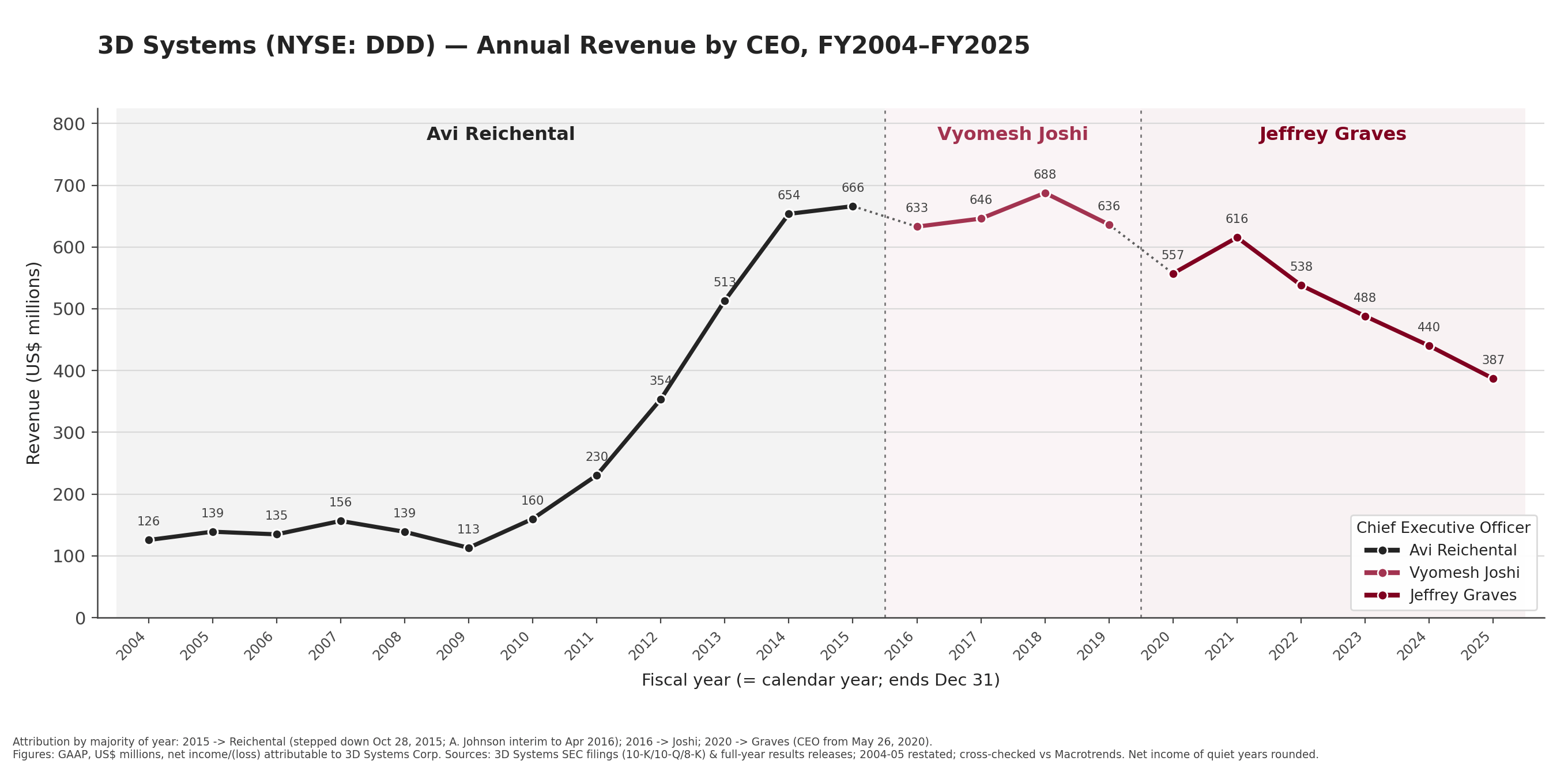
Avi Reichental ran 3D Systems from 2003. His first full year, 2004, closed with revenue of $125.6 million. A decade later, in 2014, the company reached $653.7 million. It was the era of massive expansion, driven by dozens of acquisitions and stock-market enthusiasm around 3D printing.
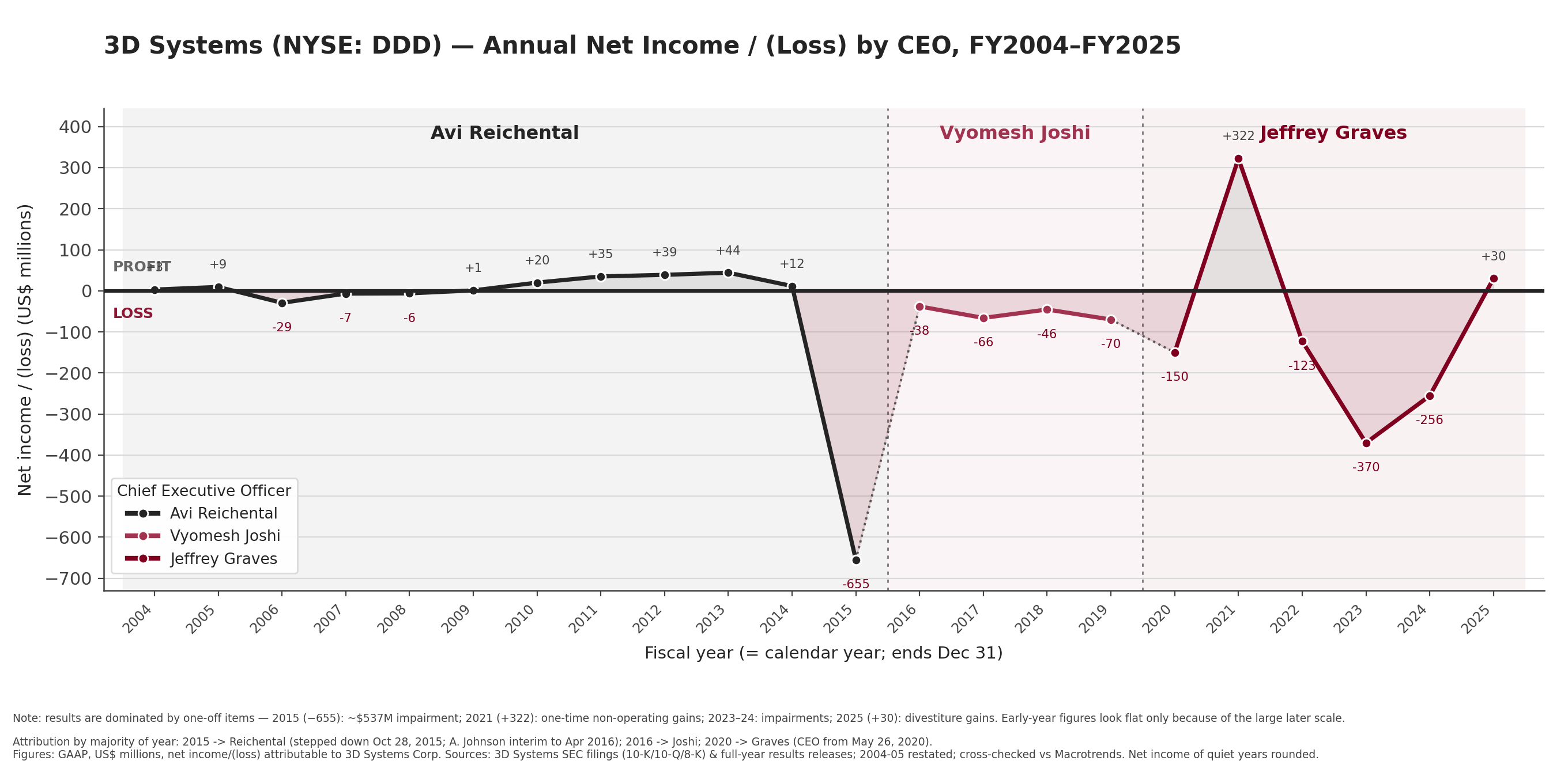
Then came 2015 and the bill for that expansion. With record revenue of $666.2 million, the company posted a $655 million net loss, mainly because of a $537 million impairment of goodwill and intangible assets. That same fall, Reichental left the company.
He built a market and a huge company. He also left behind an organism stitched together from dozens of acquisitions that were never fully integrated. A corporate Frankenstein whose ugliness overshadowed even the later collections of companies assembled by Desktop Metal and Nano Dimension.
After Reichental, Andrew Johnson ran the company on an interim basis for a few months. A caretaker for the transition, with no ambition to change course.
Joshi - the manager from the “adult world”
In April 2016, Vyomesh Joshi took the chair, a veteran of HP’s printing and imaging business. He had never run an additive manufacturing business before. That’s an important difference.
His record was four consecutive years of net losses: from $38 million in 2016 to almost $70 million in 2019. Revenue remained flat or declined slightly during that period. A competent manager from the mature, adult industry (yeah, I know how it sounds) who failed to restore either momentum or a clear identity to the company.
Graves - the surgeon of order
Jeffrey Graves arrived in May 2020, in the middle of the pandemic. He went at the company like a surgeon. He cut 20% of the workforce, split the company into medical and industrial businesses, and cleaned up the finances.
Then he started selling and buying. On one side, divestments: Simbionix for $305 million, Geomagic for $123 million, generating a $125.7 million gain. On the other, a series of acquisitions: Allevi, Oqton, Volumetric, Kumovis, Titan, dp polar, Wematter.
The emblem of this era is Oqton. Bought in 2021 for $188 million, sold in 2025 together with 3DXpert for $3.3 million. Almost sixty times cheaper, four years later.
And then there was that infamous, ultimately failed attempt to acquire Stratasys in 2023. An epic that ended in a massive embarrassment for everyone involved and, consequently - this is my own theory - triggered the industry’s great crisis and the collapse of the publicly traded AM unicorns.
The revenue numbers tell an even simpler story. After the pandemic, they declined year after year: $557 million in 2020, then $615 million, $538 million, $488 million, $440 million, and finally $387 million in 2025. 2024 was the weakest year since 2012.
The company reported a GAAP profit in 2021 and again in 2025. Both times it came from one-off transactions, not from operating business. In 2025, behind the “$29.9 million profit” was a $96 million operating loss. Accounting did what the market couldn’t.
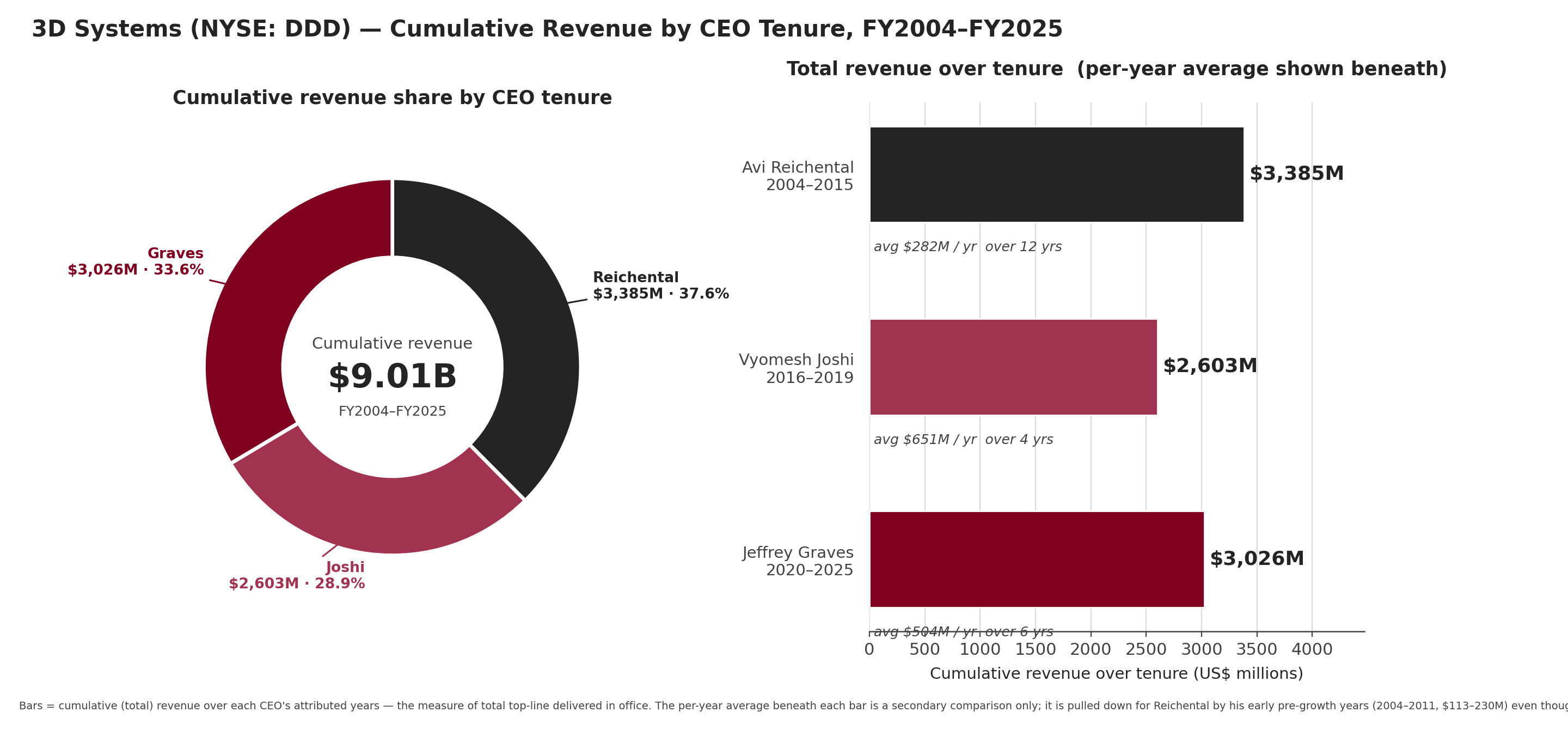
Now let’s look at the graphs:
How do I assess Graves’ tenure? Strategically, he was aiming at where the industry seemed to be heading: medicine and specialized manufacturing. He kept the company in one piece through the pandemic and years of market uncertainty. Solid piece of work.
The problem is that he never turned what seemed like the right diagnosis into revenue, and the road he was supposed to pave in 2020 somehow stopped being paved somewhere along the way.
He completely missed on bioprinting. I remember that early in his tenure, as 3D Systems went deeper and deeper into dental, specialized medicine and biotechnology, I was strongly rooting for it.
Nothing came of it. The bioprinting company, Systemic Bio, was shut down. During the process of trying to acquire Stratasys, it also came out that most of 3D Systems’ dental business depended entirely on working with a single customer - Align Technology.
And then there was that desperate attempt to acquire Stratasys. At that point, everyone briefly dropped their pants. Which was embarrassing enough on its own, regardless of what anyone saw underneath those pants.
And that’s basically the point.
You can clearly see that for more than a decade, 3D Systems hasn’t really known what it wants to do with itself or where it is going.
Too big to fail?
Companies rarely fail for a single reason. Sometimes it’s outdated technology or a cheaper competitor. Sometimes it’s debt that nobody dealt with in time. But sometimes the reason is quieter, spread over so many years that it becomes invisible. The company simply loses sight of its own reason for existing.
On paper, 3D Systems looks exemplary.
It has printers covering almost every additive manufacturing technology. It has its own software and top-tier medical and industrial certifications. It is a default supplier for the U.S. healthcare system and military, with contracts across aerospace, naval, rail and automotive industries.
By August 2026 3D Systems worth on stock exchange is roughly $613 million. A single quarter did much of the work: unexpectedly strong results, demand in metal printing and aerospace/defense climbing, dental growing, and the stock leaping 44% in one week.
However it is still way behind Stratasys ($774 million), and it remains a rounding error next to the Chinese giants - Farsoon, Bright Laser Technology, Shining 3D, and yeah, even Creality.
So where does this gap between what is on paper and what the market says it’s worth come from?
From the fact that nobody really knows what this company actually is.
Basically, ever since the Reichental days, you could ask 3D Systems for anything and the answer was: “Yes, we can do that.”
Prototypes, serial production, implants, prosthetics, bioprinting, software. They were sending you a quote for all of it.
Sounds great until you think about it for a little longer.
A company that can do everything isn’t the best at anything. At best, it’s good at it, and “good” in this market is dangerously close to “average.”
Which leaves us with a question that people in the industry tend to ask quietly.
Is 3D Systems too big and too important to be allowed to fail?
In my opinion, yes.
It is too deeply embedded in American defense and healthcare for anyone in Washington to simply watch it disappear. A lot will be done to keep it afloat. Regardless of what its quarterly numbers look like.
But what if it did collapse, or was sold off piece by piece?
It would be a symbolic blow, much heavier than the numbers themselves. With all proportions maintained, because the scale is completely different, for America’s technological heritage it would be an event on the scale of the collapse or breakup of Ford, General Electric or IBM.
Because that’s exactly the weight 3D Systems carries for 3D printing. It is the company where it all started.
It would be a shame if history remembered it as the company that created the market and then couldn’t find a place for itself in it.