

The Inventor’s Dilemma
For years, the additive manufacturing industry kept offering fascinating inventions in a market that only pays for solving a specific, boring problem

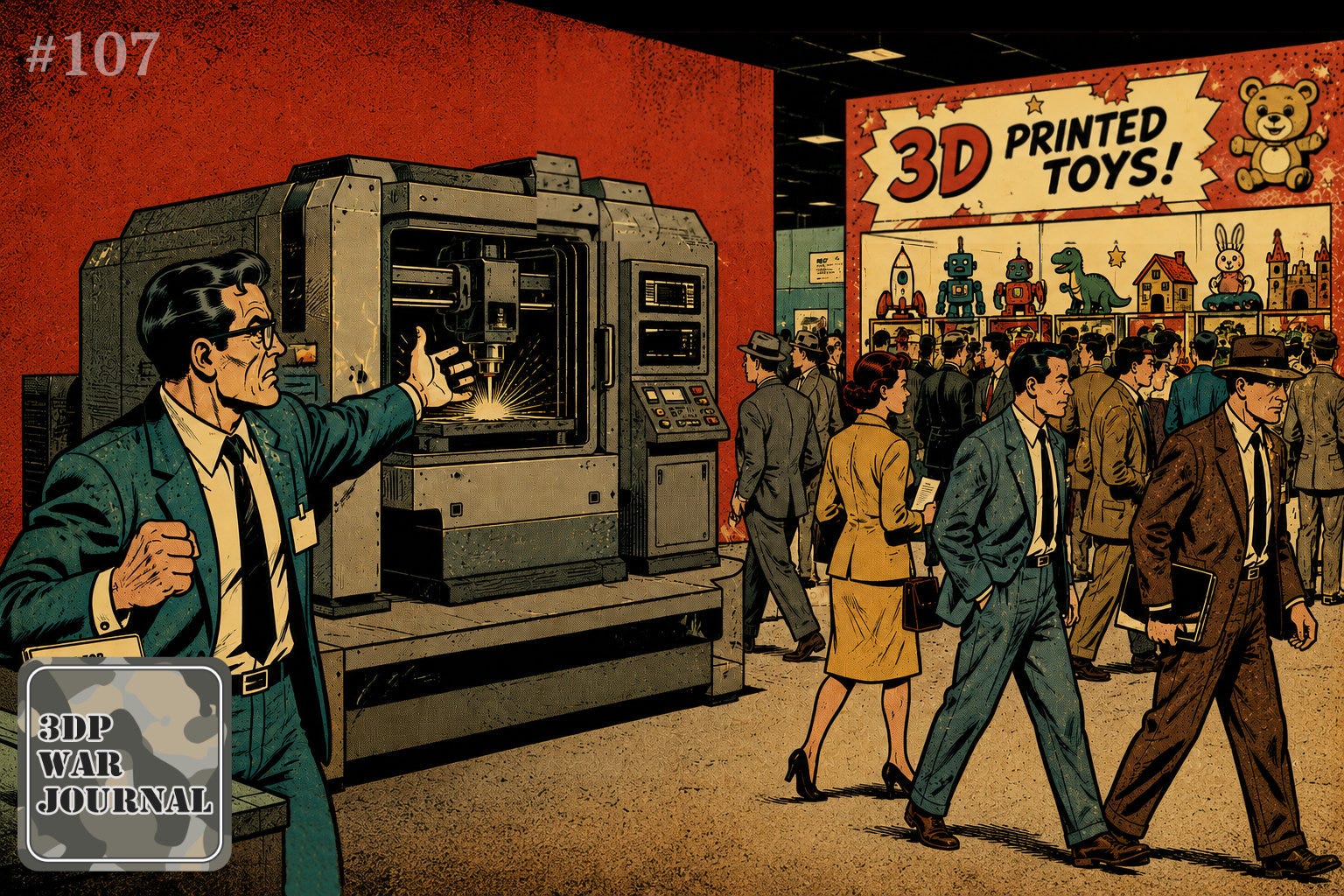
At every AM trade show, there was always at least one booth like this.
Behind it stood an odd-looking guy who had spent the last four years working on something nobody had managed to do before. His machine could process a material with properties no competitor could match. Or it offered a process that finally bypassed a fundamental mechanical limitation.
The sample prints sat inside generic IKEA display cubes, lit from below, on black backgrounds. The machine itself wasn’t there (because there was only one, and it was sitting in a lab).
People stopped and took pictures, and after a short conversation, they were genuinely impressed.
Someone would say it was going to change the entire industry. Someone else would ask for a sample to show their boss.
Right after the trade show, the LinkedIn recap post collected 200 reactions and 40 comments (half of them replies from the exhibitor himself).
And that was it.
The inbox was still waiting for RFQs. The meeting calendar was still wide open.
The inventor explained it to himself by saying the market wasn’t mature yet, and customers first had to be educated.
„Just wait another two years. Then everyone will get it” – he repeated to himself...
The problem was that two years later the company was gone, and the trade show samples had either ended up in a landfill or in a box of old souvenirs.
All because the inventor had made one fundamental mistake from the very beginning.
He answered a question nobody had asked.
In 3D printing, that single mistake has killed more companies than price pressure and Chinese competition combined.
Hundreds of projects that impressed everyone while solving nothing.
Technologies with value locked inside themselves, adding no value to anyone outside.
Admiration is a currency you can’t book
The additive manufacturing industry is made up mostly of people who invent and develop technologies.
Alongside them is a small group of people who know how to turn someone else’s invention into an actual business. And an even smaller group who managed to do both.
That last group consists of just a handful of names everybody knows.
Those proportions have financial consequences, because the first group tends to think in a very particular way.
The inventor’s world is the workshop, the laboratory and the factory floor. His product is the sum of his work, his expertise and several years of his life.
And because it is the sum of all those things, its value seems obvious to him. Not just to him, but to the entire world.
His product is both his vision and an advertisement for himself. His product is supposed to be an argument.
The problem is that every single time, it becomes a pretentious monologue.
But the end customer - the one who is supposed to buy the technology - doesn’t have time to listen to things that sounds to him like mumbling, geeky nonsense.
Because the end customer is judged by delivery dates, unit costs and the number of customer complaints.
And yes, he already has a supplier who gets the job done. That supplier doesn’t have to be exceptional. Average is good enough, as long as he’s predictable. And in manufacturing, predictability is a harder currency than quality or innovation.
A new technological capability is a cost. It has to be tested, documented, built into procedures, approved and defended in front of management.
And if something falls apart during the tenth production batch, it’ll be the customer explaining himself - not the inventor.
The technology may be innovative, and be impressive.
But the admiration is free. Implementation often costs more than the machine itself.
Innovators die in silence
So the innovator sits there, waiting for the breakthrough that never comes. The grant money runs out. The investment dries up. Eventually, he shuts the business down.
Usually, there is no farewell post. No press release. There is, however, plenty of bitterness and frustration aimed at the world.
After every failure, the same explanation comes up:
The market wasn’t ready.
It’s a convenient explanation, because it makes the end user of the technology the one to blame.
The real story is much simpler.
The product simply wasn’t needed by anyone, for any reason.
The inventor’s dilemma boils down to a choice between inventing and listening to the customer.
You can have objectively the best technology on the market and spend years waiting for the world to appreciate it.
Or you can simply ask someone what hurts today and build the answer.
The first path brings awards and recognition.
The second brings wire transfers.
There is, however, a narrow path that this industry has walked only a handful of times in its entire history.
It’s worth looking at what those cases have in common, because the conclusion is uncomfortable for everyone.
What actually made it into mass production
There are only a handful of 3D printing applications that have genuinely reached industrial scale:
patient-specific medical devices; prosthetics and orthodontics
production tooling
parts for aerospace, automotive, maritime and rail
defence
energy.
And don’t forhet millions of colorful toys made on giant farms of desktop 3D printers.
Every one of those applications came to life the same way. Someone found a single use case that made financial sense, then repeated it hundreds of thousands of times, improving small details with every iteration.
None of them won a Nobel Prize. They won something else instead: financial stability and growing revenue.
Funny enough, everything behind those success stories sounds like a punishment when you write it down:
process qualification
documentation
material validation
training operators - including the ones who will leave after a year and have to be replaced
handling complaints
audits
building a customer’s trust over eight years, and losing it because of one bad production batch.
This is the part inventors hand over to somebody else, or skip altogether, because this isn’t what they went to engineering school for. And yet this is exactly the part that decides whether a technology makes money.
Customers don’t care how ingenious their supplier is - they care about the outcome.
Shorter lead times. Lower costs. Fewer phone calls in the middle of the night.
Innovation means nothing to them until it cuts delivery times by days or weeks.
The conclusion is uncomfortable for anyone who fell in love with this industry because it was fascinating.
3D printing has to become boring.
It has to make ordinary, completely unremarkable everyday products. The kind nobody picks up and asks, “How was this made?”
The product should be remarkable - the manufacturing process should remain the manufacturer’s private business, preferably a closely guarded one.
The less you see the words ”3D printed” in the sales message, the better the result.
This technology is still moving forward, faster than most people realize. Its future, however, fits into one rather unimpressive sentence: