

The world’s most expensive free designer
Fable 5 can design a 3D-printable model. The question is: who will pay for the tokens?

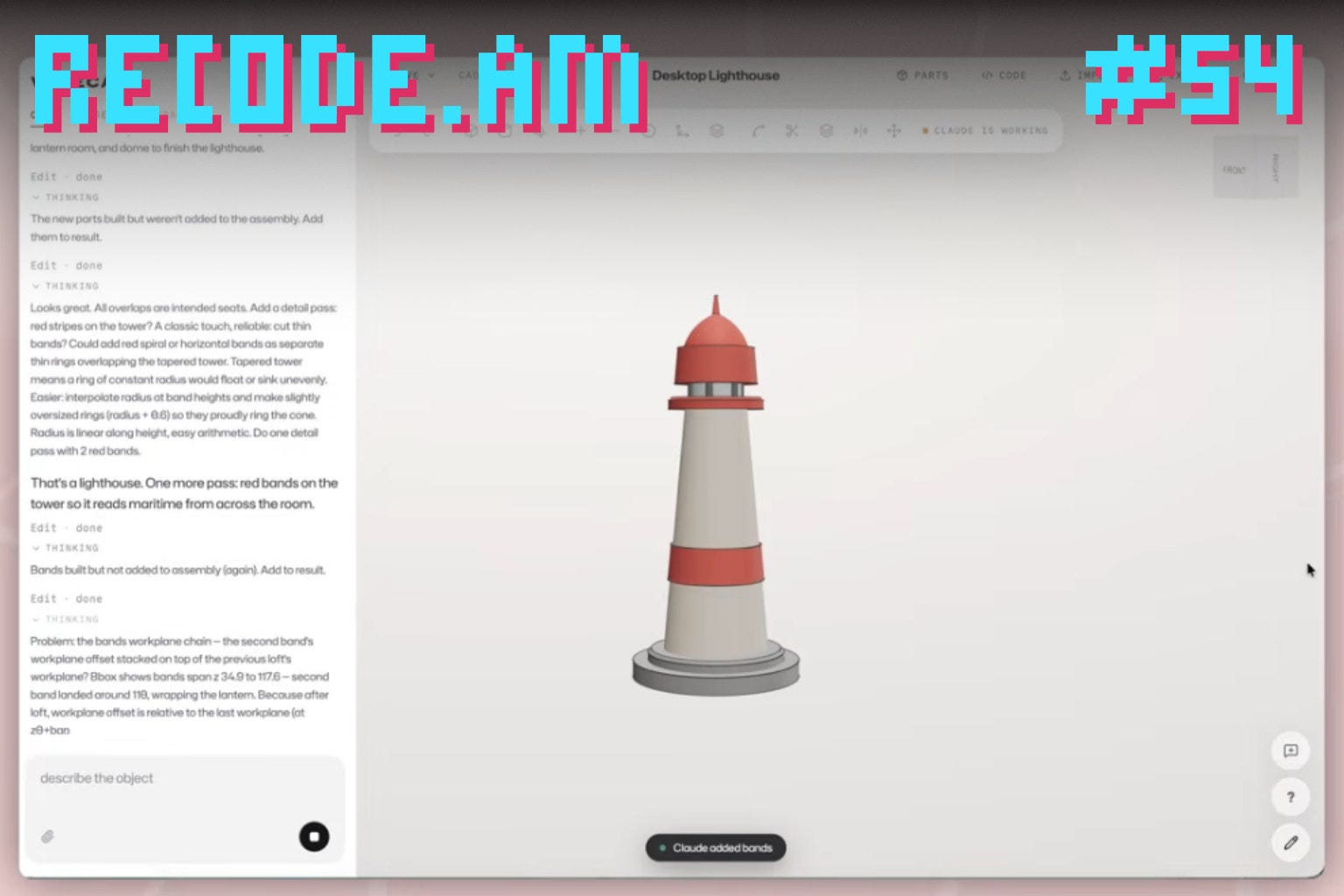
Anthropic has unveiled Claude Fable 5. At the same time, the official Claude YouTube channel released a video showing the model building its own design tool: a browser-based CAD editor called VibeCAD, complete with a built-in assistant.
Then, inside the very environment it had just created, it designed a small lighthouse for a desk.
All from a single sentence of description!
The model added a base, a tower with colored stripes, a lantern room with columns and a dome. Along the way, it even noticed that the object was supposed to fit next to a monitor and adjusted the proportions accordingly.
It’s impressive. Really.
Geometry, code, and design in a single workflow, without jumping between five different programs and two file formats.
And then you scroll down to the comments.
Man, I can’t even afford to run Opus.
And suddenly, all the magic disappears...
Because Fable 5 is the most powerful model Anthropic has released to the public so far. The problem is that it’s even more expensive to use than Opus - a model that most users had already found difficult to afford.
So now we have a designer that can create objects on demand and even think about where the monitor will sit on the desk. Yet there’s one question the video never addresses.
What’s the point of having such a designer if so few can afford to use it?
What is it about?
Let’s start with what actually happened, because it is still a major achievement.
The model wasn’t given a ready-made editor. It first wrote the tool for itself, and only then started designing the object within it.
It iterated through several inputs, saving intermediate stages in the interface, until a rough description became a closed solid model. This is precisely the design layer into which the industry has been pouring money and hope for years.
Pure software.
Of course, we don’t know whether the design is actually functional. Can it be printed? Anthropic is showcasing its best model in the best possible light, while openly admitting that it doesn’t know whether the file will produce a usable object or a pile of spaghetti.
But that’s not the point.
Those issues can be refined and improved.
What matters are the numbers.
For rich people only
Fable 5 costs $10 per million input tokens and $50 per million output tokens. Until June 22, it’s included at no extra cost in the Pro, Max, and Team plans. Starting June 23, users will need to pay with credits unless Anthropic extends the promotional period.
In other words, the free designer comes with an expiration date. After that, it moves into a pricing tier above Opus.
And that’s where the real question emerges:
For what class of objects does this actually make economic sense?
3D printing makes money where parts are unique, inexpensive, and needed immediately. A desk lighthouse is a textbook example of that category. A small object of the kind designers create by the hundreds.
But if generating the file costs more than drawing it manually, then we’re looking at a very expensive solution to a very cheap problem.
So how much does one such lighthouse actually cost in tokens?
Let’s estimate, because Anthropic did not provide exact figures in the demo, and I’m not gonna invent them.
A session that first builds an entire CAD editor with an assistant and then spends several rounds refining a design is a lengthy agentic workflow. At every step, the model rereads context, causing input token consumption to balloon.
Realistically, we’re talking about output in the range of 100,000 to 300,000 tokens, with input usage expanding into the low millions.
Using Anthropic’s pricing, that works out to somewhere between a dozen and several dozen dollars for a single lighthouse.
To be clear: that’s an estimate.
But the order of magnitude is realistic.
Now let’s look at the other side of the table.
A designer from virtually any global freelance marketplace could model the same object in thirty minutes, maybe an hour. For a comparable fee, often less. And they won’t bill you for three failed iterations where the geometry didn’t close properly.
The commenters under the video figured this out faster than any marketing department could.
You can literally do this in an hour with actual usable models.
Another commenter asked directly why Anthropic keeps adding features nobody requested before fixing its pricing and token structure.
A third summed up the company’s strategy: prioritizing raw power over efficiency will end badly, in their view, and they wished Anthropic luck with the small number of customers who will actually be able to afford it.
It’s easy to dismiss these reactions as complaints.
That would be a mistake.
AI is genuinely moving into the design layer, and it’s getting better at it at an astonishing pace. The direction is absolutely correct. A model that builds its own tool and then designs a printable object inside it is a preview of what design-for-additive-manufacturing workflows may look like in a few years.
The problem is today’s arithmetic
Once again, the vision arrived before the economics.
We’ve seen this before in the additive manufacturing industry, when consumer 3D printing was being promised a decade before Chinese manufacturers made it genuinely affordable.
First comes what we can do. Only later comes what we can afford.
Today, Fable 5 is a showroom exhibit. It is still far from the factory floor.
A brilliant, expensive exhibit that people admire from behind the rope, because after June 22, very few will be able to afford the admission ticket.
For now, the cheapest human designer still outperforms the world’s most expensive designer.