

Western Report #2: lots of executive changes and lots of AI
3D Systems is looking for Graves’ successor and reports Q2 results; 6K Additive posts a record quarter, Ricoh sells its healthcare business, and the market is being flooded with AI-powered software

Welcome to the second edition of Western Report, my weekly roundup of what is happening in additive manufacturing on the western side of the world.
This week, personnel changes took center stage, plus a dose of news from the AM software market.
Mainstream Report
I’ll start with the three moves that made the most noise.
3D Systems announced that CEO Jeff Graves will retire once the company finds his successor. The search is expected to be completed later this year. During his six years at the helm, Graves rebuilt the company, split it into medical and industrial segments, and led the acquisitions of Allevi, Additive Works, and Titan Robotics.
Greg Paulsen, who recently announced his departure from Xometry after 12 years, revealed that he is joining Guidehouse as Associate Director in its Technology Consulting team. At Xometry, he helped the startup grow into a global digital manufacturing marketplace. In his new, defense-focused role, he will support programs built around advanced manufacturing, AI, and emerging technologies aimed at strengthening the US industrial base.
Mikhail Gladkikh, formerly Director of Technology and Technical Projects at Würth Additive Group, has joined nPower Technologies as Field CTO and VP of Alliances. The move comes after Würth announced last month that it was shutting down its additive business. At nPower, Gladkikh will be building enterprise-grade software for advanced production scheduling (APS) in 3D printing.
Back to 3D Systems, because the company also reported its Q2 2026 results.
Revenue came in at $94.6 million, down 0.3% year over year, but up 1.4% when excluding the divested software business. Net loss improved significantly to $12.9 million, while adjusted EBITDA came close to breakeven at -$0.8 million, an improvement of $4.6 million. The medical segment grew 6.8% to $48.1 million, driven primarily by more than 20% growth in medical devices. Industrial declined 6.7% to $46.5 million, although aerospace and compute infrastructure contributed more than 20% growth. Gross margin fell to 36.4% due to a change in sales mix.
6K Additive showed a completely different side of the market. The company posted a record quarter with $7.1 million in revenue, up 63% year over year, while its backlog grew to $11.9 million. Metal powders alone generated $5 million, driven by demand from aerospace and defense customers looking for domestic sources of critical materials. Revenue from titanium powder tripled compared with Q2 2025, while tungsten and niobium powders also grew.
Demand currently exceeds production capacity, and returning customers account for more than 90% of sales. On top of that, the company secured an additional $1.9 million SBIR contract from the Defense Logistics Agency and is expanding its Pennsylvania facility with $23.4 million in DPA funding, increasing annual capacity from 1,600 to more than 6,000 tons.
Ricoh USA sold its 3D for Healthcare business to Gary Turner, formerly VP and GM of additive manufacturing at Ricoh USA. The business now operates under a new brand, Myrava. The division was spun out as a separate entity a year ago and holds several FDA clearances for patient-specific anatomical models. Turner previously opened the AM Center of Excellence at NCSU. Ricoh says the sale reflects the need for specialized expertise and a desire to focus on its core business, while Myrava will focus on point-of-care manufacturing.
Zellerfeld has revamped its website and marketplace in the biggest platform update to date. New features include live creator rankings, personalized model discovery, and an expanded ZellerFIT system, which builds a persistent foot profile that works across all products and creators. The company also announced a subscription model offering four pairs of shoes per year, printed on demand. The whole thing is built around a partnership with Volumental, which provides foot scans from more than 3,000 retail locations.
Carbon has moved its California headquarters to a new address, 1272 Borregas Ave in Sunnyvale, and is hiring. Beyond the relocation and recruitment, the company did not provide any specifics, so that’s all for now.
Toybox Labs has signed a licensing agreement with Sanrio and is bringing Hello Kitty and Friends to its 3D printing platform for children and families. The first wave will feature Hello Kitty, Pompompurin, and Cinnamoroll designs, initially in the U.S. and Canada. Toybox’s platform allows users to 3D print toys themselves.
AM Software Report
This week belonged to AI-powered CAD tools. Let’s start with the loudest launch.
Backflip AI launched a CAD copilot built on a new foundation model. The tool turns 3D scans, STL files, and meshes into fully editable, parametric CAD models with feature trees. The cost of digitizing a part drops from around $1,500 to roughly $10. The Copilot works as an add-in for Autodesk Fusion as well as a standalone web application, and offers two reconstruction modes: Fast and “Thinking”.
The company was founded by Markforged co-founders Greg Mark and David Benhaim, and has raised $30 million from Andreessen Horowitz and NEA. The tool is already deployed at a major automotive manufacturer, where it is used to digitize roughly half of the parts being processed. Paid plans start at $20 per month.
Dyndrite is participating in two research projects under the Delta Qual 2.0 program, funded with $9 million by America Makes. The goal is to improve qualification procedures for metal LPBF.
The first project focuses on quantitative installation qualification, enabling event-based requalification and reducing the number of mechanical inspections. The second looks at so-called bracketed qualification, meaning the definition of acceptable process windows within which parameters can be adjusted without full requalification.
Other participants in the program include EOS, Velo3D, Nikon SLM, Lockheed Martin, and Northrop Grumman.
Xometry announced a series of improvements to the architecture of its AI models designed to make the conversion of engineering data into manufacturing recommendations and quotes faster and more accurate.
An upgraded, context-aware process recommender is better at identifying part applications and material requirements, with customers accepting AI recommendations in more than 85% of cases. New CNC machining cost prediction models improved quote accuracy by around 15% in live testing. CTO Vaidy Raghavan describes the system as a layer of connected intelligence that learns from every part it processes.
Prompt2CAD has significantly upgraded its text-to-3D platform. STEP models are now more accurate, have a better understanding of relationships between parts and spatial context, and the range of supported objects has expanded beyond furniture to enclosures, brackets, mechanical components, and figurines.
Creator Michele Lugano points to improvements in detecting parts suspended in mid-air, checking dimensions, and building assemblies. Unlike typical AI services that export non-editable STL files, Prompt2CAD creates parametric CAD models that can be further developed in tools such as Fusion.
Hi3D V3.0, scheduled to launch in August 2026, is targeting a very real problem: AI-generated models that look impressive but fall apart at the slicing stage because of non-manifold geometry, thin walls, holes, and disconnected fragments. The creator is Math Magic.
CEE Report
Two pieces of news from Central and Eastern Europe.
Polish manufacturer XTPL, specializing in 3D printing for electronics, has received another order for 10 Ultra-Precise Dispensing (UPD) head modules from its first Chinese customer, a major flat-panel display manufacturer. The original order for six modules was successfully validated for repairing screens directly on the production line, improving yield and reducing costs. The new modules will be delivered to the customer over the next 12–18 months, while the company is also expecting recurring revenue from consumables: inks, cartridges, and nozzles.
The second edition of Next Layer, a Romanian event dedicated to industrial 3D printing, will take place in Bucharest on October 12–13, 2026. Following a sold-out debut with 200 attendees, organizer 3D Inbox expects more than 800 guests this time.
We know organizers very well and support them in his initiative, so if you’re interested in the details, feel free to get in touch!
AM HR Corner
Back to the people side of things, because the beginning of August brought a flood of announcements.
Metal Powder Works (MPW) appointed Dr. Ahmed El Desouky as COO. El Desouky has 15 years of experience in operations and advanced manufacturing, most recently as Director of Operations, New Product Introduction at Veeco Instruments, where he built the company’s AM function from a two-person team into a production-capable organization.
Elliot Saldukaite has been promoted to Technical Operations Lead at 3Dnatives, moving up from his previous role as Technical Content Specialist after five years with the company. During that time, he tested dozens of 3D printers, explained additive manufacturing in front of the camera, and represented the company at industry trade shows.
Thomas Vellin has joined Replique, the 3D printing platform, where he will focus on developing the French market and helping companies select manufacturing solutions. He has eight years of experience as a technical sales engineer, including four years in industrial 3D printing.
Christoph Poggenpohl announced his departure from Nikon SLM Solutions, where he most recently worked as Regional Application Engineer for Northern Germany and Denmark, as well as Eastern Europe and the Benelux region. He is staying in the additive manufacturing industry, but has not yet revealed his new role.
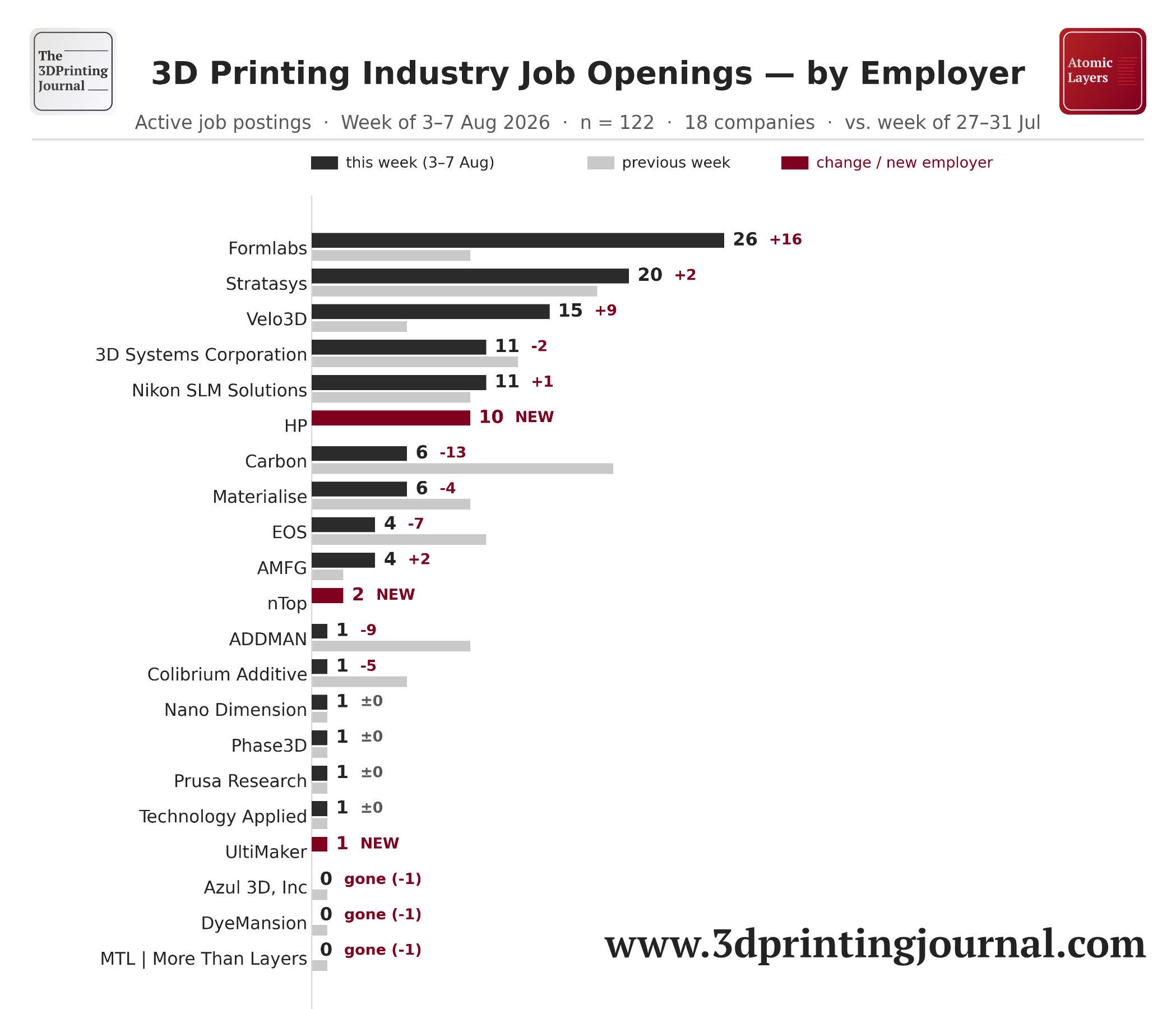
And finally, another week of tracking and analyzing the 3D printing job market.
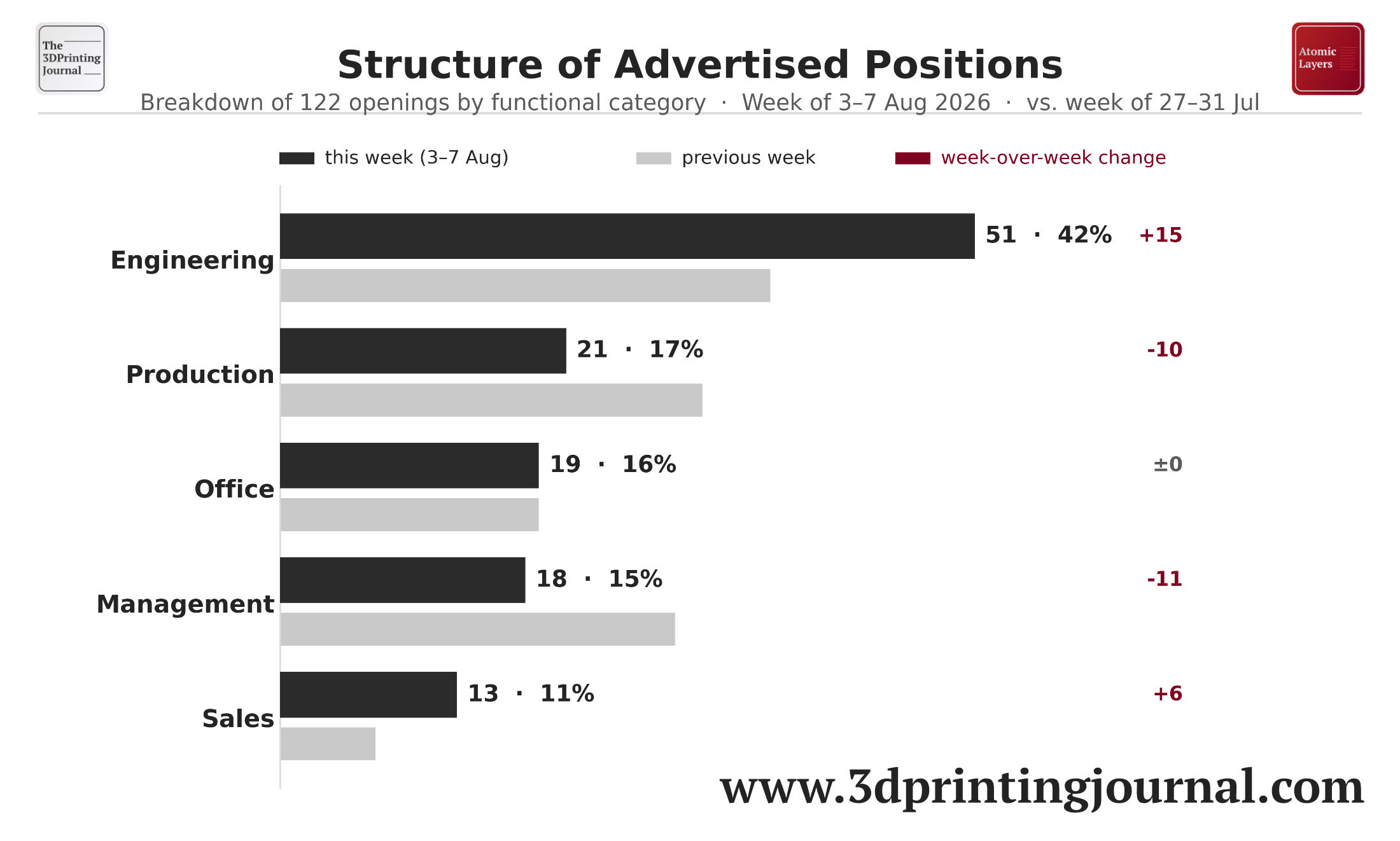
Total hiring held flat at 122 openings, but the underlying mix shifted markedly. Demand pivoted away from operational roles toward technical and commercial ones: Engineering and Sales expanded strongly, while Management and Production both contracted.
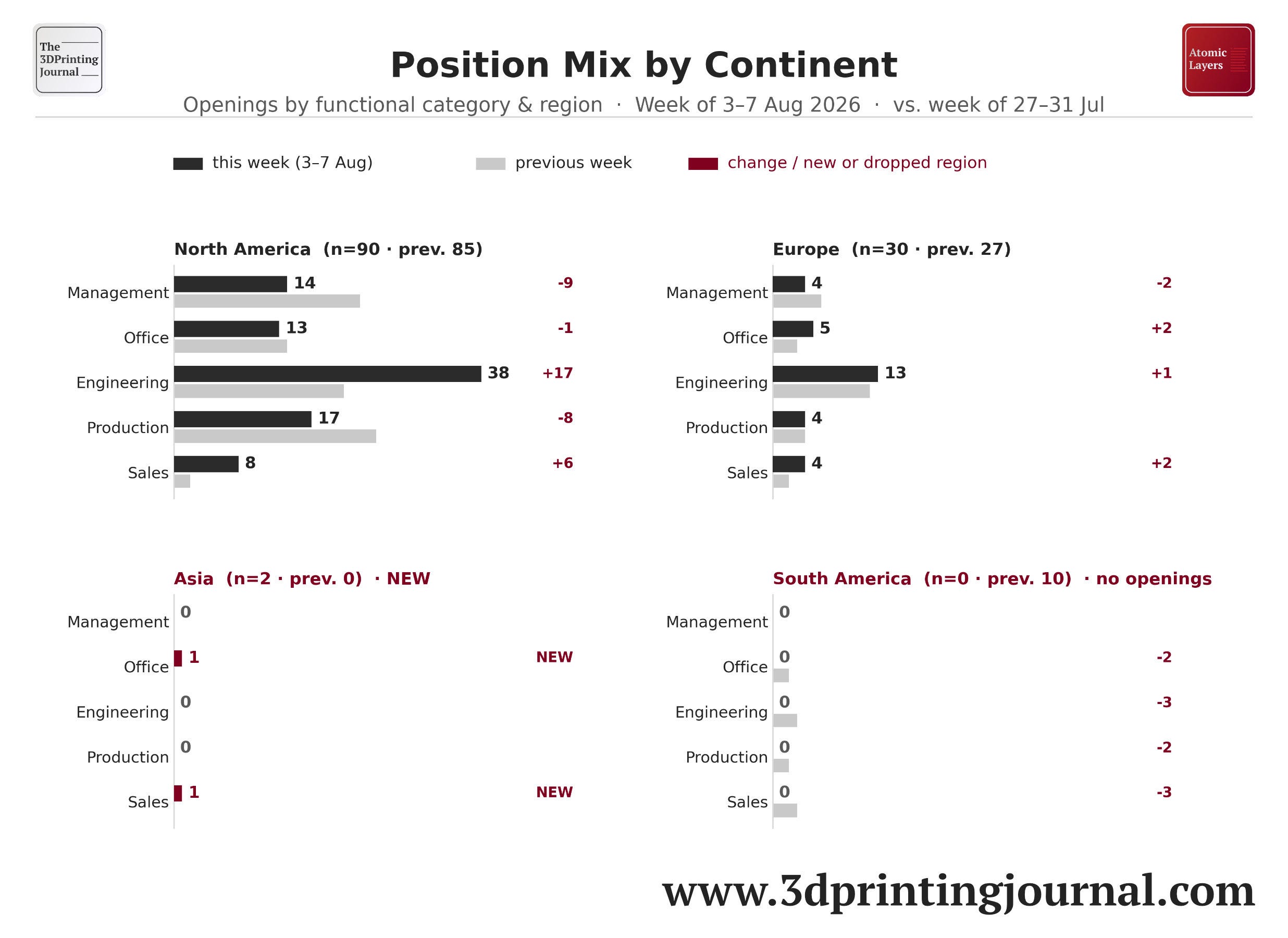
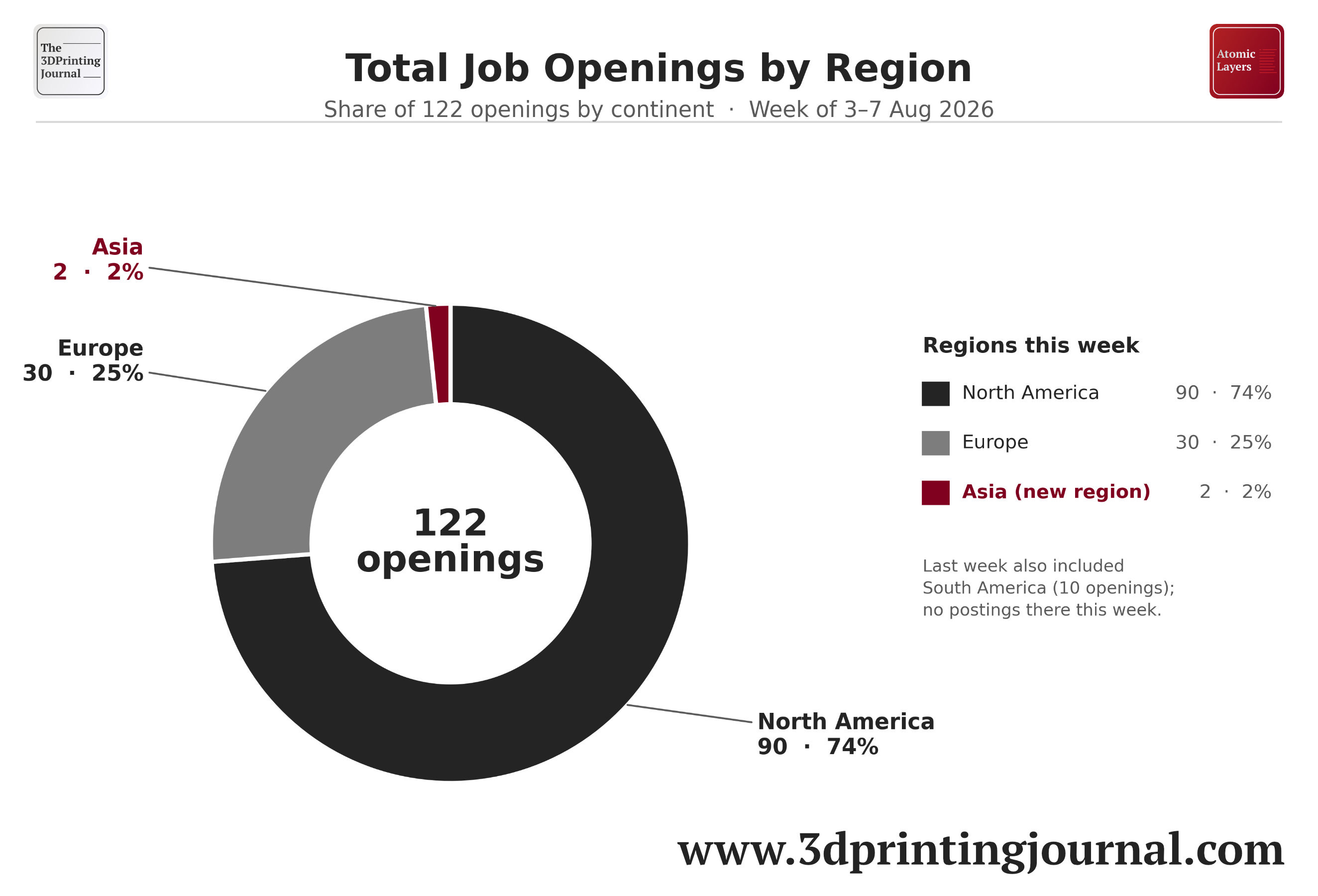
Geographically, hiring stayed heavily concentrated in North America, with Europe steady in second place.
The most notable structural change was regional churn: Asia emerged as a new hiring region, while South America disappeared, reflecting how quickly individual employers can reshape the continental footprint.
Below you’ll find charts based exclusively on data from the past week.
Also, if you are actually looking for a job, visit my LinkedIn group: The AM Restart Hub