

Western Report #3: Stratasys and Velo3D report Q2 results, while Formlabs prepares for an IPO and reshuffles its board
Plus, 3D Systems gets another round of funding from the US Air Force, and Prusa Research adds a “+” to all of its 3D printer models

Europe is still on vacation, so things are a little quieter here than in China (I wrote about that yesterday). But things have gotten interesting in the West, particularly when it comes to finance and the defense sector.
Let’s get started.
Mainstream Report
Stratasys reported Q2 2026 revenue of $137.6 million. That’s flat year over year and up +3.7% quarter over quarter. Consumables hit a record $66.3 million, while sales to the aerospace and defense sector increased by +17%.
The rest of the numbers are mixed. GAAP net loss came in at $16.9 million ($0.19 per share), while non-GAAP net income was $2.3 million ($0.03 per share). Adjusted EBITDA reached $5.3 million. Operating cash flow was negative, at -$18.7 million, although the company attributes this to one-off events and expects positive cash flow in the second half of the year.
Stratasys has $212.5 million in cash and zero debt. The company maintained its full-year guidance, apart from operating cash flow, and reiterated its commitment to the ongoing acquisition of Markforged.
Velo3D has a more interesting story. The company, which not long ago was flirting with bankruptcy, reported $20.7 million in revenue, up 52.3% year over year, and returned to a positive gross margin of 21.5%.
Printer and parts sales grew +57% to $19 million, driven primarily by demand from aerospace and defense. Net loss narrowed to $11.5 million, compared with $13.3 million a year earlier. Cash, following equity offerings, reached $91.1 million, while debt fell by more than 70% to $8.2 million.
New orders totaled $29 million, with a backlog of $31 million. The company announced a new manufacturing campus in Livermore that is expected to triple production capacity, raised its full-year revenue guidance to $65–75 million, and expects positive adjusted EBITDA in the second half of the year.
The same engine we saw at Stratasys is clearly at work here: aerospace and defense are pulling the numbers upward.
3D Systems reported its financial results last week, so this time the more important news is something else. The company received another $9 million from the US Air Force for the next stage of its Large-Format Metal 3D Printer Advanced Technology Demonstrator program, namely the GEN-II DMP-1000 system.
3D Systems has been working on the program since 2023, focusing on large-format, high-temperature metal printing for aerospace-grade applications. Total project funding now stands at $27.4 million, compared with $7.65 million allocated for the same purpose a year ago.
Now for the loudest corporate rumor of the week. Bloomberg reported that Formlabs, the US 3D printer manufacturer, is holding preliminary discussions with advisors about going public. The IPO could raise around $500 million, although the details may still change.
A little context. Formlabs was valued at around $2 billion in its 2021 funding round, led by SoftBank Vision Fund 2. The company has sold more than 130,000 printers, generates more than $250 million in annual revenue, and employs more than 750 people. A company spokesperson declined to comment.
We’ll come back to Formlabs once more in the HR section.
And finally, Paweł asked me to draw your attention to what he calls the “work of a lifetime” by Joris Peels of 3DPrint.com. Joris has put together a huge, extremely detailed comparison of HP and Formlabs technologies, using the HP 1200 and Formlabs X1 machines as examples.
It’s around 5000 words and basically mandatory reading for anyone working with powder-based technologies on a daily basis or considering investing in more MJF or SLS machines.
AM Software Report
CoreTechnologie released 4D_Additive 1.8. The biggest new feature is an editable build history tree, allowing users to go back to earlier steps and modify them without repeating the entire preparation process. The release also adds automatic repair of defective mesh models.
The Advanced Automatic Mode combines repair steps and cleans up meshes with holes, overlaps, or incorrect faces. For metal processes such as LPBF, new reinforcements help reduce thermal deformation in thin-walled components, while expanded lattice-structure tools allow users to control weight and mechanical properties.
Meshy unveiled Meshy 7, a new AI model for turning images into 3D models. The company claims it reproduces input images more accurately than four competing models. It became available on August 10, 2026, although downloading generated models requires a Pro subscription or higher.
For 3D printing, two features are particularly relevant: Auto Split quickly turns a model into watertight, print-ready parts and arranges them on the build plate, while Multicolor 2.0 converts textures into up to 16 colored regions and exports 3MF files.
Slant 3D launched Brick Builder, a free browser-based tool for designing custom Lego-style bricks without any CAD knowledge. Users simply place studs on a 25×25 grid to define the shape and size of the brick.
The tool provides a live 3D preview and immediately calculates the printing price through Slant 3D. The model can be downloaded as an STL file and printed independently, or users can order printing and shipping directly from Slant 3D. The editor includes drawing, erasing, and grid-cleaning tools, and no account is required to download the STL. You can find it at brickmaker.slant3d.com.
And finally, a small, not exactly groundbreaking thing, but potentially useful around the house. MakerWorld released SnapFrames Lite, a generator for 3D-printable photo frames. You enter the dimensions of the frame and your build plate, and the tool automatically splits oversized frames into segments connected with hidden snap-fit joints. It also adds corner clips, mounting holes, and optional stands. Available styles include Classic, 3D-Art, and Floater, in thin, standard, and thick variants, plus adjustable geometry that mimics hickory wood grain.
CEE Report
Prusa Research refreshed its printer lineup and introduced the XL+, CORE One+ Gen 2, and CORE One L+. All three models now come with a new standard nozzle wiper and GT1.5 belts designed to reduce repetitive patterns on print surfaces. The XL+ also gets 360-degree cooling and a faster eddy-current toolhead positioning sensor. The CORE One+ Gen 2 heats up the first layer faster and features a top panel that can be removed without tools.
ROSA PLAST Sp. z o.o., the manufacturer of ROSA 3D filaments, has made it into the Forbes Diamonds ranking for the second year in a row. The ranking recognizes companies with strong financial performance and credibility.
In less than a month, from September 8–11, 2026, MSPO, the International Defence Industry Exhibition, will take place in Kielce, Poland. 3D printing will once again be one of the key topics in discussions around military logistics and the future of the defense industry: spare parts, rapid prototyping, and distributed manufacturing for the military. MSPO is one of the most important defense exhibitions in Europe, bringing together industry, the military, and technology suppliers.
AM HR Corner
Back to Formlabs. The company announced changes to its board of directors and brought in Dan Riccio, an Apple veteran, as a strategic advisor and investor. Riccio, the former Apple Senior Vice President of Hardware Engineering, will advise the company on product development, design, and scaling operations.
The rest of the reshuffle looks like this: co-founder and CEO Maxim Lobovsky is also taking over as chairman of the board, replacing Nathan Linder, who is stepping down after 15 years but will remain as an advisor. Chief Product Officer David Lakatos is joining the board as president. Existing board member Rob Willett is increasing his involvement, while Nadia Shouraboura is taking on the role of lead director.
Wayland Additive has expanded its US sales team with Adam Simons, who will cover the East Coast. Simons brings extensive experience selling AM solutions: he previously served as Head of Sales and Applications for the Americas at ATLIX, Head of 3D Printing for North America at TRUMPF Additive Manufacturing North America, and Sales Manager at CADimensions. The company expects the move to strengthen its commercial presence and technical sales operation across the Atlantic.
Peter Hansford has launched his own consulting firm, Additive Growth Partners Ltd. The company will help AM technology providers, service bureaus, OEM manufacturers, and industrial operations turn technical advantages into actual sales and production deployments. Hansford previously served as Chief Revenue Officer at Wayland Additive and, before that, held leadership roles at 3D Systems, Z Corporation, EnvisionTEC, Prodways, HP, UnionTech, and RPS.
Konstantin Wiplinger has joined Oqton as Senior Application Engineer. He will primarily work with 3DXpert, which covers a broader part of the AM workflow than typical software in this category, as well as AM Vero, which is used to monitor, analyze, and validate build processes and results. He previously worked, among others, at Dyndrite, Divergent, and SLM Solutions.
Juan Gil has joined Hexagon Manufacturing Intelligence as Geomagic Regional Sales Manager for the Western region. He will help customers and partners with design and quality-control tasks, as well as metrology process optimization. He previously worked at Shining 3D and Bombardier.
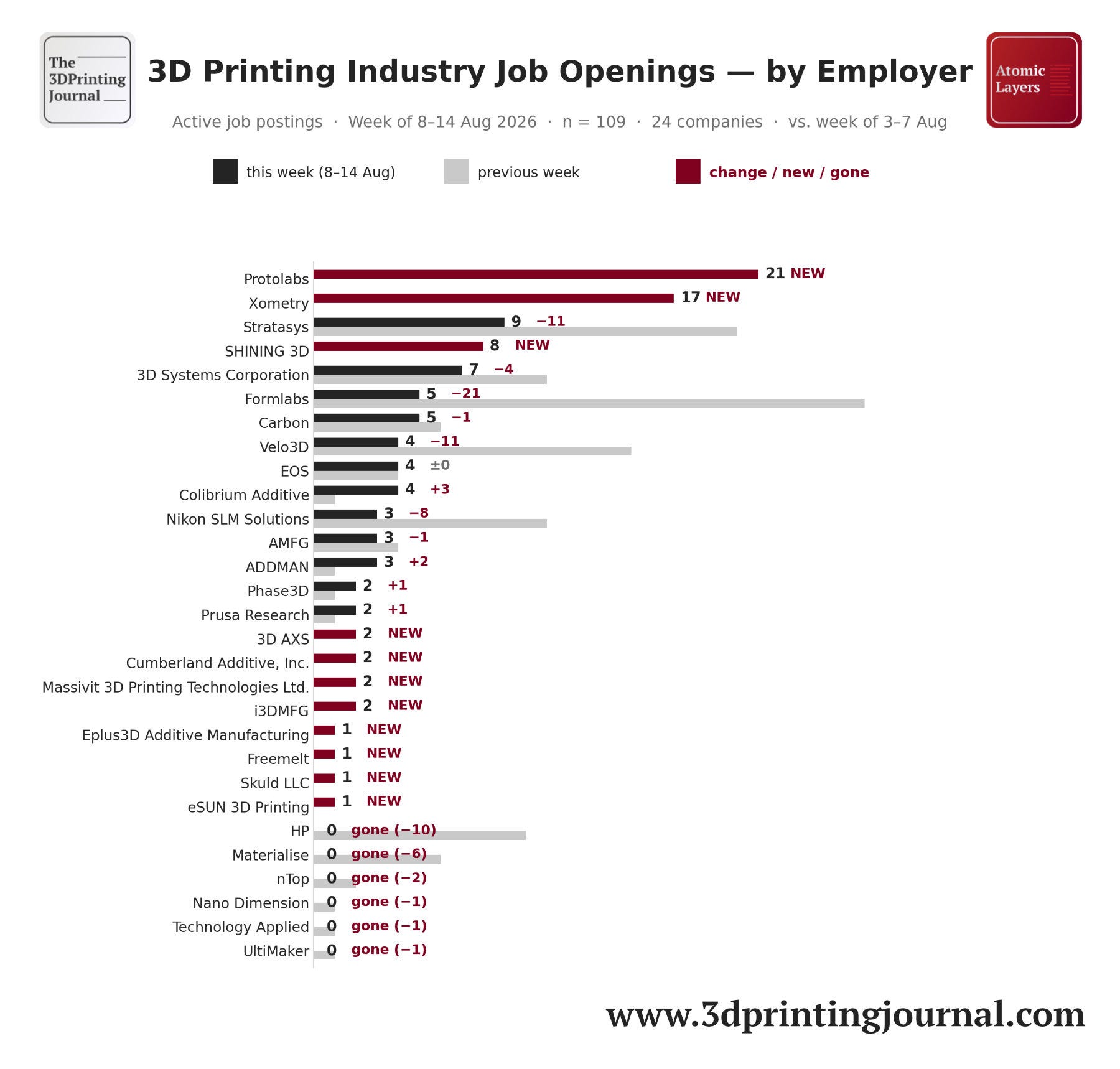
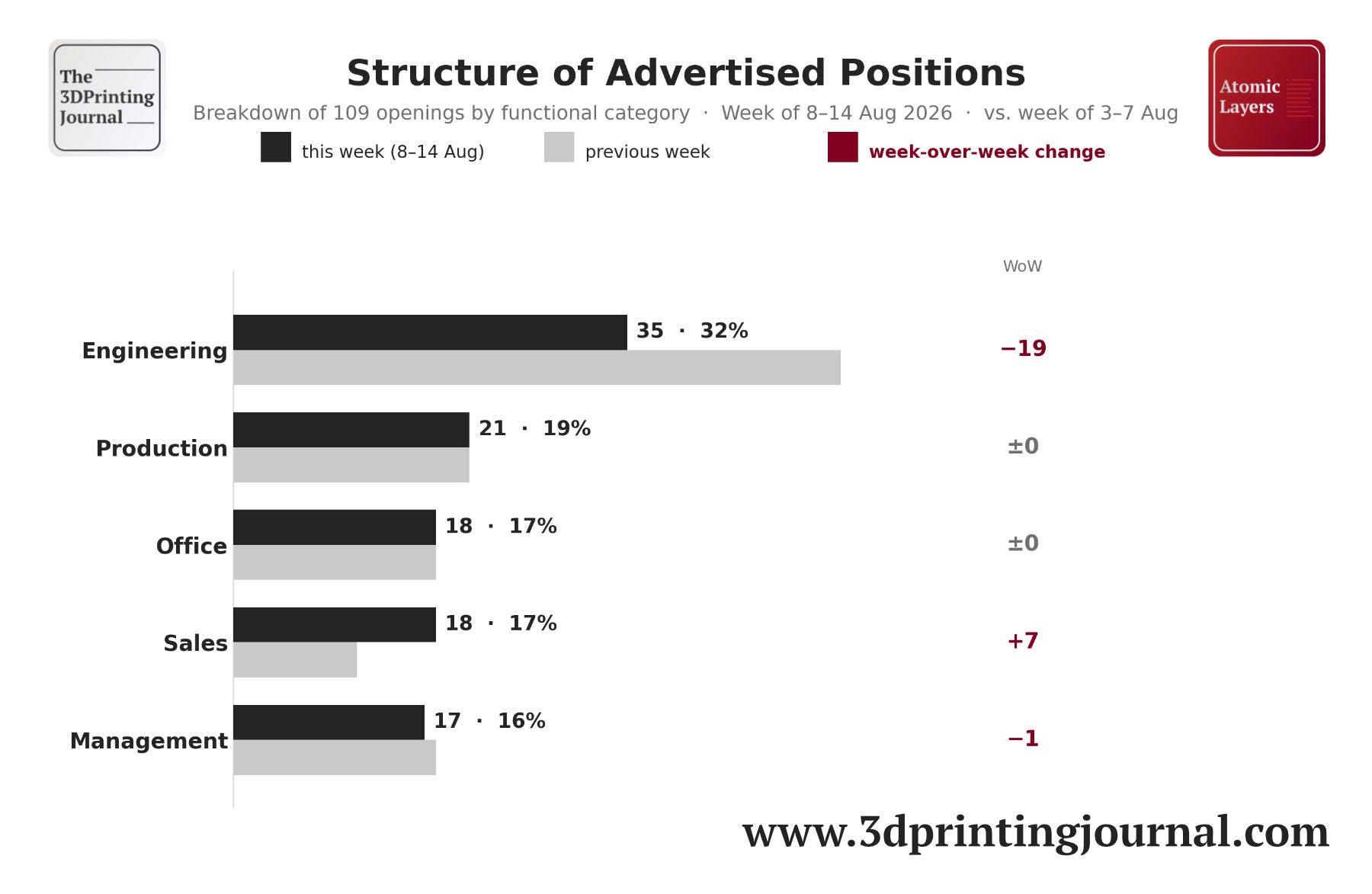
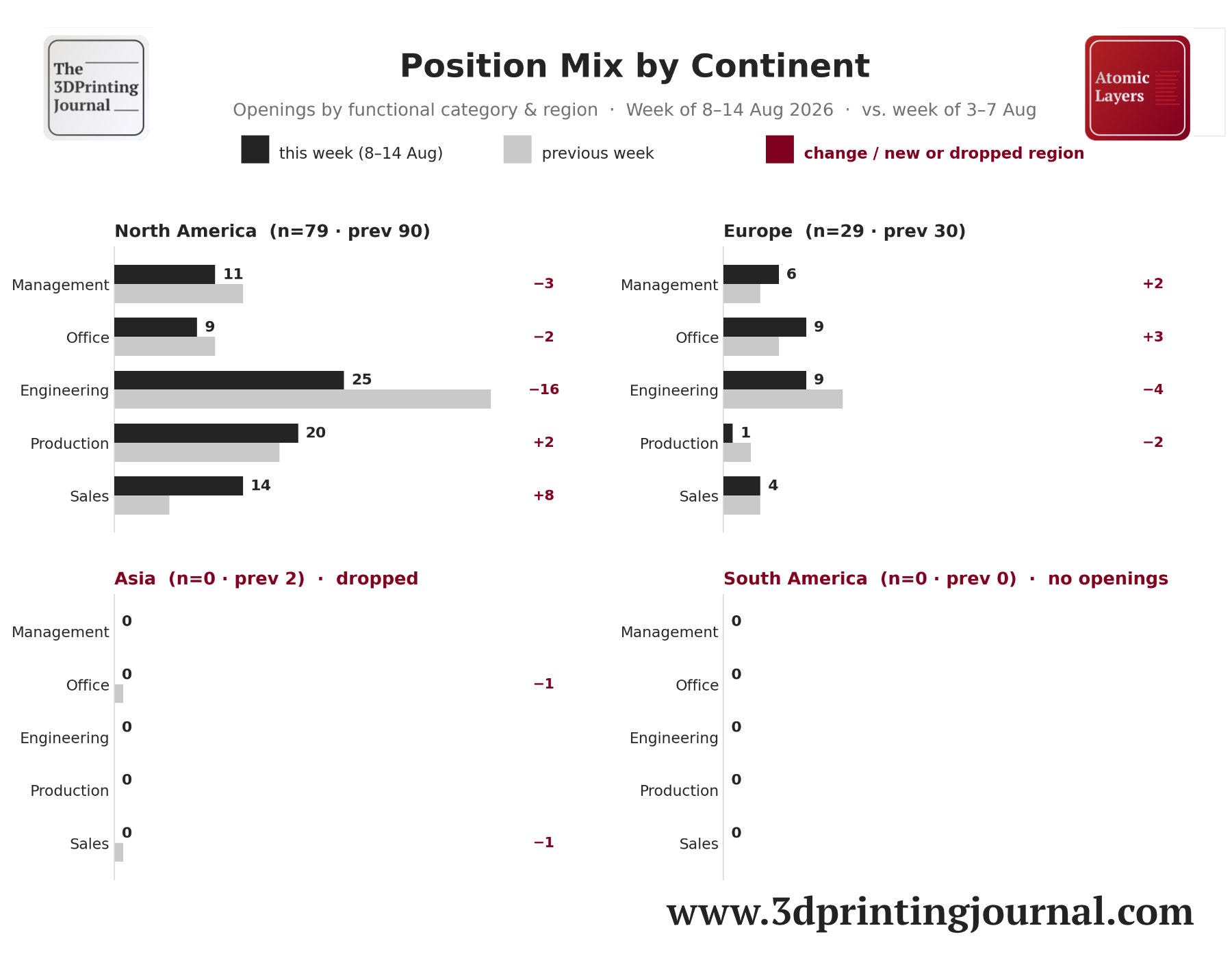
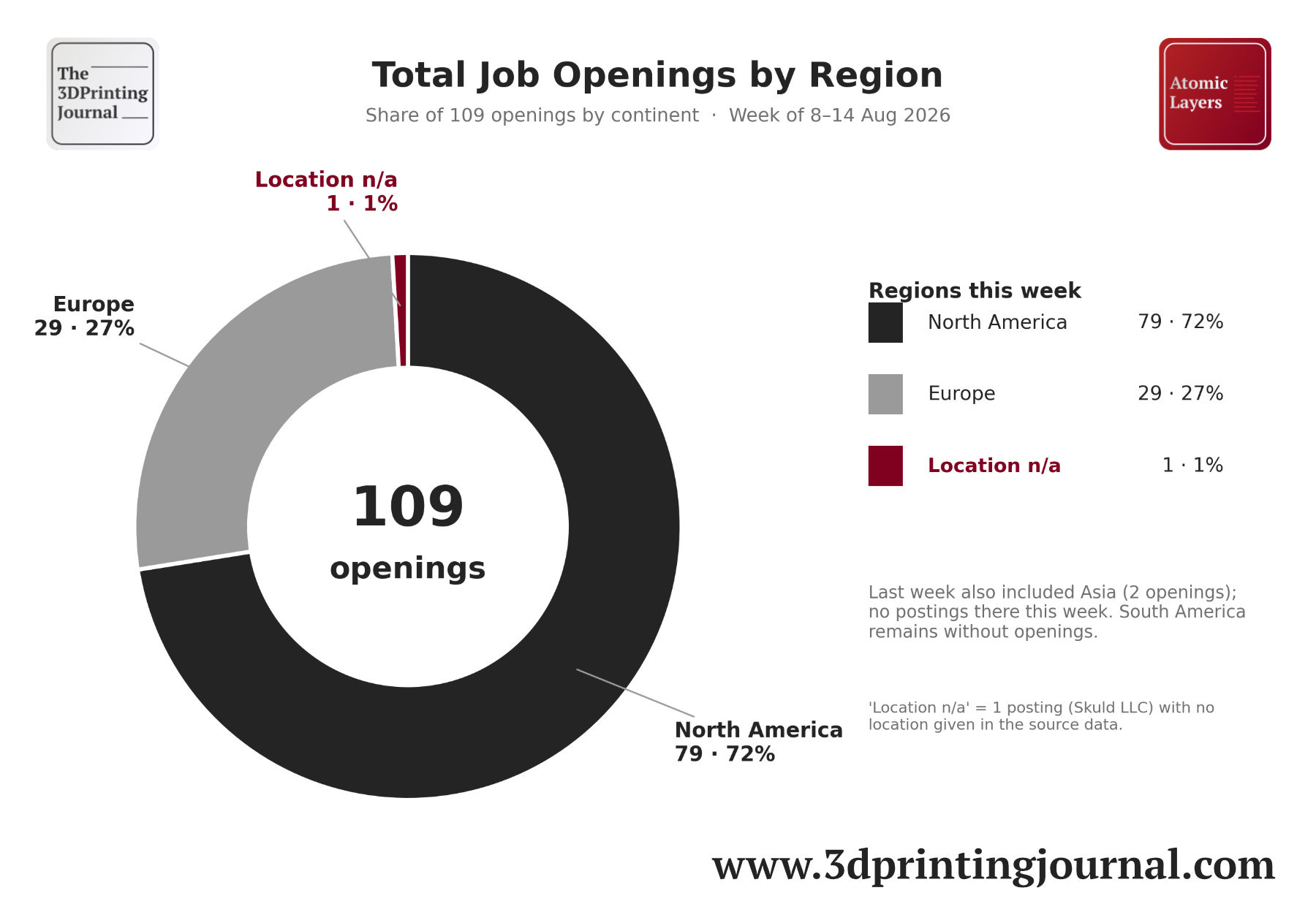
And now, the weekly overview of the AM job market.
Below is a list of job openings that appeared during the second week of August 2026, broken down by company, position, and region.
The database is slowly turning into an interesting resource, and at the end of August I’ll prepare a more comprehensive overview.
Also, if you are actually looking for a job, visit my LinkedIn group: The AM Restart Hub