


Hi, it’s Anna. Today we’ve got a solid batch of news, led by the dispute between 3D Systems and Intrepid Automation: a relatively quiet story, but a really interesting one.
There’s also plenty from the software, industrial and desktop sides of the industry, plus our Polish cherry on top: Zortrax’s latest plans to conquer the universe.
Let’s go!
Mainstream Report
I’ll start with a case that went almost completely under the radar. A California jury has awarded Intrepid Automation $11.6 million in its dispute with 3D Systems, finding that 3D Systems had willfully misappropriated trade secrets.
The conflict grew out of a rivalry between 3D Systems and Intrepid, a company founded by Ben Wynne, a former 3D Systems engineer. Wynne worked on the development of the Figure 4 printer and later created a large-format, multi-projector DLP machine called Range.
According to Wynne’s account, while working on the machine, a 3D Systems employee visited Intrepid under the pretext of discussing a job, signed an NDA, and then passed confidential information back to his former employer. According to Intrepid, that information enabled 3D Systems to launch the PSLA 270 printer at Formnext 2024, which Intrepid has described bluntly as a “brazen knockoff.”
There’s a second layer to the story. It was actually 3D Systems that first sued Intrepid over alleged theft of trade secrets, while Intrepid responded with a patent infringement lawsuit.
The latest verdict closes the trade-secrets chapter: $5.6 million in damages and another $6 million in punitive damages. However, the broader patent dispute surrounding the PSLA 270 is still ongoing. 3D Systems is seeking to have that case dismissed, arguing that Intrepid failed to adequately specify its technical claims.
Staying in the US, there has been an interesting development in the controversial issue of 3D-printed firearms.
Judge Reed O’Connor of the US District Court for the Northern District of Texas struck down an ATF rule that required firearm parts kits that could readily be converted into functional firearms, as well as frames or receivers, to be treated in the same way as complete firearms.
For the 3D printing industry, this is an important development. Several states, including California, Colorado, New York and Washington, have been fighting so-called ghost guns by introducing bans and restrictions that also affect 3D printers.
The judge ruled that the regulation conflicted with the historical tradition of private gunsmithing, while its lack of clarity violated the Due Process Clause of the Fifth Amendment.
The ATF introduced the rule in 2022. From then on, dealers were required to run background checks on anyone purchasing a parts kit that could be assembled into a firearm. The rule also defined what constituted a frame or receiver, specified which components needed serial numbers, and required serial numbers to be added to 3D-printed firearms and other unserialized firearms.
All of this was intended to tackle ghost guns, which are increasingly being used in crimes and are difficult for law enforcement to trace.
From the courtroom, let’s move to Germany. ExOne GmbH and voxeljet GmbH have formally merged into a single entity, now operating as ExOne GmbH, headquartered in Gersthofen.
Existing contracts, NDAs and quotations remain valid, while service, spare-parts deliveries and support continue without interruption. The voxeljet brand will remain with us as a product name for PMMA and HSS technologies.
According to German consulting firm AMPOWER, global revenues from metal and polymer 3D printing machines increased by 41% between 2020 and 2025.
What’s interesting is who captured that growth. Two-thirds of it went to Chinese suppliers, whose share of global revenues jumped from 10% to 26%. US suppliers fell from 51% to 34% and actually lost revenue in absolute terms.
AMPOWER puts it bluntly: competing purely on cost is structurally off-limits to Western suppliers.
Now the Netherlands. Bedrock 3D, a filament manufacturer that emerged from the former BASF-owned Forward AM division, has secured a long-term investment from 819 Capital Partners. The deal follows a management buyout.
The company, which started out as Innofil3D and was one of the pioneers on filament markett, is gaining greater stability.
And finally, a story dedicated to my husband, who as a little boy dreamed of playing basketball like Allen Iverson (he even gave our son Alan as his middle name; yes, seriously).
Reebok has teamed up with Iverson and Zellerfeld to reinvent the classic 1996 Question model. The new Reebok Question 96/26 will debut on August 25, 2026. It is 3D-printed entirely as a single piece using Zellerfeld’s technology and a flexible TPU material.
AM Software Report
Dyndrite is not slowing down. The company has become a project partner in the $5.5 million GOTHAAM program, led by General Atomics Aeronautical Systems and funded by OSD ManTech. The goal is to qualify Scalmalloy, a high-strength scandium-aluminum alloy comparable to 7075-T73, across three classes of LPBF machines, including systems from EOS, Nikon SLM and GE Additive.
Dyndrite’s SASSQUATCH methodology is designed to standardize the process through software control over variables such as laser assignment, toolpaths and scan speed, while demonstrating equivalence between individual machines.
Phase3D has secured a Phase I contract from the Department of the Air Force to adapt its Fringe Inspection technology for ceramic matrix composites (CMCs). CMCs offer high strength at elevated temperatures, low weight and oxidation resistance, making them valuable for propulsion systems, hypersonic technologies and thermal protection systems.
The system creates layer-by-layer 3D maps of surface height and uses them to build a digital twin, allowing anomalies to be detected in real time. The goal is to catch defects closer to the moment they occur, reduce costly scrap and gain a better understanding of the process itself.
Now for something from the desktop world. Bambu Lab has added a semi-automated Assembly Guide feature to Bambu Studio 2.8+, simplifying the creation of assembly instructions for multi-part prints. The tool accepts CAD files in STEP/STP format (not STL), automatically identifies individual components and generates an organized list of assembly steps.
Designers can edit the steps, add notes, labels and arrows, and then export the instructions as a PDF, Markdown file or even an MP4 video.
Hi3D V3.0 platform reaches a resolution of 2048³ voxels, which the company claims is the first commercially available solution at this level and 2.37 times higher than the previous 1536³ standard. It also offers 8K textures, improved cross-view structural inference and proprietary UV completion algorithms.
And to close out this section, there’s a project by chemist Robert Samples, who launched MeltCalc, a free online database providing realistic material-flow estimates for FFF printing.
The tool collects data on maximum flow rates, printing speeds and heating power for 64 hotends and 36 polymers, based on a thermodynamic model derived from polymer chemistry. The database helps determine whether a particular hotend can handle a specific filament at a given speed, and serves as a useful reality check for the optimistic claims often made by manufacturers.
CEE Report
Prusa Research has added six new colors to its Model+ SLA resin lineup: three opaque options (Terra Brown, Brick Red and Classic Red) and three transparent ones (Transparent Red, Green and Amber). The company has also added Prusament TPU 95A in Urban Grey.
Time for our Polish cherry on top. Zortrax has signed a letter of intent with its largest shareholder, Inarius F.R., as well as four private individuals. The goal is to develop a color 3D printer under the working name Zortrax Chroma Labs. The device is intended to deposit material layer by layer with real-time coloring using LPD CMYK technology.
A separate special-purpose company, operating as Chroma Labs, will be established to handle development and commercialization.
As an “interesting” extension to this story, I should add that shortly before this, Zortrax published its quarterly results for 2026. Two figures are particularly intriguing:
H1 2026 revenue = PLN 0.00 (€0.00)
H1 2026 operating loss = PLN -687,844 (~€160k)
For context, sales were handled through Zortrax Stores, a subsidiary that recently filed for bankruptcy.
That’s facts. I’ll leave the conclusions to you.
AM HR Corner
Fernanda Mappa has left Formlabs after seven years. During her time there, she led content around eight major hardware launches, expanded the company’s online presence to 14 countries and ran campaigns focused on applications.
Priscilla Frimpong has left the Geomagic team at Hexagon after four years as a Customer Success Representative, where she was responsible for license renewals and customer acquisition across the EMEA market.
Nicolas Dattola, well known for his activity on LinkedIn, has joined iAM Marketplace as Sales Manager EMEA, responsible for France and several other countries. He will be supplying polymer consumables, including filaments, resins and powders.
Marcus Pettersson has joined Metal Powder Group as Product Manager, leaving Uddeholm after two years.
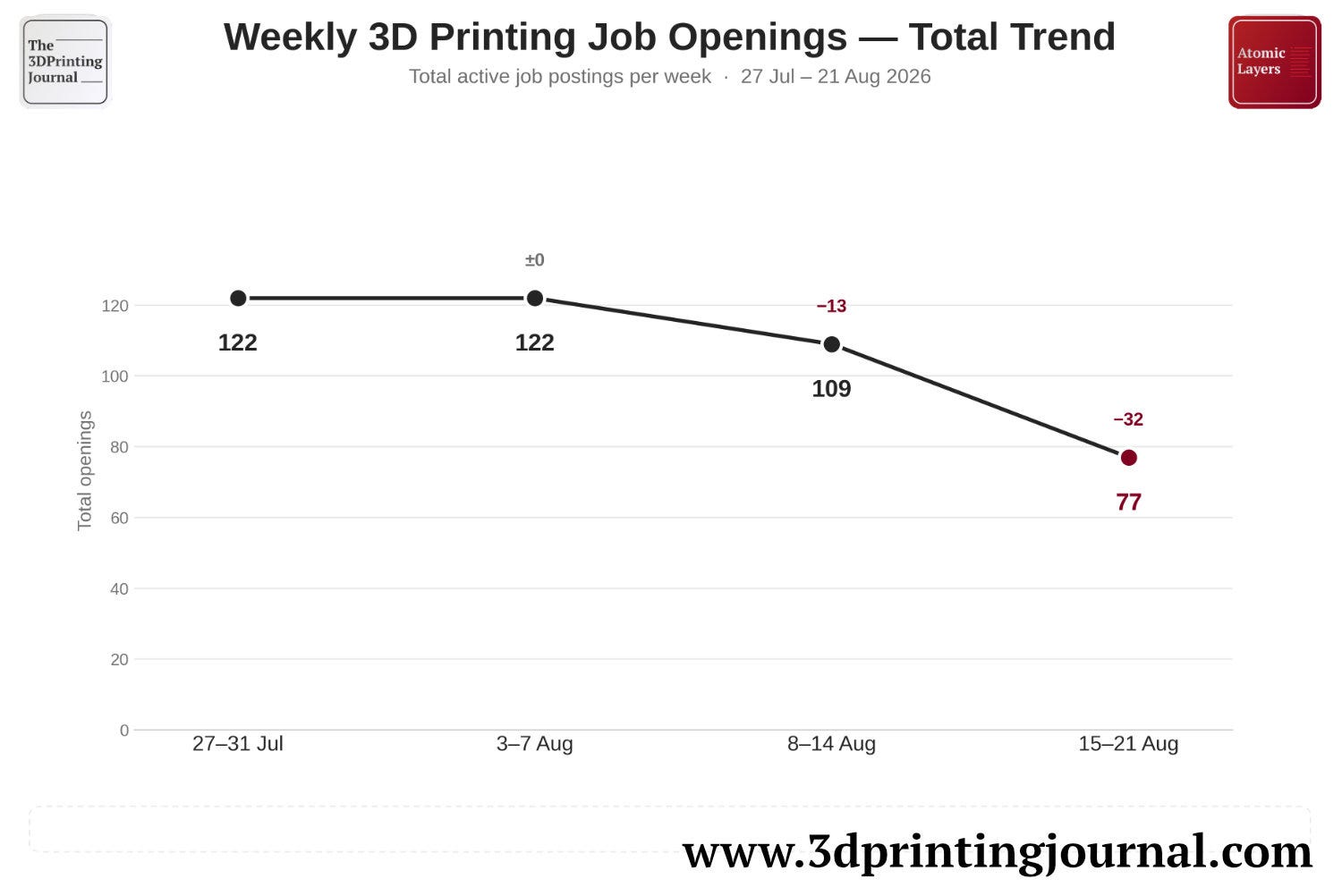
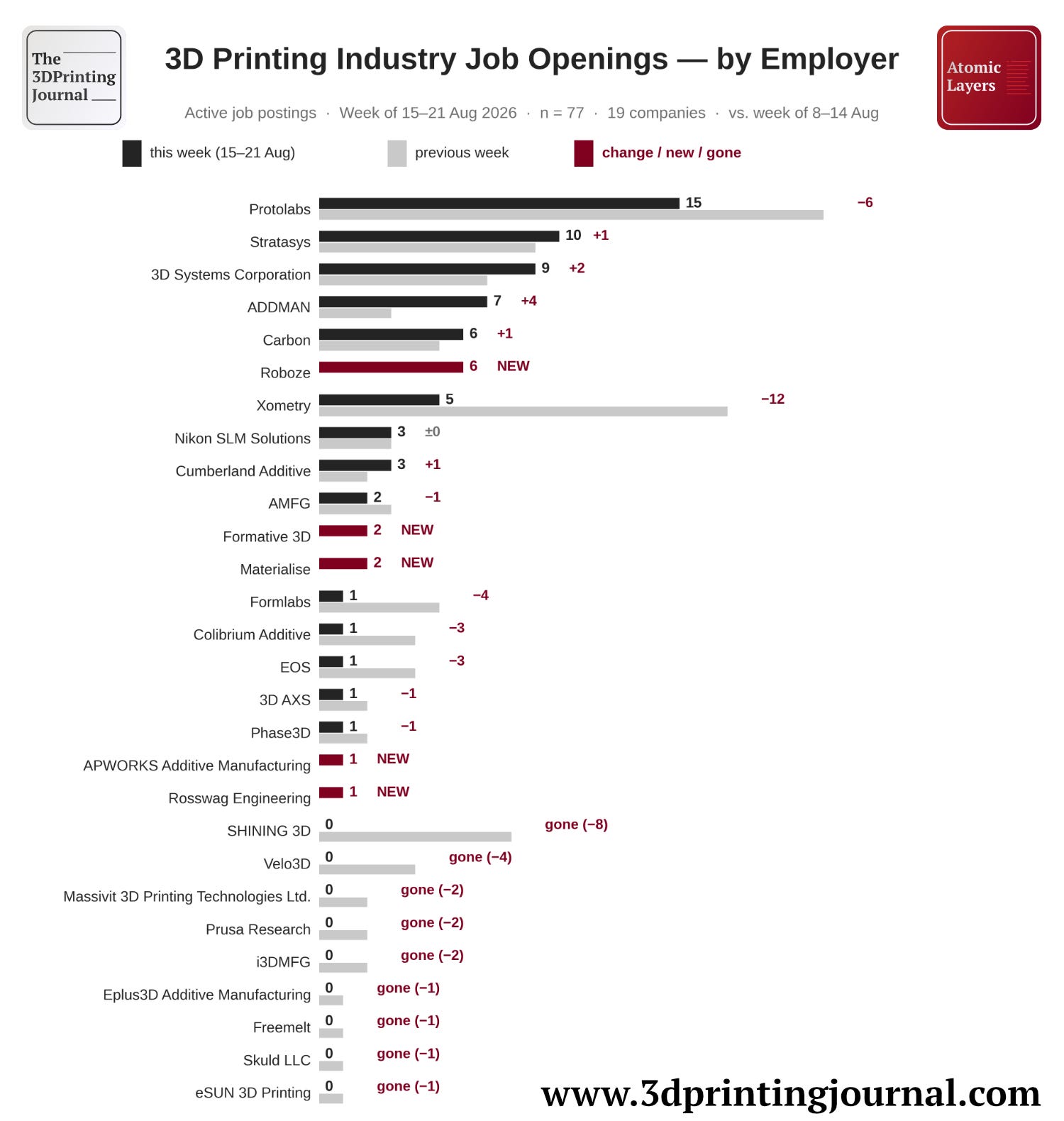
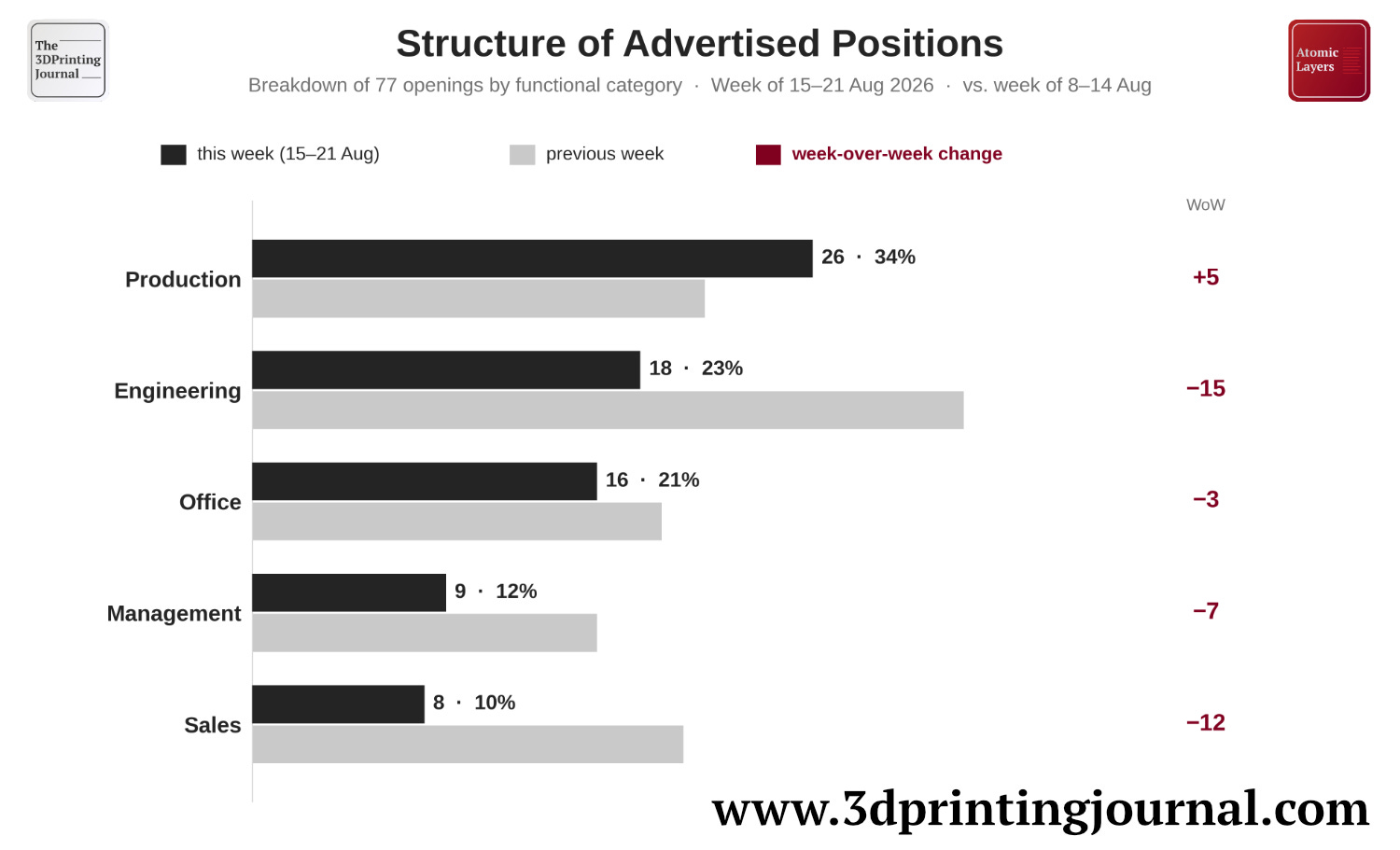
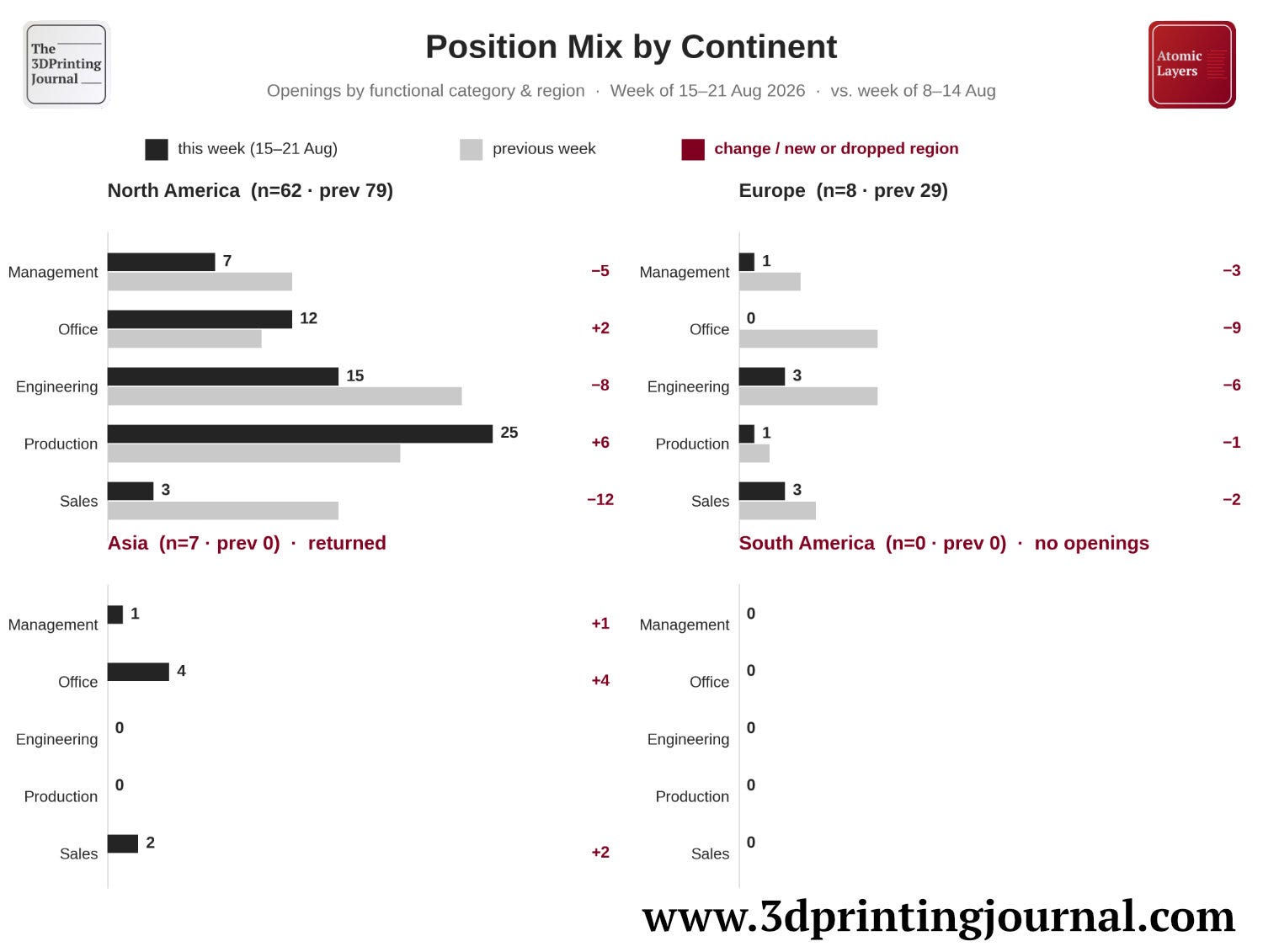
And now, the weekly overview of the AM job market.
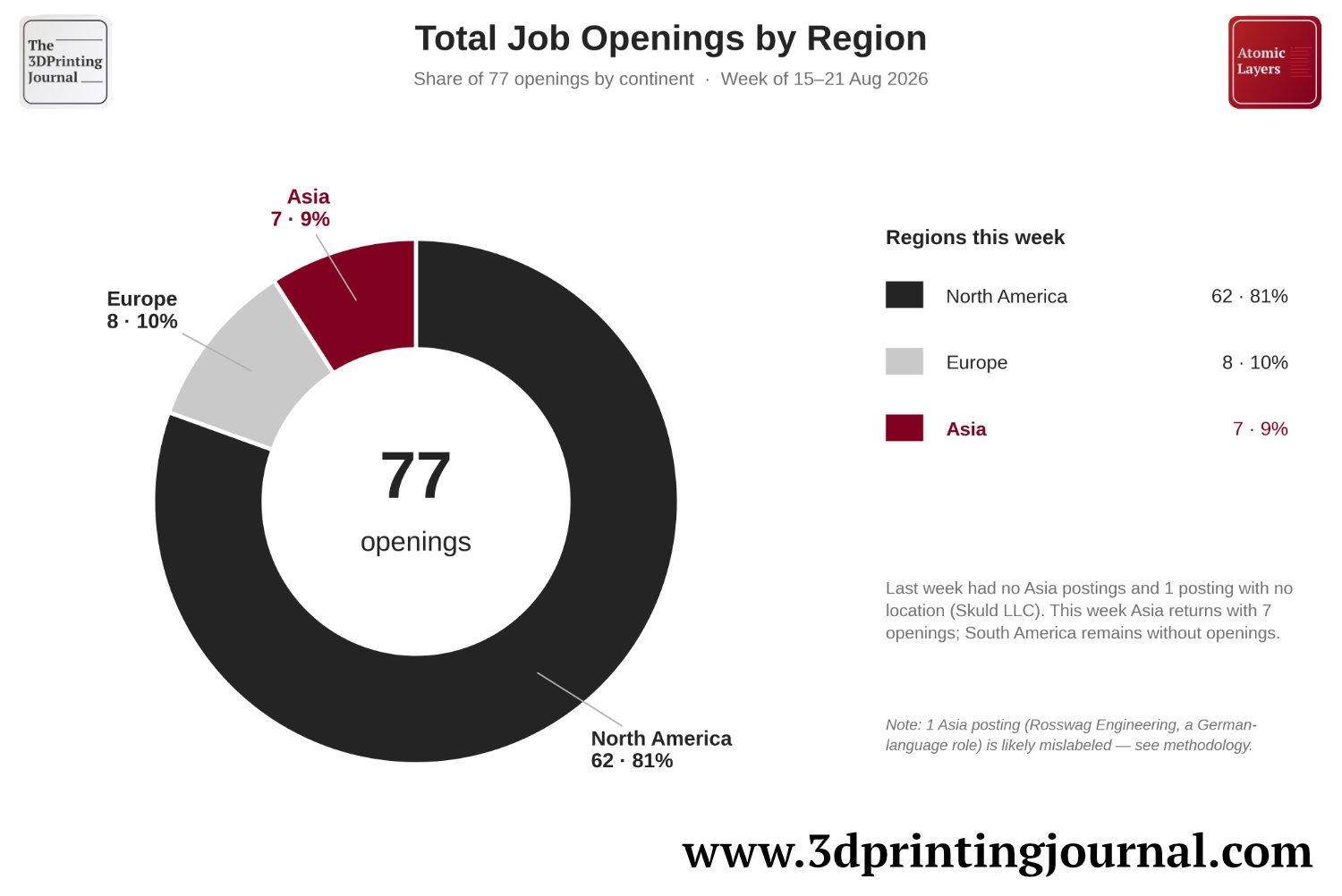
Below is a list of job openings that appeared during the third week of August 2026, broken down by company, position and region.
Also, if you are actually looking for a job, visit my LinkedIn group: The AM Restart Hub