

When you create a technology everyone talks about, but hardly anyone uses
Three reasons Markforged ended up in the hands of Stratasys for next to nothing

How many times have we already seen the same scenario in the AM industry? A brilliant, innovative technology, enormous potential, promises of major disruption and... bankruptcy, collapse, assets acquired for pennies on the dollar. Markforged has just joined that unfortunate and ever-growing list.
This is the 100th episode of 3DP War Journal. One hundred consecutive weeks without a single break 🥳
I could celebrate with a cake, launch fireworks, and write an emotional motivational post about discipline, persistence, and consistency (and you would applaud me and leave heart emojis 🥰😘😍)
But maybe I’ll do that another time. This topic is too good to waste on fireworks and public ego-stroking.
Because man, just look at these numbers...
Nano Dimension sold Markforged to Stratasys for $42.5 million. Less than two years earlier, it had paid $116 million for the company.
Back in 2021, after going public, Markforged was valued at over $2 billion. Revenue in 2025? Seventy million dollars.
The only consolation is that things turned out better than they did with Desktop Metal. Other than that, it’s a disaster.
The whole story is actually funny in a way. It unfolded like a South American soap opera.
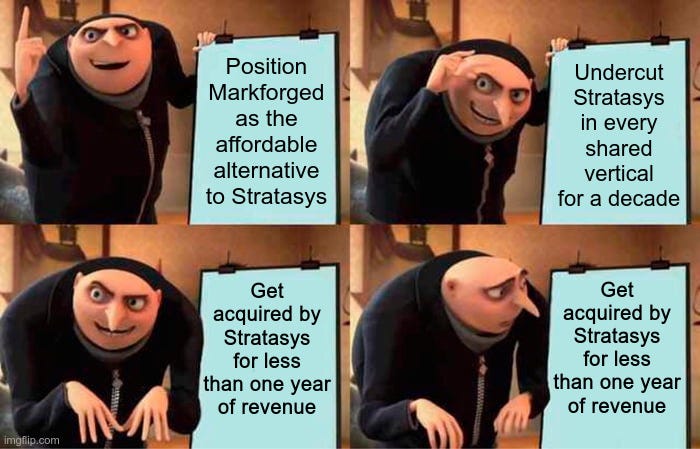
In 2023, everyone was trying to buy everyone else. Nano wanted to launch a hostile takeover of Stratasys and got rejected. Stratasys came close to acquiring Desktop Metal, but shareholders - including Nano itself - stopped the deal. Then Nano went ahead and bought Desktop Metal and added Markforged to the portfolio. Two companies that hated each other.
Now, three years later, Stratasys does not own Desktop Metal, but it does own Markforged, while Nano Dimension is barely hanging on (well, technically it’s alive, but what kind of life is that...)
Overall, my view is that Stratasys scored big this time and seized a once-in-a-lifetime opportunity. Markforged had developed two intriguing technologies - continuous carbon fiber 3D printing (CCF/CFR) and metal filament 3D printing. It had an excellent distribution network. It was the strongest alternative to Stratasys itself. And now it has landed in Stratasys’s hands for next to nothing.
I wrote about it here:

But there’s a completely different story hidden underneath all of this. Well, actually, there are three...
The first is that Markforged invented two genuinely great manufacturing technologies, spent a decade telling the entire industry about them, and never managed to earn enough from them to stand on its own feet.
Continuous carbon fiber printing, followed by metal printing - these were genuinely exciting technologies. Everyone talked about them.
Very few people used them on a daily basis.
(compared to desktop FFF folks, of course)
The second story is that when it was time to invest the money they had raised into growth, scalability, and cost optimization, the company ended up burning cash on lawyers. Not necessarily by choice, but the fact remains.
Markforged wasted a significant amount of money unnecessarily. It was pointless.
And finally, the third story: once the founder left, everything started falling apart.
A classic.
Damn, did Markforged ever really have a chance?
What was under the hood
Markforged was founded in 2013 by Gregory Mark, an MIT engineer who had previously built aerodynamic ballast systems for race cars at Aeromotions. As a result, he knew composites extremely well.
He came up with the idea of automating fiber placement: carbon fiber, fiberglass, Kevlar, and integrating it into a 3D printer.
In January 2014, at SolidWorks World in San Diego, he unveiled the Mark One for $4,999. It was the world’s first printer capable of laying continuous carbon fiber, embedding centimeter-long strands inside nylon. The resulting parts could be stronger than aerospace-grade aluminum.
On a PowerPoint slide, it looked like the end of CNC machining.
Then the company moved into metal.
In 2017, at CES, it introduced ADAM technology. You print using a filament loaded with metal powder and binder, remove the binder, sinter the part in a furnace, and end up with a metal component without needing a laser powder bed fusion machine costing hundreds of thousands of dollars.
Affordable metal manufacturing for anyone with a furnace and a bit of patience.
Both CCF and ADAM worked.
And both promised a revolution that never materialized because each turned out to be too niche to carry that revolution on its own.
Because right next to the promise stood mathematics, ruining the whole party.
Continuous fiber meant expensive materials and long print times.
Metal X meant a furnace and hours of processing, while the finished part still came out inferior to a machined component.
On the other side of the desk sat something cheaper and good enough.
To move from one-off parts to tens of units, a good product is enough. But to move from tens to hundreds or thousands, prices must begin to decline accordingly.
If a perfect 3D-printed part is absurdly expensive, people choose the cheaper option.
The infamous “good enough” principle.
And for most applications, a spool of PA-CF or PETG-CF - a standard filament reinforced with chopped fiber, works perfectly well on a conventional printer at a fraction of the cost.
Yes, it’s weaker. But in most cases, nobody notices the difference.
And when strength and precision truly matter, you go to CNC machining anyway, because it has been delivering those qualities for decades, more cheaply and more reliably.
You cannot conquer the world with a brilliant, innovative technology that is too expensive to compete with a weaker but cheaper alternative.
Markforged built two such technologies simultaneously.
Continuous fiber lost to desktop printing with PETG-CF spools and to CNC machining. Metal X lost to the rest of the workshop.
Both technologies were better. Both were too expensive. And the market, as always, chose “good enough.”
And this is not a problem unique to 3D printing. This is how every manufacturing market works. Paying a premium for a genuine advantage only succeeds where that advantage is truly necessary, and there are always fewer of those situations than investor presentations assume.
Burning cash
It is also worth remembering one uncomfortable fact. Markforged did not invent continuous fiber printing on its own, nor did it hold an uncontested claim to the concept. There was Continuous Composites. There was Anisoprint. And there was that pesky Desktop Metal. Each company took a slightly different path toward the same idea: embedding continuous fiber into a printed structure.
And this is where the second parallel story begins - one that slowly consumed the company from within. Metal X dragged Markforged into a war with Desktop Metal.
Desktop Metal was founded by Ric Fulop, the same investor who provided some of Markforged’s earliest funding in 2013 and sat on its board of directors. He left in 2015, launched his own company, and developed a process strikingly similar to Metal X.
From 2018 onward, the two sides bombarded each other with lawsuits. In the end, the court cleared Markforged of the allegations, but the victory cost years of wasted energy and millions of dollars.
During that time, both companies spent more effort chasing each other than chasing the market. They built patent arsenals while preparing for a metal printing boom that never arrived.
For years, Markforged and Desktop Metal exhausted themselves fighting one another until both began running short of cash.
Then, in 2021, Continuous Composites sued Markforged for patent infringement. One claim survived, the jury sided with Continuous Composites, and Markforged ultimately settled for $25 million, with $18 million due by the end of 2024.
A company that was already laying off employees and moving into a smaller office received that bill at the worst possible moment.
Later, in an attempt to survive, Markforged and Desktop Metal ended up under the same roof at Nano Dimension.
Like two soaked and exhausted dogs sharing the same shelter.
Not long afterward, Desktop Metal entered Chapter 11 bankruptcy proceedings, and now Markforged has been sold to Stratasys.
Now imagine a world where none of this ever happened.
Imagine both companies had spent that money on development, optimization, manufacturing, and lowering costs – literally on anything except lawyers.
Looking back today, tell me: who benefited from all of this besides the lawyers?
What exactly did Markforged or Desktop Metal gain from those isolated courtroom victories?
A fatal change of leadership
And finally, there is one more factor that may, or may not have mattered.
At the end of 2021, just as Markforged was at its peak, Gregory Mark left the company.
Shortly afterward, he founded an AI startup called Backflip, which aims to revolutionize design for 3D printing and 3D scanning.
There is a recurring pattern in the additive manufacturing industry, one that recently became visible again in the Nano Dimension story:
The founder’s paradox

In last week’s article about Nano Dimension selling its proprietary technology for next to nothing to Inspira Technologies, I didn’t mention one fairly important detail: Inspira’s CEO is Dagi Ben-Noon, who was a Nano Dimension co-founder and former COO of the company.
A founder builds a technology. The company grows. Departments appear, funding rounds arrive, and the founder spends more and more time behind the CEO’s desk and less and less time in the laboratory.
Eventually, a crossroads appears.
Either the founder abandons R&D and becomes a full-time executive, or they bring in an experienced manager and return to inventing.
Mark chose a third path.
He left and founded a software startup.
The people who remained were specialists in operations and financial metrics.
On paper, it was a sensible move. By then, Markforged had long outgrown the garage-startup mentality of 2013. In practice, however, a familiar law of the additive manufacturing industry once again came into effect.
Outside executives rarely understand the unique dynamics of the additive manufacturing market, because truly successful CEOs rarely build their careers in 3D printing. As a result, they tend to run these companies according to rules borrowed from other industries.
The outcome is usually the same.
In additive manufacturing, you have to live and breathe the industry every day.
You need to understand that customers buy reliability and cost-effectiveness, not a strength chart from a presentation slide.
You need to know where the real-world value of continuous fiber ends and where the trade-show brochure begins.
The dispute with Continuous Composites, the shrinking workforce, the smaller office, the Nano Dimension acquisition, and the eventual sale to Stratasys - it is impossible to say whether Gregory Mark could have kept the company alive.
What is certain is something else.
After he left, nobody possessed both an inventor’s instinct and a business operator’s touch at the same time.
And in this industry, one rarely works without the other.
And the punch line?
For a decade, Markforged positioned itself as a challenger to Stratasys.
Now, Stratasys bought Markforged for $42.5 million - less than the company generated in revenue during a single year.
Two brilliant manufacturing technologies ended up exactly where good ideas often end up in this industry when they are valued higher than the market is willing to pay for them:
in the hands of a larger player with enough cash and enough patience to wait for the price to fall.
And perhaps that is simply how this industry works.
Markforged leaves behind two manufacturing technologies whose technical value nobody disputes, a distribution network that competitors envied, and a brand recognized by engineers from Boston to Shenzhen.
All of it now belongs to Stratasys for the price of a single funding round.
The technology will survive.
The patents will continue to generate value.
The printers will continue laying fiber.
Metal filament will continue to find its niches.
Only the company that invented it is gone.
And that is how the story ends. With a quiet wire transfer and a new logo on the machine’s enclosure.