

292 colors from 5 filaments 😳
A MakerWorld user has created a swatch book of nearly 300 color blends generated in Bambu Studio. No more need for hundreds of filament colors? Well… not so fast, chief.

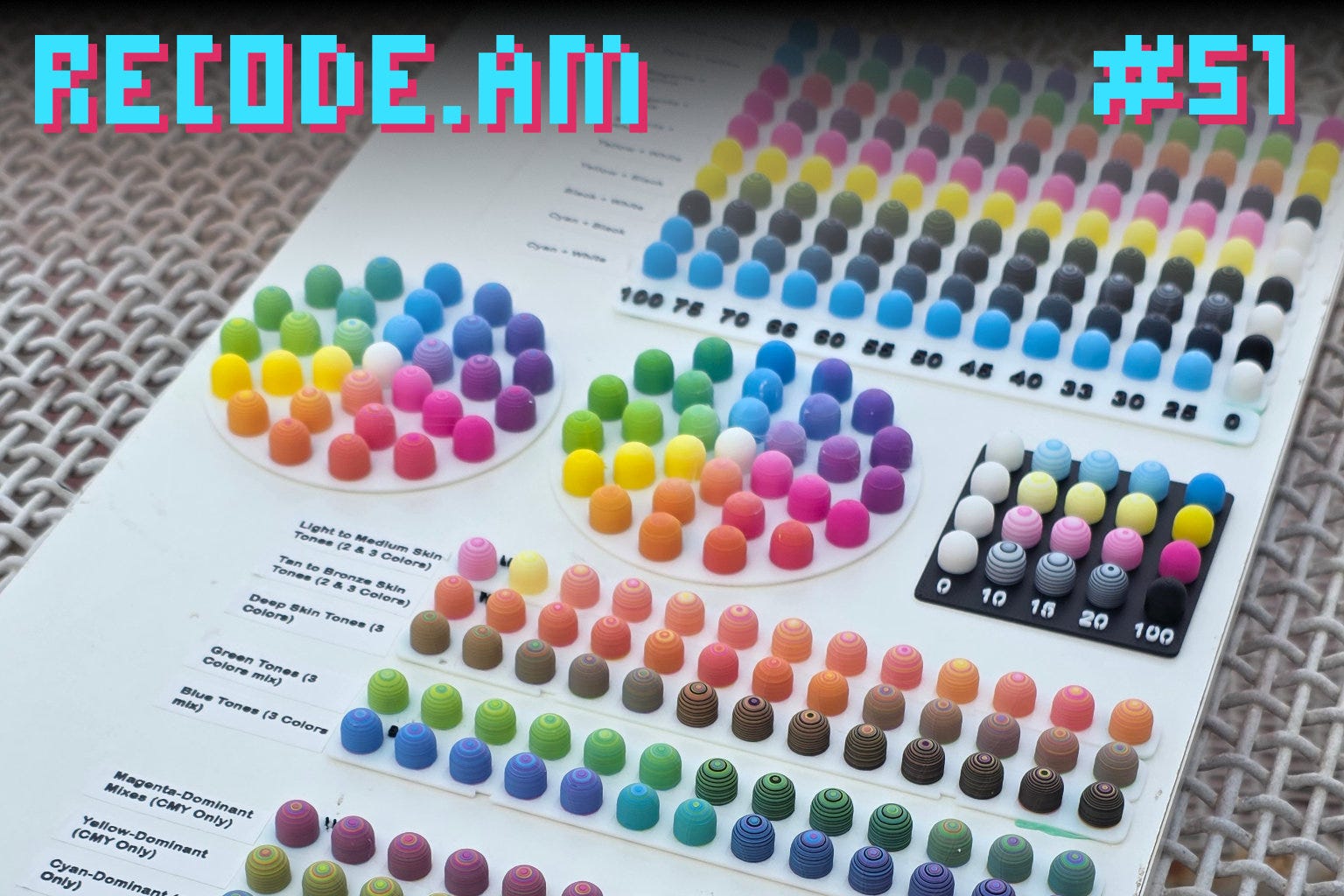
A month ago I wrote about Bambu Lab introducing the Color Mixing feature in Bambu Studio - the ability to mix filaments directly inside the slicer. Now a few words about what the community is actually doing with this feature in practice - and it turns out they are doing quite a lot.
Color Mixing allows users to define a filament in Bambu Studio as a blend of two or three other filaments in specific proportions. Instead of switching between colors, the printer literally mixes them inside a single nozzle - and that blended material is what gets deposited onto the print bed.
The result is a color no manufacturer ever had to produce.
To achieve the best results, it helps to use predefined filament sets inspired by the classic CMYK palette from the printing industry. In the case of Bambu Lab, the company offers sets expanded with white as an additional color (Cyan, Magenta, Yellow, Kontour Black, and White).
To use this feature, you need either an X2D, H2D, or H2C printer equipped with the Vortek system, or two AMS units connected together.
One MakerWorld user - VedicFutura, has probably conducted the most comprehensive tests of this feature so far. The result of that work is a catalog containing exactly 292 unique printable colors.
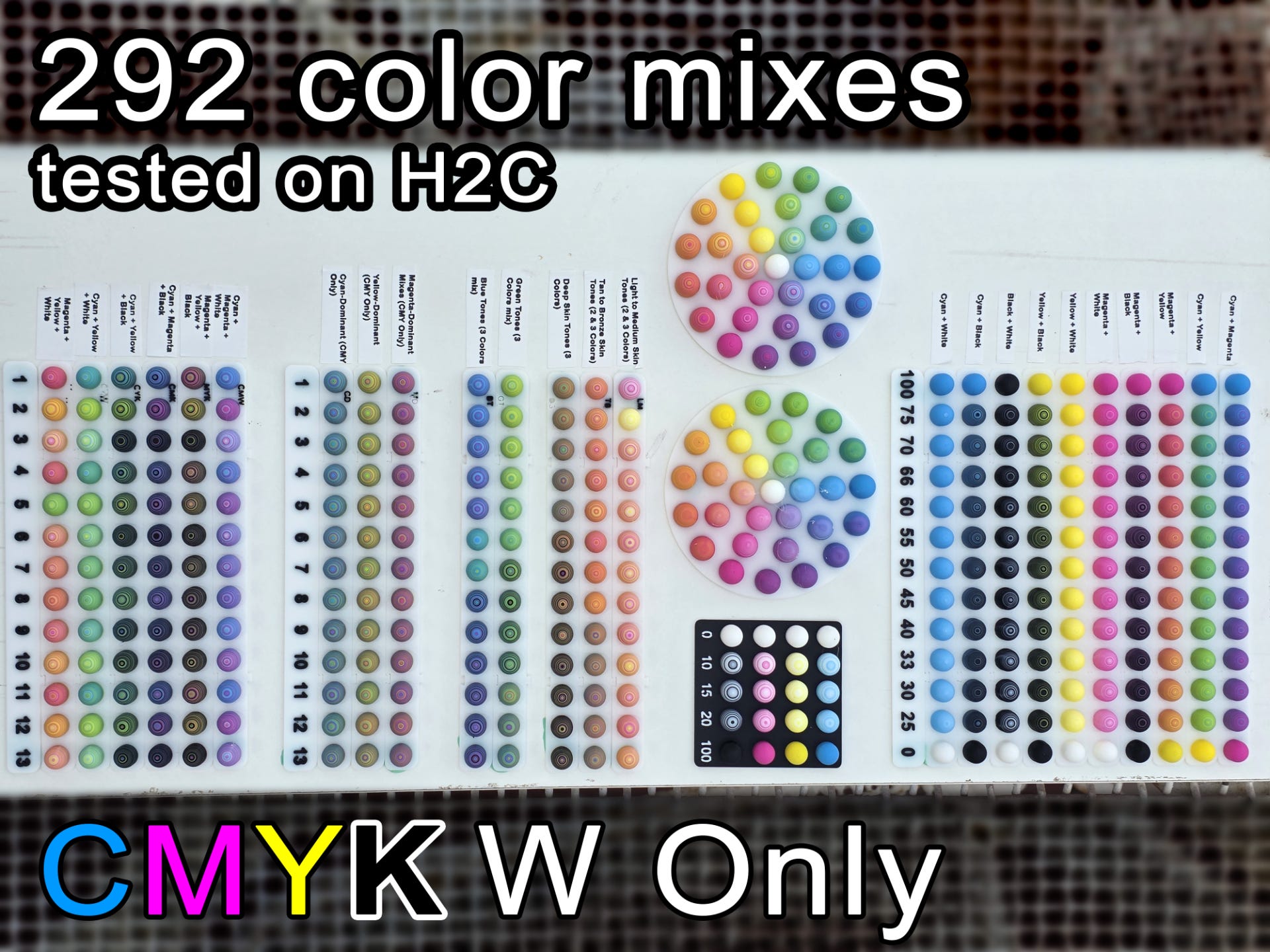
The method was simple, but time-consuming. The author generated blends in groups of a dozen or so per file, printed them on a Bambu Lab H2C at a 0.12 mm layer height, and labeled each swatch with the exact percentage composition of its components.
The color names - and this is something I really liked - were generated using Google’s Gemini. The result? A palette that sounds like something out of a professional paint studio catalog: not “70% magenta, 20% yellow,” but names like warm sienna or dusty coral.
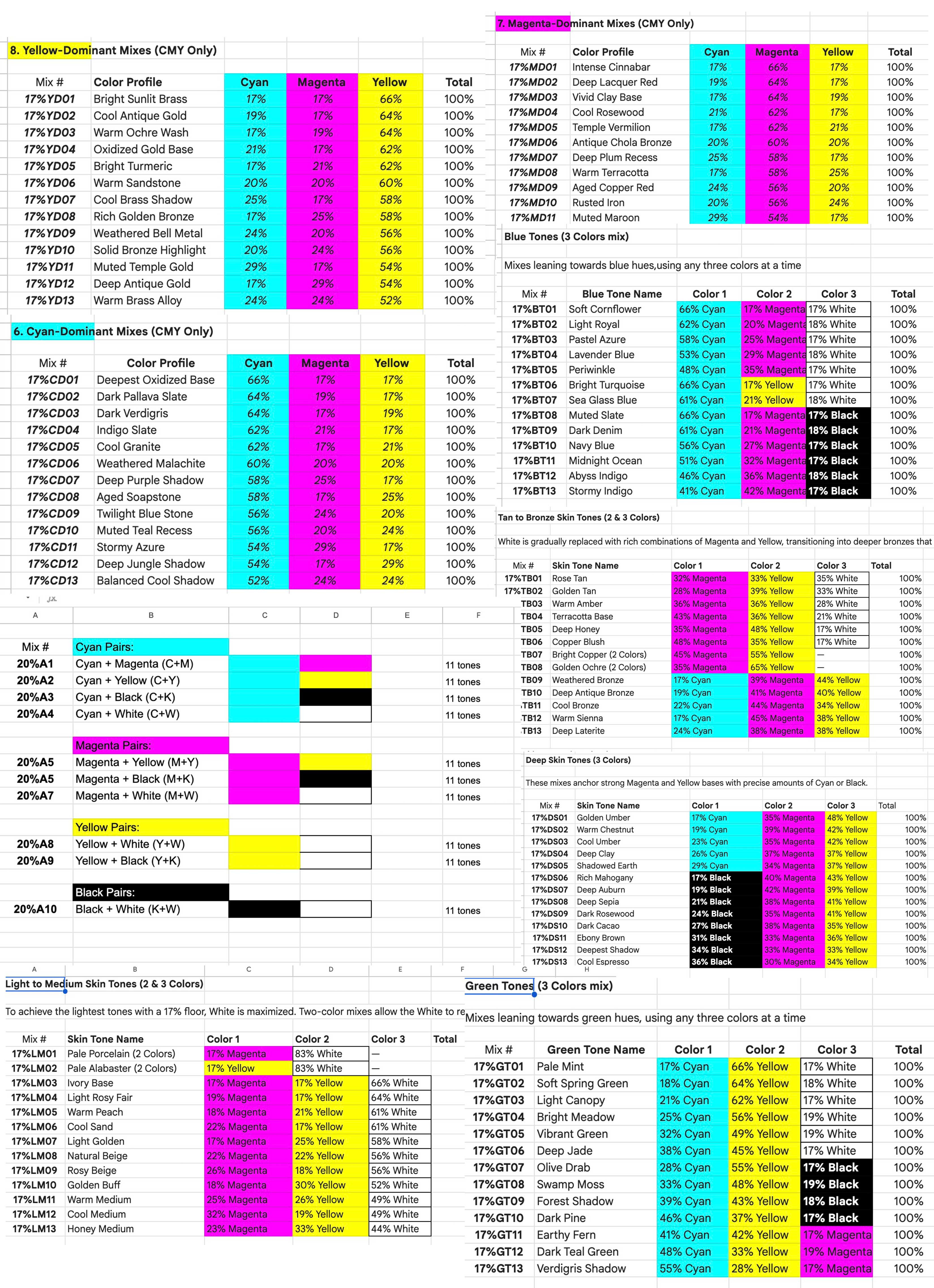
What can you do with it? Print the catalog, hang it next to your printer, and treat it like a paint reference guide.
If you paint 1:6 scale figures and are searching for the right skin tone, instead of guessing you simply grab the swatch book and recreate the formula one-to-one. It sounds simple because it is simple. And that is exactly why it works.
It is also worth pausing on what turned out unexpectedly well in these tests: skin tones. The author himself admits he was surprised - blends of magenta, yellow, and white in different ratios produce an impressively wide spectrum, ranging from light, almost porcelain-like tones to warm browns and deeper, darker shades.
This is an area that has traditionally been problematic in 3D printing - either a plastic-looking beige straight out of the box, or manual painting after printing. Now there is a third option.
That said, not everything is perfect. The author openly points out two things users need to keep in mind.
First, Bambu Studio “lies” in its color preview - what you see on screen does not match what actually comes out of the printer. The screen renders something that looks like a mathematical interpolation, but real filament mixing inside the nozzle behaves differently. Bambu Lab itself mentioned this in the update notes. Without printing a sample, you cannot be certain what result you will get.
Second, many blends show visible banding - stripes caused by uneven color blending between layers. In close-up prints and on flat, uniform surfaces, this can be noticeable. On figures viewed from a distance, however, it is far less of an issue.
There is also a technical limitation worth knowing about: Bambu Studio allows a maximum of 32 colors or blends in a single 3MF file. The author worked around this limit by splitting the catalog into several separate files, each containing 22-26 colors. Slightly inconvenient, but manageable - and still better than having no catalog at all.
Overall, this is quite an interesting direction for desktop FFF 3D printing - especially when you remember what things looked like 10–15 years ago. Back then, this would have been considered a major revolution. Today, it feels more like an obvious development that quietly passes by without much attention.
But it is still intriguing.