

Desktop metal printer for $4,888. PolyJet for under $2,000. Trust, but verify.
Glorious Platinum and HeyGears have revealed their pricing for the first time

Atomic Layer of the Week:
China is driving down the cost of technologies that, for years, have justified their premium primarily through price. The question is whether a desk is really the right place for them?
Last week I wrote that it had been an exceptionally good week for metal 3D printing. I also said we’d wait for more details before drawing conclusions.
Well, the details arrived sooner than I expected - along with the price tags.
Glorious Platinum has unveiled the price of the DP-C1, its “consumer” metal SLM printer: $4,888. Meanwhile, Guangzhou-based HeyGears has opened pre-orders for its G1 series of full-color UV material jetting printers, starting at $1,699, with a Kickstarter launch scheduled for July.
Two launches. One strategy.
China is no longer content with dominating consumer FFF and SLA. It is moving into metal and full-color UV printing - and doing what it always does: driving prices down.
That leaves us with two simple questions:
Can you really build a good metal 3D printer for under $5,000?
And should such a machine be sitting on a desk next to a MacBook Pro?
What exactly do you get for $4,888?
The DP-C1 measures 500 × 515 × 830 mm and features a cylindrical build volume of Ø108 × 100 mm. It is equipped with a single 300 W air-cooled fiber laser and currently supports just one material: stainless steel.
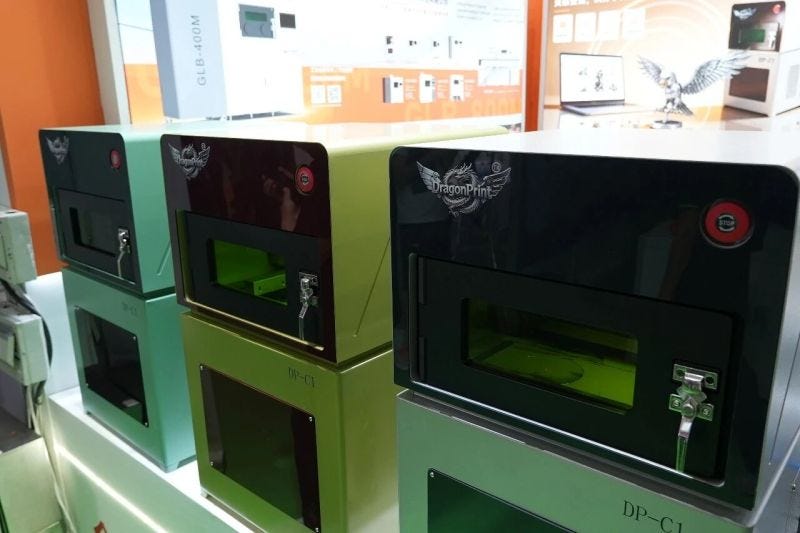
Glorious Platinum was founded in 2023 and claims to have sold more than 1000 machines across 60 countries. The company already offers a desktop metal printer for the dental industry, so I’m not assuming anyone is making things up.
I’d simply like to see what an air-cooled 300 W laser does to stainless steel over the course of a full build.
The $4,888 price tag certainly grabs attention, but there’s an important footnote.
It only applies to export orders of at least 20 units.
In other words, it’s a dealer price and does not include shipping, taxes, or import duties.
The domestic Chinese version - the upgraded DP-C2 - costs around $8,779, with a minimum order quantity of 10 units.
So yes, the “desktop printer” is sold in batches of twenty.
At the same time, the company is following exactly the same playbook we’ve already seen from consumer FFF manufacturers. The hardware is only part of the package. Around it comes AI, a model library, and an online ecosystem. The DP-C1 can generate models from photos, text, and voice prompts, while the IronNova platform includes a library of 10,000 free designs.
So no worries about designs. The problem is that metal printing is difficult for entirely different reasons.
With SLM, the finished part comes out welded to the build plate and buried in metal powder. Someone still has to remove the loose powder, cut away the supports, and often perform stress-relief heat treatment.
And having fine metal powder in a home office is, frankly, an absurd idea for which there is no simple solution.
Anyone with even a basic understanding of metal additive manufacturing knows that the real work begins after the print is finished.
That hasn’t changed.
HeyGears takes a different approach
HeyGears is attacking a different segment - and doing so more sensibly.
The G1 is a full-color UV material jetting printer. Parts come off the platform already in full color, and a single print can combine opaque and transparent elements.
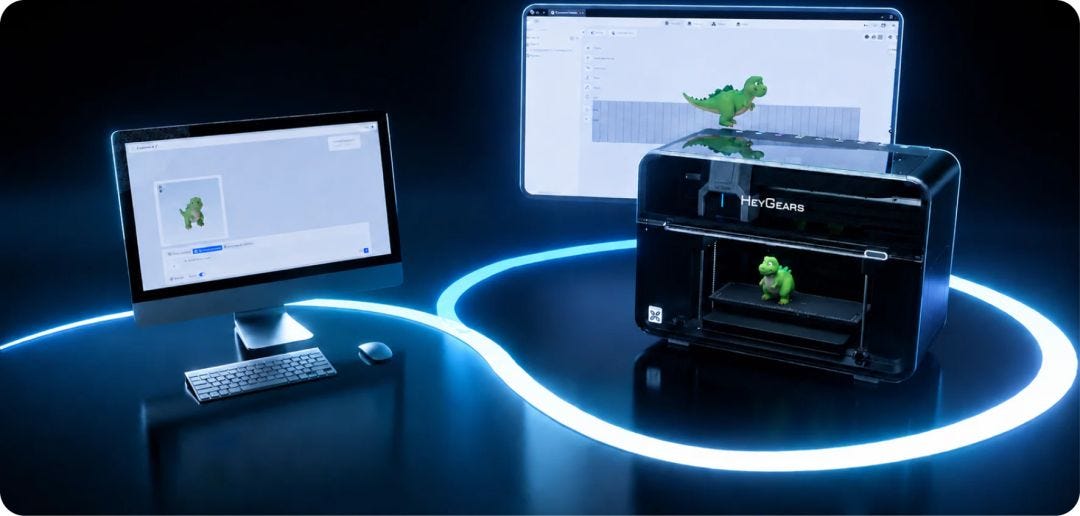
The printer will be offered on Kickstarter. Early bird prices are going to be $1,699, $2,999, and $3,299.
Shipping is scheduled to begin in 2026. For now, customers can reserve a unit with a fully refundable $50 deposit.
Of course, tariffs, taxes, and shipping costs are still unknown.
The G1X version features an Epson i3200 printhead, eight ink channels, support for more than 10 million colors, water-soluble support material, and compatibility with more than 400 substrates, including metal, acrylic, and textiles.
The company is also building the same kind of ecosystem around the machine: HeyVerse software, Blueprint Studio, a library of more than 500 ready-to-use assets, and AI-powered model generation from text and images.
Full-color printing could genuinely be useful for small creative studios, making this launch sound considerably more practical than the idea of a metal printer sitting on your desk.
The more interesting question is who HeyGears actually wants to compete with.
Is it Stratasys and Mimaki? Or is it companies like Anker and EufyMake, whose Kickstarter campaign broke funding records last year?
Of course, the HeyGears G1 is not a 2.5D printer like the EufyMake - it is allegedly true 3D printing platform. But knowing Chinese hardware companies, I wouldn’t even be surprised if they had never heard of “Objet Geometries” 😉
Does any of this make sense?
The pricing certainly does.
China’s cost-reduction machine has finally reached technologies that, for years, defended themselves with premium pricing: metal additive manufacturing and full-color PolyJet-style printing.
The direction is obvious.
The first wave of pricing pressure will hit the segments where every thousand dollars on the invoice matters most - small studios, service bureaus, and the mid-market.
Putting a metal SLM printer on a desk is another story.
At least for now, that sounds much more like clickbait than a sensible solution.
Atomic Layer from the Past:
13 years ago, Microsoft announced native 3D printer support in Windows 8.1, enabling direct printing from third-party apps via a simple “print” command. A demo showed a vase printed on a Makerbot Replicator 2 without extra drivers.
Microsoft partnered with Makerbot, 3D Systems, Formlabs, Autodesk, and Netfabb. The Type A Machines Series 1 became the first open-source printer with direct support, followed by Fabbster and UP! 3D.
Although the initiative ultimately faded, it sparked two key developments: the 3MF file format (to replace .STL) and the 3D Builder app, later succeeded by Paint 3D.
Read all:

News & Gossip:
#1
Congratulations to Jigar Patel from the University of Waterloo, who took first place for best oral presentation at HI-AM 2026. The topic: vector-level toolpath optimization for tighter LPBF process control.
Sounds dry, matters a lot.
A warm nod to Dyndrite too, because the work was built on Dyndrite LPBF Pro, and the Dyndrite team fielded all 124,534 of his questions without flinching. Climbing that learning curve clearly paid off. Nicely done.
#2
ExOne is back with the S-Print Pro, a compact sand binder jetting system aimed at the small foundries and pattern shops that everyone else skips.
Under 12m2 of floor space, a 1200 x 750 x 500 mm build box, 400 dpi CoreBoost printhead, and a full job box per shift. The pitch is affordable to buy, install, and run, which is exactly what small shops have been asking for.
Worth noting this is the first real product since the ExOne and voxeljet merger, so it carries some weight. Deliveries start in the second half of 2026, beta partners first. We will wait for the parts.
#3
Phase3D, a Chicago metrology outfit, just closed a $2.9 million oversubscribed round led by Quest Venture Partners.
Its product, Fringe Inspection, uses structured-light metrology to capture layer-by-layer height data during metal powder bed fusion, so you can catch recoater issues, spatter, and powder bed problems while the build is happening, not after you cut it open.
The money goes to manufacturing capacity and more deployments. This is the unglamorous software-and-inspection layer that metal AM actually needs to grow up. Small round, sensible direction.
#4
Dr. Dieter Schwarze, co-inventor of Selective Laser Melting and Chief Engineer at Nikon SLM Solutions, has retired after a career spanning more than 40 years.
He had a hand in every generation of the company’s technology and holds over 100 patents, which is the kind of number that quietly underwrites a whole industry.
Roughly 30 years ago he helped turn SLM from a concept into something foundries and aerospace shops now treat as routine. The company sent him off with a guard of honour and a 3D printed trophy, which feels exactly right.
#Respect 🙏
#5
TPM, the South Carolina solutions provider (not the Chinese TPM3D who manufactures SLS 3D printers), has sold its HP 3D printing and Advanced Manufacturing division to Master Graphics, an HP-only specialist.
All contracts and service relationships move over, and the account manager goes with them. TPM frames it as sharpening focus, keeping its 3D Systems, Artec, and SOLIDWORKS lines.
#6
And finally, a hint at a bigger story still developing. Two prominent Würth Additive figures have announced they are looking for new jobs, while letting you read between the lines that the company itself is done. Nobody, however, wants to confirm any of this on the record yet. So for now it sits somewhere between rumor and an unconfirmed fact. Keep watching.