

The metal 3D printing industry is afraid of its own shadow, and pays millions for it
The certification costs more than the machine, and (almost) nobody wants to talk about it

In metal 3D printing, you can spend two million dollars on a machine and another few thousand on powder. But in the end, the most expensive thing will still be something else: proof that the finished part is fit to fly.
Qualifying a single part can cost more than the machine it was printed on. Then there is the time. Three to five years before someone is willing to sign off on putting that printed component inside an engine or an airframe.
So the question is not when metal 3D printing will become widely adopted across manufacturing.
The question is whether the industry will collapse under the weight of its own bills first.
During a webinar organized by 3D Printing Industry, Harshil Goel, founder and CEO of Dyndrite, described the situation in one word: „insane”. And he wasn’t throwing the word around for effect. He used it because that is what the data from six months of work on the shop floor says.
The core issue is something that has been overlooked for years: the cost of qualification does not come from physics. It comes from a lack of trust in the machine. And trust, unlike a CT scan, can be measured.
Someone has just started measuring it.
Qualification is now the most expensive element of the entire metal AM production chain. More expensive than the machine. More expensive than the entire powder charge. And there is one reason for the price: nobody fully knows what will come out of the machine, so everyone pays to make sure.
Where the bill comes from
Lack of trust creates fear, and fear creates invoices.
When you are not sure what you are going to produce, you hedge your bets. You CT-scan every part. You simulate everything that can possibly be simulated. Each of these activities becomes another line on the bill, and each one exists to cover the same gap: nobody trusts the process.
You can see it most clearly in the absurdities. Thin-walled pressure vessels are qualified using ordinary mechanical test specimens, as if a specimen printed next to the actual part could tell you anything about its real-world geometry.
Goel puts it bluntly - this approach “masks the problem in favor of some kind of bureaucratic standard.”
There is a simple test that exposes the absurdity. If we subjected castings and forgings to the same level of scrutiny as additive manufacturing, not a single part would be flying today. We have been making them for centuries without CT-scanning every single piece. Only AM is treated as if every time is the first time.
Why now?
For thirty years, metal 3D printing machines were black boxes. You couldn’t control the parameters, so cautious, statistical qualification made sense. If you don’t know what is happening inside, you hedge against the unknown with assumptions. That condition has just stopped being true.
The machines have opened up. EOS, after years of having a reputation for closed systems, has decided to become the most open LPBF platform on the market. SLM, now under Nikon, has done the same. And American machines have become the most controllable they have ever been over the past six months.
Then came the software that actually makes use of that openness, because openness without a tool is just a dead entry in a specification sheet.
There is an analogy here that should end the discussion. Welding.
LPBF is essentially micro-welding, and welding engineering solved the problem of variable process parameters decades ago. You define and control the entire acceptance window within which the parameters are allowed to vary.
Goel talks about this with a noticeable degree of disbelief:
“Laser powder bed is a micro-welding operation, so why we aren’t simply copying what welding figured out a long time ago”.
The proof
You define the window in which you are allowed to operate. As long as you stay inside it, you don’t have to qualify everything from scratch.
That is the foundation of two Dyndrite programs.
The first, AI for AM, carried out under America Makes and won by Dyndrite, asks whether it is possible to generate a statistically meaningful set of allowable values without building a complete, prohibitively expensive database.
A minimal set of prints, reasonable confidence, and the rest from mathematics.
The second, SASSQUATCH (Software Adapted Scan Strategy Qualification Assisting Thermal Control and Homogeneity), is a framework for defining the boundaries of the process window. Inside that window, you can change the parameters as much as you like. A qualification process that could cost up to three million dollars and take five years effectively drops to zero - as long as you stay inside the window.
The method starts with fundamental equations, standing on the shoulders of people such as Jesse Boyer and Mark Shaw. Process windows are generated in dimensionless space, producing a new set of KPVs fully compatible with AMS 7003 and NASA 6030. There are correction equations for temperature, cooling rate and geometry. The entire process is automated, transparent and traceable from beginning to end.

But the best proof is not the equations. It is six months in the life of Ursa Major.
October: repeatable test specimens at a 30-degree angle, printed on five different machines: SLM 280, Renishaw 500Q, EOS M400, EOS M290 Flex and Velo3D Sapphire, without accounting for laser power and without distinguishing between materials.
February: 20-degree overhangs with significantly better microstructure, without simulation, using a hard recoater that would simply jam at the slightest real distortion.

Then came smooth downskins on 20-degree specimens, 9-inch domes, support-free printing, two to three times faster.
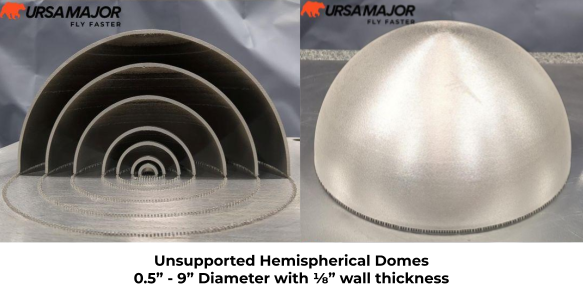
Look at the images from those machines and you won’t be able to tell one print from another.
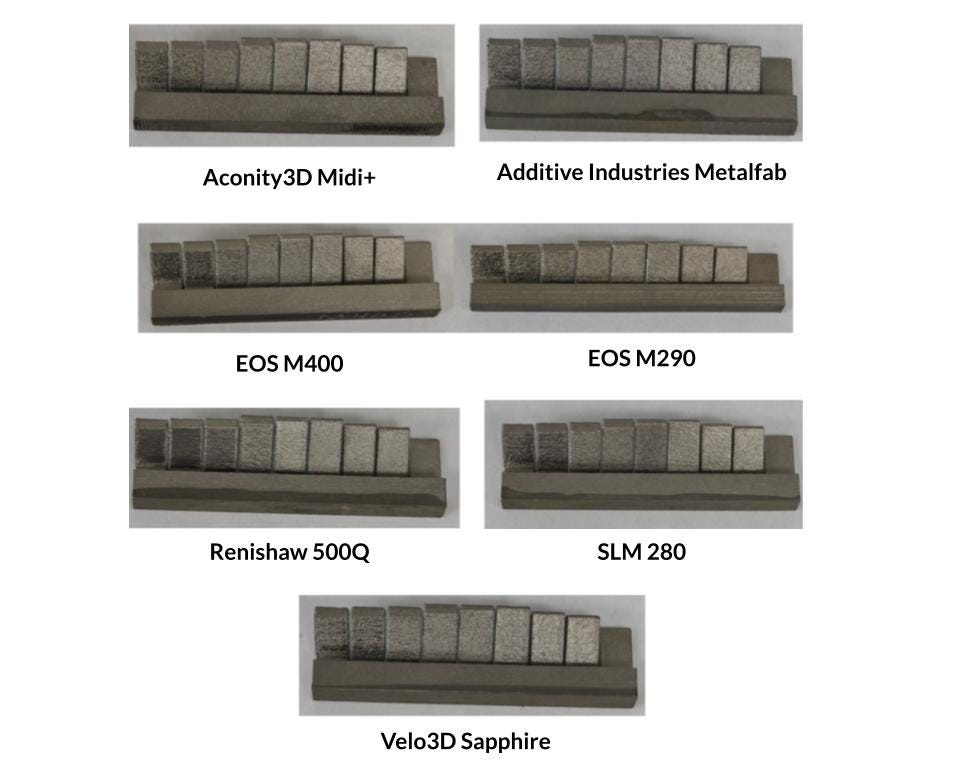
And that is exactly the point.
Goel wants this to be a conversation that is “as boring an engineering conversation as humanly possible,” because in this context, boring is synonymous with trust.
Let’s go back to that invoice from the beginning
If qualification becomes cheaper and faster, the main obstacle to scaling metal 3D printing into serial production and aerospace disappears. This is the one thing that is keeping the entire technology stuck.
Except technology alone isn’t enough.
There are still two obstacles, and neither has anything to do with physics: regulatory approval and the inertia of the industry itself.
Surprisingly, regulators are doing quite well.
Goel recalls how, three years ago, he almost naively asked Dr. Benedict of AFRL what exactly the government expected when it came to qualification:
“It’s not the government’s job to tell you how to qualify something. Your job is to convince us that what you’re doing is reasonable.”
That should give anyone hiding behind regulations something to think about: no standard dictates specific KPVs. The door is open.
But the industry is standing in front of it, hesitating.
Because the real resistance is internal.
It comes from the people working in materials and mechanics who forgot the mathematics they learned at university and would rather ask “what if?” than open a textbook.
There is nothing new about this approach. Everything Goel describes is something a second-year materials engineering student could figure out, if they bothered to remember what they already knew.
The certification wall that currently protects Western industrial metal 3D printing from Chinese price pressure isn’t going away.
It is moving.
It is moving from expensive, opaque bureaucracy toward transparent, automatable process-window mathematics, and toward the software that actually runs that mathematics.
Whoever controls that tool controls the new wall.
And that changes the very nature of competitive advantage.
For three decades, the advantage was the certificate: paper, cost, time, a barrier that was almost impossible for new players to overcome.
From now on, the advantage is the code that turns that barrier into arithmetic.
Goel puts it rather nicely: he wants us to qualify parts “as if they were doing the arithmetic in a cave.”
The machines are open. The mathematics is documented and validated. The regulators are waiting.
There is only one thing left - the hardest thing to automate of all: