

Western Report #1: a Week on the Western 3D Printing Market
Bondtech admits the INDX nozzle issue, EOS expands into hydrogen, 3D Systems makes FDA history, and Prusa launches cloud subscriptions

Hi everyone, Anna here again. Another debut on my part.
Yesterday I showed you the first issue of China Watch. Today we’re launching the second part of the new Atomic Layers format: Western Report. This is its inaugural edition.
The report is divided into four sections:
Mainstream Report covers the week’s most important developments among leading AM companies.
AM Software Report focuses on software.
CEE Report covers Central Europe.
And finally, AM HR Corner, dedicated to personnel moves. In this last section, I’m also starting something that I hope will eventually become a value of its own: tracking and analyzing the job market.
We’re right in the middle of the holiday season in Europe, so there’s much less happening than in China (as you could read yesterday). But stay with me. Things are about to pick up.
Mainstream Report
I’ll start with the story that has been heating up the open-source community over the past few days. Bondtech - the Swedish manufacturer of accessories for FFF 3D printers, has officially confirmed that the nozzles for its INDX system are not hardened, despite being marketed as such. Their hardness is 30–32 HRC, while genuinely hardened nozzles reach 55–60 HRC.
When printing with carbon fiber, glass fiber, or glow-in-the-dark filaments, they wear out extremely quickly. The issue affects the Founders Edition as well as the first production batches of kits for the Prusa CORE One+.
Prusa Research’s role here is significant. As the distributor of the assembly kits, the company has the right of recourse against Bondtech over customer claims. The market expects compliance with the relevant EU directive: either free replacement with proper hardened nozzles or a proportional price reduction. Instead, Bondtech is offering only vague “upgrade options” for an unspecified surcharge at some unspecified point in the future.
Customers who spent around $1,000 don’t want to pay a second time for something they were already promised.
The company’s financial situation helps explain its nervousness. Producing properly hardened nozzles will take months. That’s a serious blow, as INDX was supposed to become the company’s main revenue driver in 2027.
Adding to that is disastrous communication, including reports from users that critics are being blocked on Discord. This story is still very much developing...
At the same time, we’re staying with Prusa, this time on the software side. The company has introduced subscription plans for its EasyPrint cloud slicer. The tool runs on the Printables platform and allows users to slice models directly in the browser, including from smartphones and Chromebooks.
The controversy began when a user named Dustin shared a screenshot showing a message encouraging him to upgrade to a higher-tier plan in order to process a more complex model. The free tier includes 1 GB of storage and 60 seconds of computation time. The Basic plan costs $8.99 per month (20 GB, 120 seconds), Premium costs $29.99 (100 GB, 240 seconds), with custom Enterprise plans also available.
Josef Prusa responded directly. He explained that the supposedly “simple” model actually contained hundreds of thousands of triangles and placed a significant load on the servers. He reminded users that PrusaSlicer remains the foundation: free, open-source, local, and subscription-free. And that this will not change, and if it ever did, the community could immediately fork the project.
He added that EasyPrint is simply a convenient tool for occasional use, available even to people who aren’t Prusa customers. He also acknowledged that the upgrade prompt was poorly worded and promised improvements.
Now, industry.
EOS has ordered 155 Dual Setup Stations for its M4 ONYX system from Grenzebach. Forty units were ordered before Formnext 2025, with another 115 added after the system’s launch. The stations separate material preparation from the actual printing process, reducing job changeover time to just 30 minutes.
The second EOS story is about hydrogen. The company has joined the MAT-H2 consortium, which focuses on materials and technologies for the hydrogen economy. The consortium brings together industrial and research partners, including Wärtsilä, to address the challenges hydrogen environments pose to metals. EOS will contribute its expertise in metal additive manufacturing and material characterization. Hydrogen is extremely demanding for metallic materials, and additive manufacturing makes it possible to develop and test new solutions much faster.
A nice piece of news from the medical sector. 3D Systems has helped the 3D Medical Applications Center at Walter Reed Hospital secure FDA premarket clearance for its titanium cranial plate system. This is the first implant in history to receive such approval for a point-of-care facility - that is, one manufacturing implants directly at the place of treatment. The personalized implants are intended for active-duty U.S. military personnel suffering head injuries, wherever they are deployed around the world.
Materialise has commissioned a photovoltaic park at its headquarters in Leuven, Belgium. The €1.56 million installation has been fully operational since January 2026. Its 3,200 solar panels are expected to generate around 1,700 MWh of electricity annually - roughly the annual consumption of 600 Flemish households, while reducing CO2e emissions by more than 40 tonnes per year. The project was carried out together with Argona and Induzz3. Its goal is to increase the share of renewable energy and reduce the company’s dependence on external electricity suppliers.
To wrap up this section, a few numbers. VoxelMatters has released its latest report on the polymer 3D printing market for 2025. According to the report, the segment reached $9.45 billion, up 18.7% year-over-year. Hardware accounted for the largest share at $4.36 billion (+20.9%), followed by services at $3.21 billion (+17.3%) and materials at $1.89 billion (+15.9%).
Among individual companies, the report highlights Bambu Lab, which alone generates more revenue than all of the leading industrial polymer AM players combined. HP has returned to growth (+25%), while Stratasys remains the industrial market leader, growing steadily and consistently. Formlabs, Carbon, Axtra3D, and Caracol are also on the rise, as are service providers Materialise, Prototal, and Xometry.
On the other side of the market, the picture is much less optimistic. 3D Systems is facing serious difficulties, BigRep is heading toward liquidation, Nano Dimension has largely withdrawn from the market, and brands such as Anycubic, Elegoo, Arkema, and Photocentric are all reporting declines.
The report covers more than 800 companies across the entire polymer AM ecosystem.
AM Software Report
There’s quite a lot happening in software around simulation and automation. Aibuild has validated its FETS thermomechanical solver using data from Additure’s experiment: a 15-layer wall manufactured using the WAAM process. The GPU-accelerated simulation accurately predicted both the thermal history and the resulting distortions. The calculations took 6.2 minutes on a laptop GPU (NVIDIA RTX 5090), making it possible to generate toolpaths with distortion compensation directly within the CAM process.
Aibuild is also hosting an online event dedicated to Aibuild OS on August 4, 2026. It’s a platform where the user describes their requirements in plain language, while the system automatically operates CAD and CAM software to deliver the final result. Registration is open, and a recording will be made available afterward.
AMIS has unveiled Runtime, a print preparation automation engine that brings programmable control to AMIS Pro. It allows users to script the entire workflow - from import, through nesting and slicing, all the way to export. The goal is repeatability, whether you’re producing a batch of five parts or five hundred. The approach combines the visual interface of AMIS Pro with Runtime’s scripting layer, reducing both the total cost of ownership and the cost per part.
An interesting story from the open-source world. A GitHub user has created FreeCAD MCP, an extension that allows FreeCAD to be controlled directly through Claude AI using plain language. The tool is built on the MCP (Model Context Protocol) and enables geometry creation, editing, and even finite element analysis (FEA). The project was featured two days ago in the RECODE.AM series.
CEE Report
The second edition of the AM Connect conference will take place on September 23–24, 2026, at the Faculty of Polymer Technology of the University of Primorska in Slovenj Gradec, Slovenia. It’s a cross-border event organized as part of the ADDCIRCLES project and co-funded by the INTERREG Slovenia–Austria programme. Attendance is free of charge and on-site only, with organizers expecting between 80 and 120 participants.
From Poland comes news from ROSA3D. The company is launching a filament dropshipping program aimed at online stores, e-commerce sellers, and startups. The model allows businesses to enter the filament market without maintaining inventory or making an upfront investment: the customer handles the sale, while ROSA3D takes care of packing and shipping. System integration is designed to automatically forward orders for fulfillment. The offer is aimed at companies that want to sell filament without tying up capital or spending time on logistics.
AM HR Corner
Elementum 3D has a new CEO. Andrew Crickenberger has taken over the role from founder Dr. Jacob Nuechterlein. Nuechterlein is moving into the position of Chief Strategy Officer while remaining Executive Chairman of the Board. Crickenberger brings more than 30 years of experience in the aerospace and defense industries. Most recently, he served as Chief Growth Officer at NIOA Group, and before that as Vice President of Strategy for the Aerojet Rocketdyne division of L3Harris. The leadership change is the result of a planned succession process.
Zortrax has also announced changes to its management board. On July 24, 2026, Angelina Stokłosa stepped down as CEO, citing other professional commitments. On the same day, the Supervisory Board appointed Rafał Tomasiak, one of the company’s co-founders from 2013, as the new CEO. Tomasiak returns after spending several years away from the company’s day-to-day operations. Zortrax has been undergoing restructuring since 2024 and continues to struggle with delayed financial reports, suspended stock trading, and the controversial issuance of blockchain tokens.
Finally, something that’s only just getting started but has every chance of becoming my favorite part of this series. I’m beginning to track the 3D printing job market.
Below you’ll find charts based exclusively on data from the past week. In future editions, I’ll update them and compare them over time so we can see trends rather than just isolated snapshots. The project is only just beginning - it’s still under construction, so stay with me.
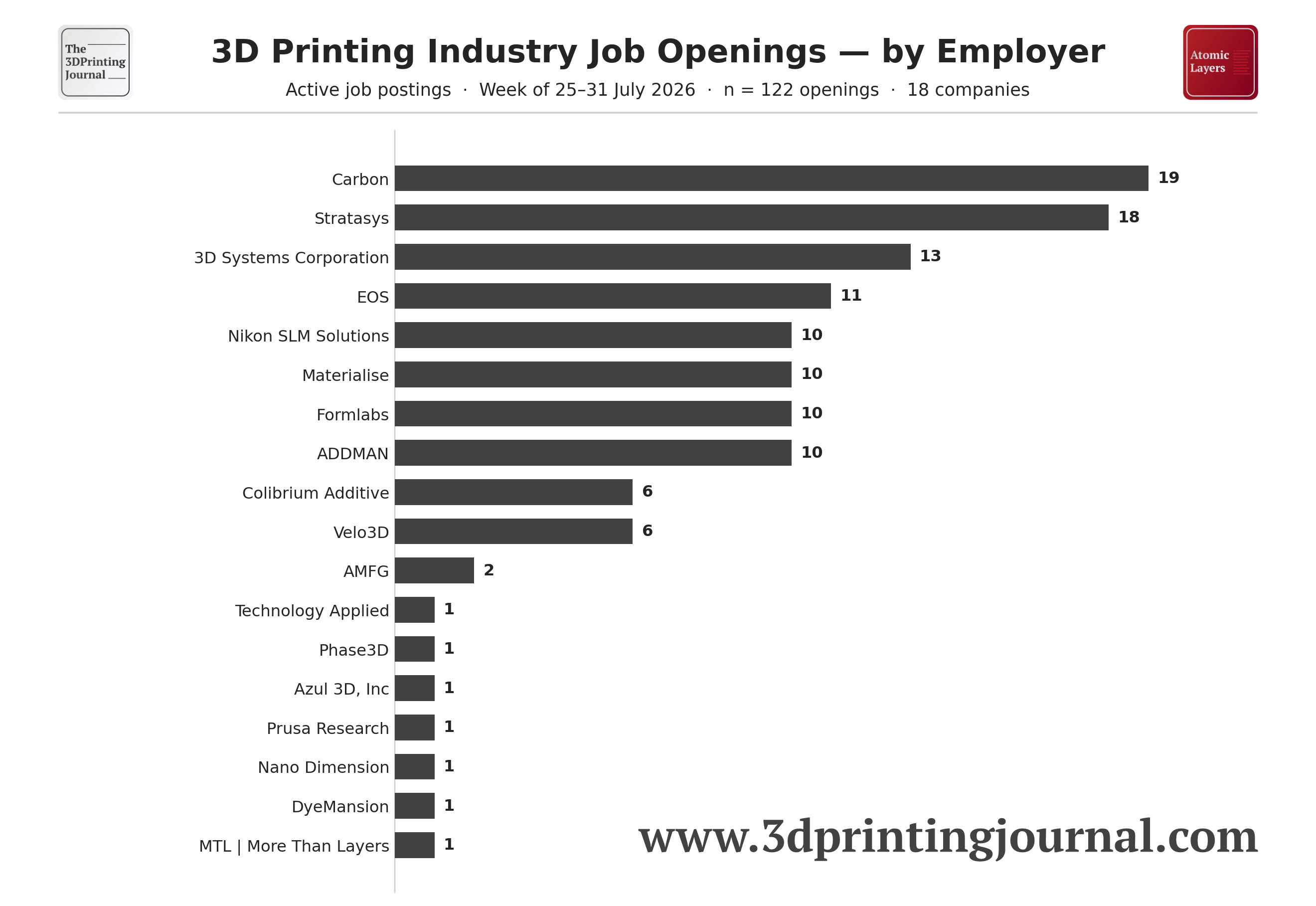
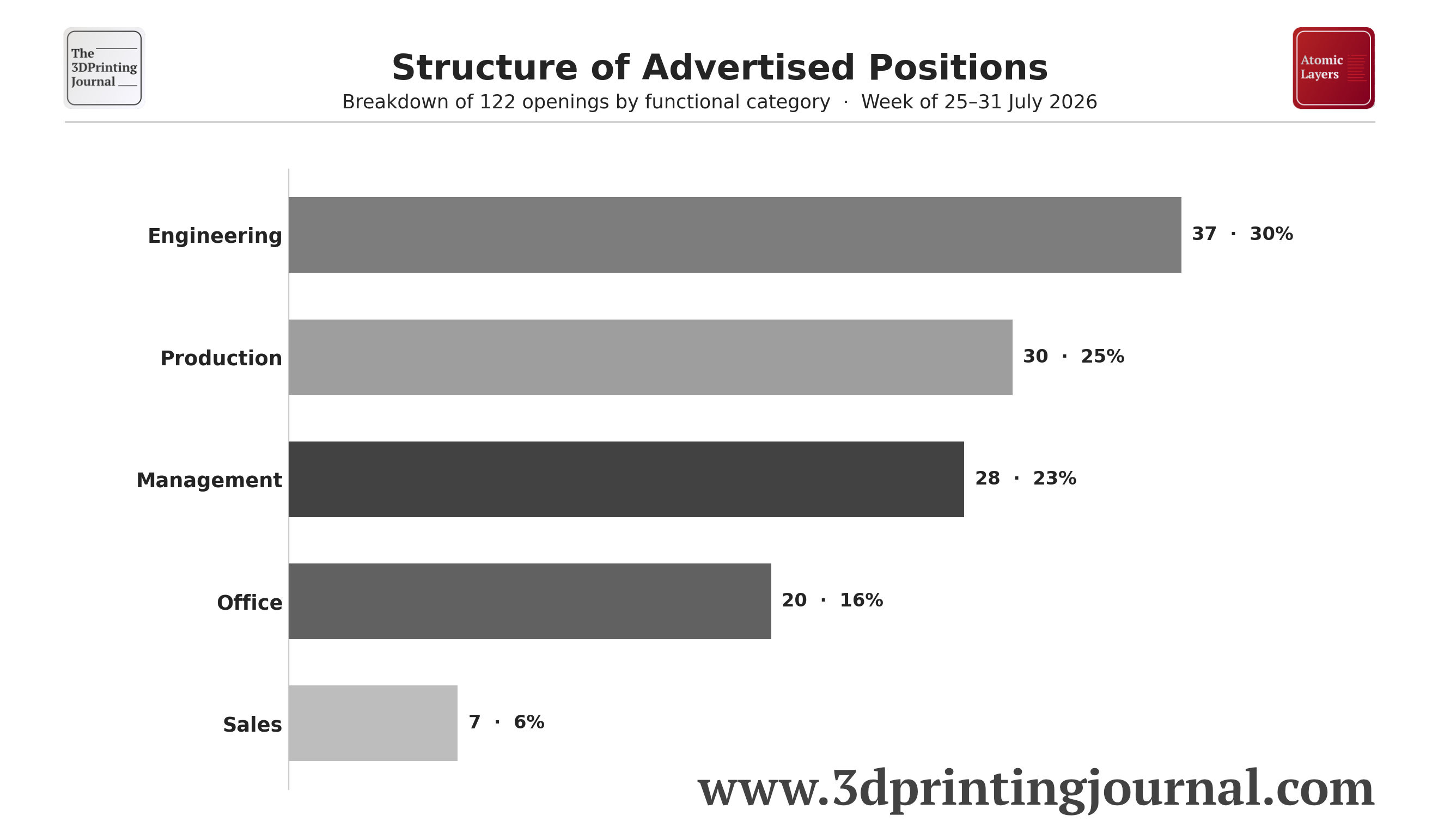
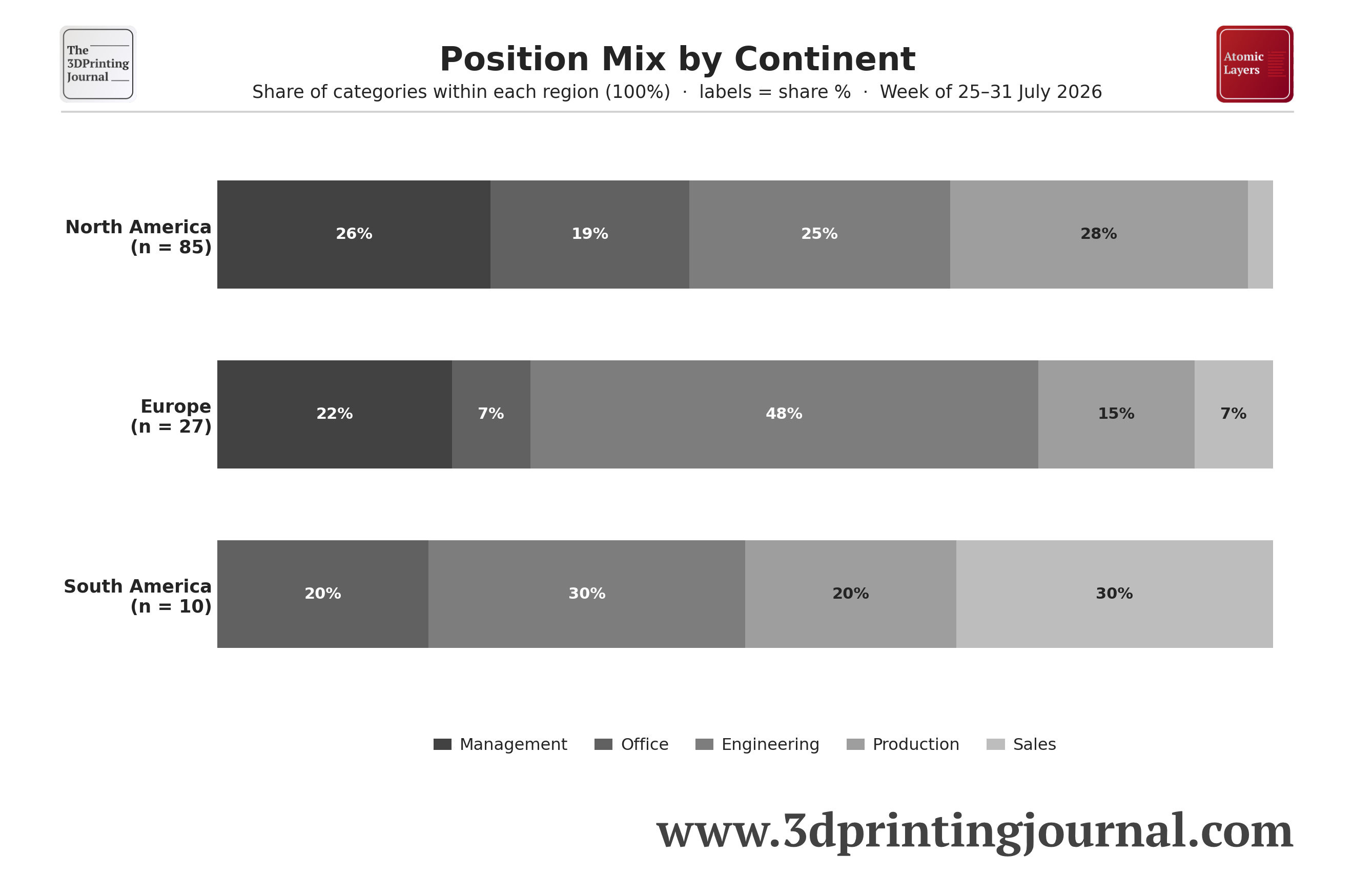
For now, the analysis covers 18 companies, but that number will continue to grow.
Also, if you are actually looking for a job, visit my LinkedIn group: The AM Restart Hub