


Atomic Layer of the Week:
This is a true breaking news story! The UK-based MyMiniFactory is acquiring Thingiverse - the American icon of hobbyist 3D printing (though ownership-wise also Dutch).
Or, to put it another way - MyMiniFactory is saving Thingiverse from oblivion…
It’s an intriguing piece of information. Ten years ago - unthinkable. Five years ago - surprising! Today it still is, but for entirely different reasons.
Thingiverse has been a fading powerhouse for several years now, functioning largely thanks to its gigantic, record-breaking number of designs, as well as its still sizable user community.
Unfortunately, at the same time it has become increasingly outdated and behind the times, especially when compared with current leaders - Bambu Lab’s MakerWorld and Prusa Research’s Printables. And even with MyMiniFactory itself, which, unlike all of the above, has followed its own path and is built on completely different business foundations.
The whole problem behind Thingiverse’s decline is that this otherwise excellent platform has had extremely bad luck with its owners.
It was founded by Zach “Hoeken” Smith and Bre Pettis – key figures in the RepRap community in the USA and future founders of MakerBot Industries. The platform officially launched in 2008, although initially it operated on a very small scale.

With the debut of MakerBot and the sale of its first desktop 3D printers, Thingiverse became the natural place where all beginner users went looking for models.
Over time, competitors emerged - whether Ultimaker’s YouMagine or MyMiniFactory - but Thingiverse remained dominant and for well over a decade was the undisputed number one in the 3D printing repository space.
This is where all the most iconic 3D models of the 2010s made their debut:


But… in 2013, MakerBot was acquired by Stratasys, which didn’t really have a clear idea of how to develop the platform. It was largely left on its own, and when MakerBot itself underwent major restructuring, the Thingiverse team was cut to the bone.
There were hacking attacks and user data leaks (mine included…). It was obvious that manpower and the right strategic approach were lacking.
In 2022, MakerBot merged with Ultimaker, and once again, amid the massive efforts to integrate both companies in terms of hardware and software, Thingiverse ended up at the very bottom of the priority list.
An interesting idea was the creation of an educational section and the development of lesson packages for teachers. Combined with MakerBot’s 3D printers, this had considerable potential, but it never achieved the expected traction. Nor did it ever truly expand beyond the American education system.
Meanwhile, the competition did not stand still. MyMiniFactory transformed itself into a serious marketplace for collectible and gaming models, which were additionally sold in physical form (the company operates a large 3D printer farm).
Josef Průša launched Printables, which introduced an engaging program rewarding user activity with physical prizes (including Prusament - the proprietary filament from the Czech manufacturer).

Bambu Lab launched MakerWorld, elevating earlier functionalities to an even higher level, while introducing features such as MakerLab - a suite of 3D design tools, Maker’s Supply - a store for electronic accessories for printed models, and an integrated crowdfunding platform.
But most importantly - both Prusa and Bambu Lab integrated their platforms with 3D printing software - PrusaSlicer and Bambu Studio - making the workflow smooth and effortless.
Thingiverse… well, you could still transfer models to a MakerBot, except that hardly anyone had been buying MakerBot 3D printers for a long time…
As a result, Thingiverse continued to exist mainly thanks to its legacy users. New users started their journeys on entirely different platforms, and Thingiverse was largely irrelevant to them.
But MyMiniFactory wants to change that!
Last year, they acquired Ultimaker’s YouMagine and turned it into a platform for RC designers. Now they want to do something similar with Thingiverse. Well… probably…?
For now, they plan to remove AI-generated models from the platform. Fair enough - I wrote about this myself recently:

They intend to keep the platform open and free. And additionally, it is supposed to remain independent from MyMiniFactory.
Next Tuesday, February 17, MyMiniFactory plans to hold a Q&A session with users, where they will present their plans while also listening to questions and suggestions. The company emphasizes the latter – it does not want to make all decisions on its own but wants to understand the community’s expectations.
What could all this mean?
My personal opinion is that MyMiniFactory simply took advantage of an opportunity and purchased a platform whose owner had no real vision for it.
Information that UltiMaker was looking for a buyer for Thingiverse had been circulating in the market for some time, especially since everyone knows UltiMaker itself has been facing serious challenges and is seeking money wherever possible.
I won’t attempt to judge whether selling Thingiverse was the wisest move UltiMaker could have made - it is clear today that the platform was no longer essential to them, so they decided to let it go.
Given that MyMiniFactory is the buyer, we can assume the price was not particularly high - certainly not billions of US dollars…
What will come of this remains to be seen, but in the longer term, this is good news, as this well-deserved platform finally ends up in the hands of someone who understands the business and knows how to run it.
Atomic Layer from the Past:
7 years ago, Airbus announced partnership with Ultimaker to deploy S5 3D printers across its European facilities. The company sought certified solutions for on-demand production of tools, jigs, and fixtures. Ultimaker’s blend of hardware, secure CURA software, and durable composites won the deal. Though not for end-use flight parts, the application optimized manufacturing workflows.
It was the peak of Ultimaker’s career.
Read all:

News & Gossip:
#1
restor3d has commercially released its Ossera AFX Ankle Fusion Cage System, expanding beyond made-to-order implants to include off-the-shelf options. Targeting complex fusion and limb salvage cases, the 3D printed titanium implants feature TIDAL porous architecture for osseointegration.
More on: www.voxelmatters.com
#2
AM Solutions has released the M1, an automated vibratory finishing platform for smoothing, grinding, polishing, and deburring printed metal and polymer parts. It replaces the M1 Basic with upgraded features: fresh-water connection for Keramo-Finish, redesigned process tub, and media separation on a material cart. It can contain parts up to 550 × 150 × 130 mm.
More on: www.3printr.com
#3
Bambu Lab has announced EOL (end-of-life) of the open-frame P1P 3D printer, effectively removing it from sale. The company promises firmware updates until 2027, security patches through 2029, and spare parts supply until 2031. Users who enclosed their P1P via the upgrade kit will follow the P1S support roadmap.
More on: www.all3dp.com
#4
Dave Randolph stepped down as CEO of Prusa-owned PrintedSolid. He started as a small, local reseller, and became a major US assembly and distribution hub for Prusa printers. No successor has been named. Prusa Research is expected to assume tighter operational control, potentially repositioning PrintedSolid as a tariff-mitigating “Prusa USA” amid escalating US trade restrictions. Because “word on the street” is that Josef has given up on Europe and has transitioned his focus to Donald Trump’s USA. People in Czech Republic say so…
More on: www.fabbaloo.com
#5
Hey, it’s Zortrax again! The immortal zombie company from Poland. So this week, Zortrax has registered Zortrax Defence sp. z o.o., a subsidiary focused on designing and producing drone systems and modular armor using AM technologies for the defence sector. The move marks the first step in Zortrax’s new business strategy, with full details expected by the end of Q1 2026.
More on: www.pap.pl
#6
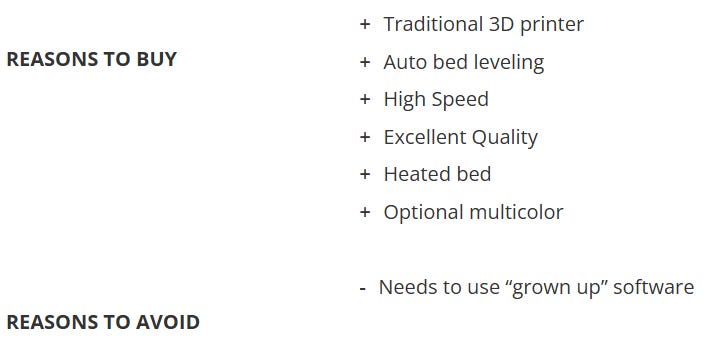
And finally - do you know why the Bambu Lab A1 Mini isn’t really suitable for beginner 3D printer users? According to reputable Tom’s Hardware, it’s because it “needs to use ‘grown up’ software.” See for yourself:
Great to read from your point of view. We agree as much, but as a former Makerbot employee I miss the most what thingiverse was... Hope to see greatness again.